
by Priscilla Alderson.
The Quaker Socialist Society (QSS) held an online meeting in January to discuss ways to promote life-long Quaker, and socialist, values in state schools and in Quaker private schools. Members of QVinE,(Quaker values in education), joined the meeting. Their key values are: integrity, equality, simplicity, community, stewardship of the Earth, and peace.
Francis Green, Professor of Work and Education Economics at the Institute of Education University College London, began the meeting by speaking about his book, co-authored with David Kynaston, Engines of Privilege: Britain’s Private School Problem. Francis discussed the democratic deficit when private schools educate 7% of children in Britain; they get over 16% of the funds spent on British schools, and have 14% of Britain’s teachers. The schools’ ample resources, libraries, labs, drama theatres and sports facilities, help these students when they become adults to be the well-paid leaders in all areas of public life. They benefit from networks of influential and wealthy contacts, friends and marriage partners. The figure shows the percentage of privately educated members of some professions.
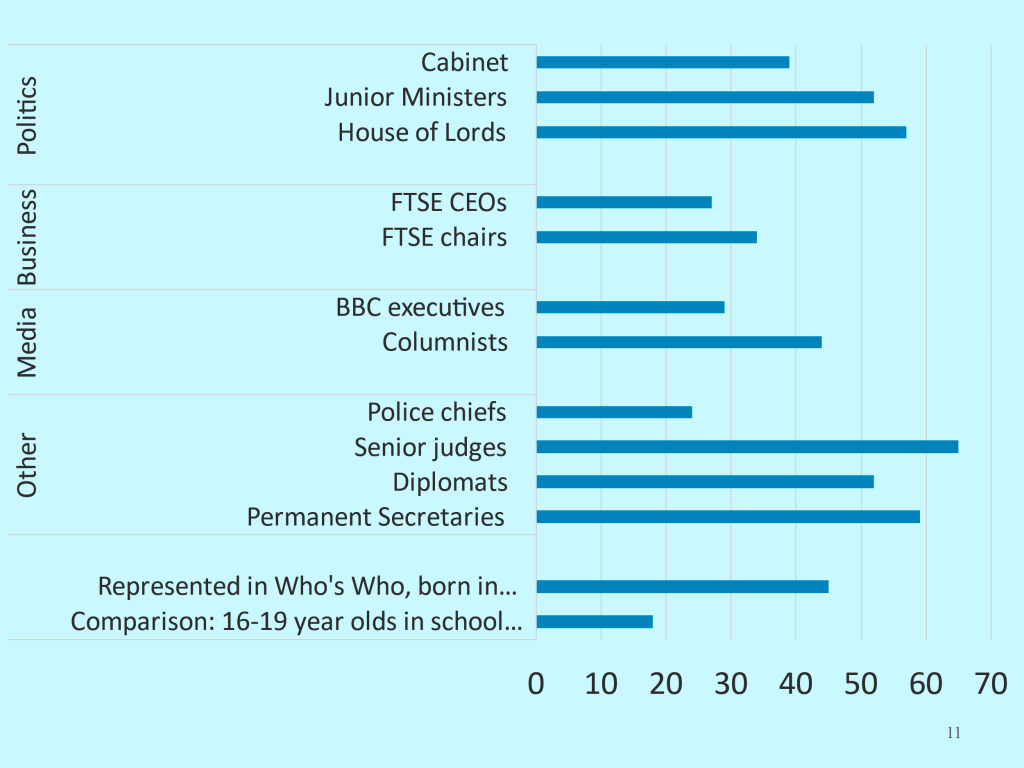
Francis, who was educated at a leading private school, works on reforms to address these injustices. He collects evidence on the schools’ impact on society, promotes fresh thinking and debate, and he shows how private schools could be reduced such as through higher taxes and through integrating them more with the state system. He ended by asking if there could be Quaker free state schools.
Almost all British Quaker schools are private schools with fees of around £33,000 to £43,000 a year for senior boarders. There was hope in the 1950s that state schools would improve so much there would be no need for private schools. QSS is concerned that over past decades differences in spending, resources and outcomes between the two sectors have continually increased. Finland, often described as having the best education system in the world, has no private schools, and private schools in most European countries are much more like state schools than in the UK. In Britain, private schools control society through their lifelong impact on their former pupils who become the ‘ruling class’.
During the online discussion among 45 people, there was general concern about sending children away from their families to school, especially at younger ages, with the lack of daily loving family contact and local friends. Some of the best people have attended boarding school, but many others suffer from ‘boarding school syndrome’. This is shown in extreme forms by Donald Trump and Boris Johnson, the out-of- touch attitudes of Rishi Sunak and David Cameron, Michael Gove cutting arts and sports in state schools, Paula Vennells’s treatment of sub-postmasters, the former head of Ofsted Amanda Spielman, and many others. Jeremy Corbin attended private schools. Private schools treat education as a product for sale, not a human right. Yet the British public repeatedly vote for politicians educated in private values, who keep privatising national services. Privately educated billionaires own most of the media, and through them powerfully influence public opinion and elections.
Some Friends at the meeting described Quaker schools having the freedom to promote Quaker values in ways state schools cannot. They are peaceful and allow students to be individuals, learning ‘to get along with each other and having the space and the respect for each other’ with none of the bullying seen in large class sizes. Others thought that ‘for a very wealthy country we don’t devote enough of our resource to education’. The wealthy should pay higher taxes, and state schools should be less ‘run as tick boxes’ with an over-prescriptive curriculum, and should be more freely creative. We need a ‘national debate about what education is for and who it is for’.
One person recalled asking her parents to send her to boarding school, which she enjoyed. The youngest of three sisters, she did not want to follow her sisters through their school, and she was pleased that her chosen school helped her and others each to develop their own individual life.
Quakers work in Quaker schools and state schools to promote peace education, ever more crucial with the growth of armed conflicts, talk of planning for future wars, and promotion of the military in British schools. Quakers work with Restorative Justice to help children to build fairer communities and tackle inequalities, to act against bullying and take responsibility for their relationships.
One QVine member with years of experience teaching in state schools and at a university believes many state schools have values very similar to Quaker values, though they might not call them that. They respect individual’s space for children to be themselves. They listen to children, respect them and work with them. They try to work creatively within the constraints of the curriculum, with a strong sense of community. Some schools with a ‘massive cross section of backgrounds’, often in quite deprived areas, have extremely good practice and ‘many primary schools do amazing work’. We should heed the Children’s Manifesto written by thousands of children who sent their beautiful ideas about what kinds of schools they would like.
One teacher, who was sent to boarding school when aged 8, later taught in a state comprehensive, quite a ‘rough sink school’. He thought it produced ‘far more rounded, kind, tolerant characters’ than most people he knows who went to private schools. He mentioned books such as Sad Little Men, about how private boarding schools ‘churn out very damaged people’, who feel a lack of love. Apart from abuse in the schools, he believes it is abusive to send a child away to boarding school. He questioned someone’s earlier comment that ‘education is always a privilege given that many children around the world have no schooling’. He is deeply concerned that during Michael Gove’s reforms of state schools he knew of more than one child who committed suicide in the run up to exams. With massive mental health crises, he believes more childcare is needed in all schools. Having taught in inner city schools, he considers that allegations of bullying there are ‘slightly over-egged’. The problems would be addressed much more rapidly if most parents didn’t use the option, their democratic right, of going to an alternative private provision. Instead, if they stayed with the state sector and helped to improve it with positive parental support, far more money and resources would flow into state schools. He added that the 17th Century Quaker John Bellers, called the first Marxist educator, had many great ideas.
An early years specialist thought the Government’s education policy of ‘young children being told things and being instructed’ just doesn’t work. She had helped to set up Sure Start, with multi-professional working to involve and support parents. She is ‘absolutely horrified’ at Ofsted’s destructive assessments of schools. ‘People used to come from around the world to look at our primary education a generation ago. It was so enlightened, so learner-centred. I won’t call it child-centred because the teachers were learning as well, and it was an adventure, we led the world. I have been all around the world telling people about our primary and early years education. It is tragic that we’ve lost all of that. We just need a political change.’
One socialist doubted that state schools’ finances could be boosted to private school levels, and he favoured dismantling the private sector. Others thought this was impossible and state schools could not take on the Grade 1 listed ancient buildings that are so costly to maintain. The head of a Quaker school said how private coaching and catchment areas, where state schools increasingly reflect their privileged or disadvantaged local housing and communities, undermine equality within and between state schools. There was interest in setting up a Quaker Free School.
There were three closing commentaries. A QVine member who has taught in state and private schools was interested in the discussions around how Quaker values are lived out within our school communities and the challenges for educators in all schools. He had found more interest in talking about the purpose of education in a Quaker school than when he had worked in a range of state schools from urban to rural settings. He mentioned recent 2023 Quaker conferences about how can education create a better world, and other educators’ sense of relief to be able to be involved in these discussions. Quaker schools that were set up 200 years ago in very different contexts face new challenges to adapt to the needs of the modern world. With 30 educators, 120 students from schools across the world took part in another Quaker conference in June 2023. They echoed themes discussed at this QSS meeting, and like the Children’s Manifesto they made a call to action. Their three priorities were: 1) For schools to prepare students much more to take part in future local and global communities; 2) More practical and critical learning about the environment crisis; 3) More education about diversity and inclusion.
A Quaker socialist spoke personally. ‘I’ll be really radical. We should simply get rid of private schools. I’ve always believed that socialist equality is the most important Quaker value. But I’m told “that’s simply not possible, not feasible, don’t be ridiculous and idealistic, get into the real world”. That’s where I am this evening. I haven’t heard any views as radical as mine.’ Some other people showed their agreement.
Francis ended the meeting by welcoming the range of interesting insights and he responded to some of the comments. On the abuse of sending young children to boarding school he believes things are improving. It is now less common, the schools have changed a lot over 40 or 50 years, there is far less boarding, children start boarding when they are older, and many schools are now coeducational. He is glad for his own children at state schools that they can play with local friends during the holidays, which he couldn’t do. He agreed with criticisms of overcontrol of the state curriculum, the downgrading of arts and sports education, and he believes fear of Ofsted contributes towards the problems schools have in recruiting and retaining teachers, with a coming crisis for the profession. Frances thought that raising VAT for private schools would make little difference, certainly not to the top private schools. One possibility is to make it much easier for private schools in trouble to transfer into the state sector. Some Quaker schools might act as a kind of a model or leading light for this.
Comment by the Clerk
I clerked the meeting so did not give my views but will add two personal comments. Thank you very much to everyone who attended and contributed to the meeting.
First, a main theme of the meeting was relations between individuals and the systems we live within. To socialists, the overriding system is social class. Equality therefore means inclusion across all classes and (dis)abilities as well as across gender, ethnicity and international backgrounds. Equality flourishes in inclusive local schools when all kinds of children learn and work together, supported by the mixed local community and the elected local authority. This state system began to be broken up with semi-privatised academies, growing informal selection by schools, and competition between them – policies promoted by former boarding schoolboys Tony Blair, David Blunkett and Andrew Adonis.
Second, Habermas contrasted the System (State and Market) with the Lifeworld (personal life, free associations). The System colonises the Lifeworld, such as by trying to price everything. Many believe that children need a daily balance between school (formal System of public life and rules) and home (private Lifeworld of family, friends and free play) to nurture the values of integrity, equality, simplicity, community, stewardship of the Earth, and peace.
Priscilla Alderson, Member of Dorchester Meeting, 24/1/24
2 F. Green & D. Kynaston. 2019 Engines of Privilege: Britain’s Private School Problem. Bloomsbury.
3 https://www.theguardian.com/commentisfree/2023/oct/06/tories-private-schools-vat-tax-breaks-expert-labour-fair-sensible; https://www.theguardian.com/commentisfree/2024/jan/24/britain-richest-10-per-cent-wealthy-inequality-labour-private-schools
4 https://www.forceswatch.net/our-work/the-military-in-education/
6 https://www.theguardian.com/education/2011/jan/25/the-school-i-would-like-manifesto; https://www.theguardian.com/education/2011/may/03/school-i-would-like-childrens-manifesto
7 R. Beard. 2021 Sad Little Men: Private Schools and the Ruin of England. Harville Secker..
8 https://www.quakersintheworld.org/quakers-in-action/172/John-Bellers
10 https://qedconference.com/june23conference/
11 https://qedconference.com/next-steps/
12 P. Alderson. 2013/1999 Learning and Inclusion: The Cleves School Experience. Routledge; P. Alderson & C. Goodey. 1988/2018 Enabling Education: Experiences in Special and Ordinary Schools. Tufnell Press.
13 J. Habermas. 1986 The Theory of Communicative Action, Vol 1. Polity.
 Quaker Socialist Society
Leave a Reply