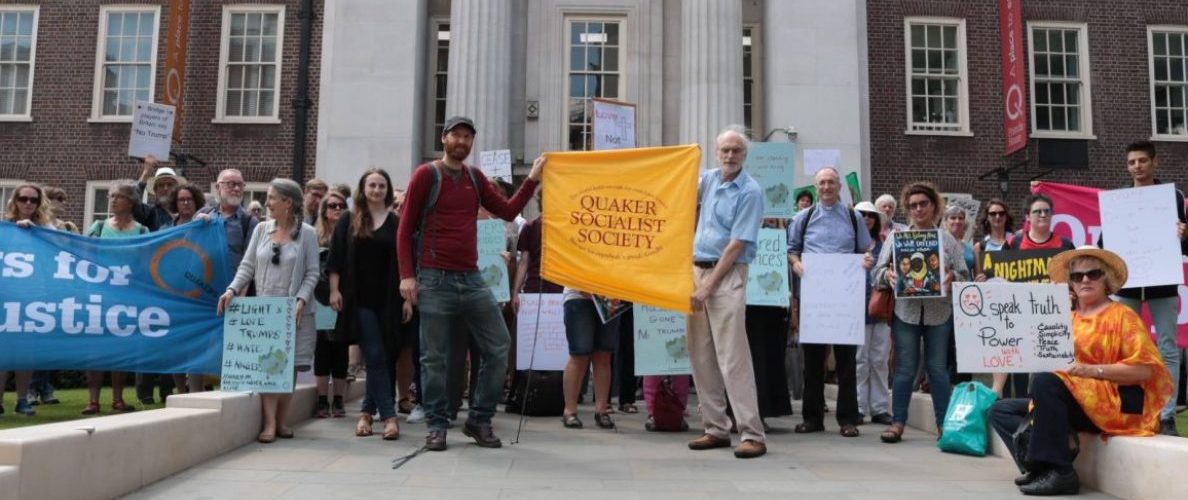
by Nicola Grove.
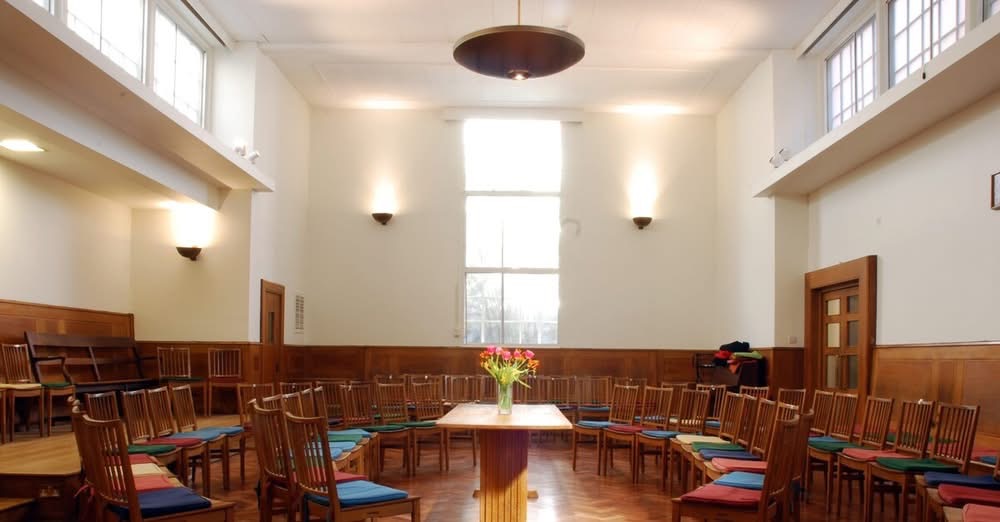
Quakers are the centre of media attention after the shocking police raid on Westminster Meeting House on 27/3/25. A room in this beautiful Meeting House had been let to Youth Demand for a welcome talk to discuss issues such as climate change and Gaza, and the women present were arrested for conspiracy to commit a public nuisance. There is widespread outrage at this abuse of police powers. I pray that this event will mark a turning point in Quaker solidarity with those taking action to oppose genocide in Palestine. I fear it will result in a cautious retrenchment that increases restrictions on the letting of Meeting Houses. This article explains why.
In the autumn of 2024, I proposed to Quakers in Britain that they should run an Action Hour for Palestine, a UK version of the American Friends Service Committee weekly event, AFSC Action Hour which has been running since the beginning of the conflict. They declined. So I went ahead and did it myself. See below for details.
Every month, on a Saturday, around 200,000 people march peacefully in London to demonstrate their support for a free Palestine. So far, 24 marches have taken place, and I have attended several. And when I talk to the people there – young, old, Christian, Jewish, Muslim, Hindu, all ethnicities – and say “I am a Quaker”, the most frequent response is “Where are they? What are they doing? Why are they so silent?”. On the Quaker website you will find formal statements that express regret and demand action from our government, but they don’t cut through to people on the street. And this appears to be the most that is on offer.
So many words. So little action.
Searching “Gaza” on quaker.org.uk is instructive: 41 “news” items, 15 “blogs” , 7 “documents”, 23 “pages” ..and… 0 “events”. Quakers in Britain, with Plum Village, facilitated a multifaith walk for peace twice – in January and June 2024 (against wars in general, although Palestine was mentioned). Nothing since.
Quakers are known for worshipping in silence. Silence can be healing, can be powerful, can be a space to safely hold discord and doubt. But sometimes silence is complicit, an avoidance. There are in fact a few vociferous Quakers supportive of the Israeli stance, who are not slow to write to the weekly magazine, The Friend, (the main source for discovering views of Quakers). They write in favour of maintaining trade with Israel, against any talk of war crimes, against any historical contextualising of the Hamas attacks on October 7. The latter inveighs against the release of Palestinians convicted of terrorist offences and claims that the official Quaker statement welcoming the ceasefire shows a lack of evenhandedness. Was there any Quaker beside myself who wanted to respond to this? To make the points that a) release of jailed terrorists (or freedom fighters from a different perspective) has been a feature of the resolution of many bitter internecine wars, in South Africa and Northern Ireland to name but two b) that the alternative is continuation of the status quo which, by implication, the writer would prefer c) that those released included women and children rounded up for administrative detention (ie with no charge) d) that Israel tries Palestinians in military, not civil courts, with limited access to lawyers, and a lower burden of proof: one in 5 Palestinians have been arrested and charged at some point in their lives.
The main decision making body of the Society of Friends (Quakers) comprises representatives from all over the country and meets quarterly. In autumn 2023, the dates (October 6-8) coincided with the Hamas incursion and subsequent initiation of Israel’s bombing campaign. Not a single mention was made in the minutes. This should be compared to the outpouring of support amongst the same group for Ukraine after the Russian invasion (minute 220323). Since then, reports from these important meetings cite scarcely any correspondence from Quakers on the topic of Gaza, Palestine and Israel.
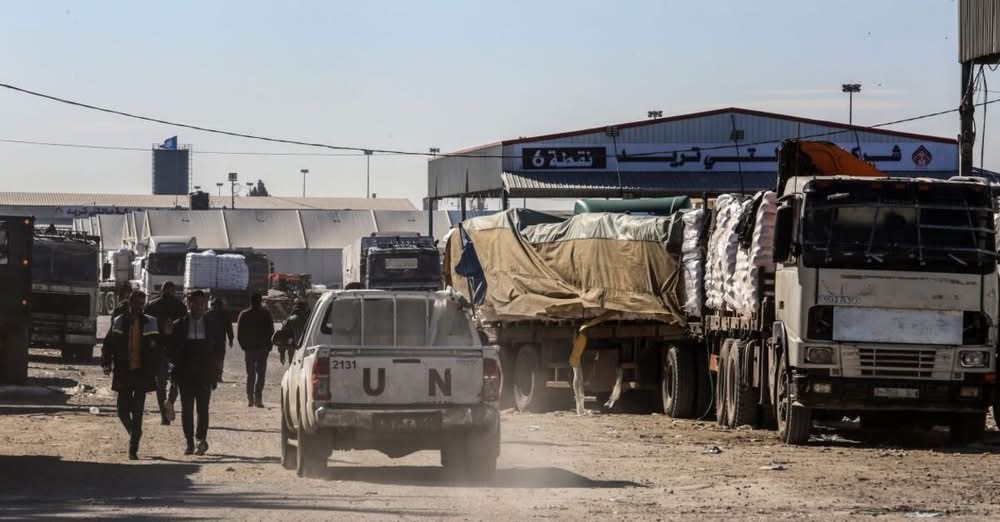
When we ask, why no action, why such sidelining? one reason given is the potential threat to a programme in Palestine administered by British Quakers. This is the Ecumenical Accompaniment Programme (EAPPI) which involves sending volunteers to stand alongside Palestinians facing daily attacks from Israeli settlers, police and military. The argument is that open protest against Israeli conduct of the war could jeopardise the programme. However, although Quakers are the administrators for the UK and Eire, the programme is actually run through the World Council of Churches. Government opposition, and Quaker protests from Spain, Norway and Ireland (who are member churches) have not resulted in cancelled visas, so maybe peaceful action is worth the risk.
For over a year, the official Quaker view was that genocide should not be mentioned, because the language was deemed too challenging and offensive. Quakers cling to the concept of “principled impartiality” which has served them well as mediators in past conflicts. But Quakers have not been asked to mediate here. Many Quakers, like myself, breathed sighs of relief when the situation changed last year after much debate – to acceptance that the International Court of Justice ruling should be respected, and that the descriptions “apartheid “ and “plausible risk of genocide” applied to Palestine. But nothing has changed. No support was forthcoming for a silent vigil walk organised by Campaign Against the Arms Trade protesting against arms manufacturers, because the word “genocide” was used in its promotion. Likewise, use of the word genocide prohibits any publicity for the AFSC Action Hour, despite it coming from fellow Quakers. No mention of Gaza and “plausible risk of “ genocide at the Quaker official marking of Holocaust Day,
This really is clinging to the letter of the law which kills, rather than the spirit that gives life. Since then, the situation has worsened beyond our deepest fears. The Israeli government openly states their wish to rid Gaza of its inhabitants, and to bring the same conditions to the West Bank.
The administration at Friends House, the London headquarters of Quakers in Britain, is protective of Quaker reputation. The advice on attending protests reminds us that using the word Quaker on a banner “will be seen by others as representative of all Quakers”. I need to say that the absence of the word Quaker on a banner is also seen as representative of all Quakers. I believe that this absence has made it far easier to portray these protests as “hate marches” by Government and the media. A silent Quaker vigil at one of the stations along the route could have made a huge difference. On Saturdays, there is a Women in Black silent vigil outside Friends House in Euston. Have Quakers working in, or visiting the building acknowledged them? Have they joined them? Is there any publicity for them?
Years ago, Quakers marched alongside protestors against the invasion of Iraq. Yet then, as now, there were two views on the war, one being that an invasion was needed to free the country from the abusive terror of Saddam Hussein. Quakers took a side then. I don’t recall any discussion at that point of the need for “principled impartiality” in the face of warmongering.
When Quakers discern the need for action, it often begins as personal – to be tested through the Local and Area Meetings where people come together for worship, reflection and action. A good analogy is climate change. This concern began with individuals, was tested locally, spread and grew till discerned as an official priority. Now, events, articles, letters, and support for campaigners feature every week in The Friend, and in newsletters. Climate change is prominent in the latest papers from the decision making body, and in Trustee reports. There is nothing at all on Palestine.
I have had great support from my own Local Meeting for raising the question time and again. But this is not a matter of individual discernment, it is about the Society of Friends staring into the abyss of extermination of an entire nation, in which we are complicit through the actions of our Government. To me, there seems to be a gaping disconnect between what individual Quakers are doing in support of Palestine, and the official line. This amounts to a cognitive dissonance that bodes ill for the future of Quakers in Britain. Quakers have other preoccupations, not least reorganisation in response to falling membership and dwindling resources. Agendas at business meetings are so squeezed that there may be “no time” to talk about genocide. I understand this. Truly I do. But it’s not a place that accords with my own experience and interpretation of Quaker values.
Faced with a 21st C Holocaust perpetuated by some of the descendants of Holocaust survivors, “What would you have done then?” becomes “What are you doing – now?”
After the refusal by Quakers in Britain to support an action hour for Palestine, I approached CAMPAIN, an organisation that works to counter misinformation in the media. To find out more about our work, please visit the website. We now run JUST….
- Meet on Mondays at 7.30 pm… for up to one hour
- Witness… a minute of silence remembering ONE event or person
- Learn… what’s going on – UPDATE
- Act…. at least ONE simple action that might lead to change
- Share…what is happening in your area that counts as a small WIN
Reports are sent after each meeting, so whether or not you are online with us, you can still take part. Many Quakers are involved – please join us. You can sign up here.
Nicola Grove (31 March, 2025)
The Meet on the Ledge reference is at: https://www.youtube.com/watch?v=avX5VlU7MXM
Reminder from Quaker Socialist Society: Articles on this website do not necessarily reflect the views of the QSS but are the responsibility of the author.


Leave a Reply