
by Pastor Munther Isaac.
[This is the transcript of the sermon given by Munther Isaac at Bloomsbury Central Baptist Church, London, on 18th Feb 2024. Munther Isaac is pastor of the Lutheran Christmas Church in Bethlehem. As Gaza was being bombed and the West Bank raided, he addressed a packed church as follows:]
“I don’t take lightly your support and your solidarity with us. I truly wish I was here in different circumstances, yet I’m glad for this opportunity we have to come together in one heart and in unity.
“Is not this the fast that I choose:
to loose the bonds of injustice,
to undo the straps of the yoke,
to let the oppressed go free,
and to break every yoke?” (Isaiah 58:6)
It has been more than 130 days since the war on Gaza began. It is beyond my comprehension to believe that this war, this genocide is still going on. 28,000 thousand killed, including 12,500 children. Thousands more still under the rubble. 70,000 or so injured, 1.7 million displaced, trapped and starved. This is beyond inhumane!
What happened to the conscience of the world leaders? I say, “world leaders” and “lord of wars”, because the voices in the street are sending a different message. They are speaking loud and clear: stop this genocide. But sadly, the war lords are not listening.
The International Court of Justice was clear in its description of what is happening and its rebuke to Israel and those complicit in it, yet even the ruling of the ICJ was not enough to stop this genocide. And now we fear that Israel will assault Rafah! Could it get even worse?
The people of Gaza broadcast to us scenes of their genocide, the war leaders declared to us and to the world their intention to wipe out Gaza and recolonise it, and the world is still debating and deliberating whether what is happening is a war of genocide or not. It’s hard to believe.
Israeli soldiers are posting mocking videos of the destruction of an entire civilization… while the world still debates and deliberates! They’re even debating just getting humanitarian aid to Gaza. We’re not even able to get humanitarian aid, let alone end this genocide.
That’s why I say the truth is evident for all to see. There is nothing to debate. Apartheid is clear. Genocide is clear. We don’t need to explain it anymore. Truth is evident for all to see and, believe me, world leaders know the truth. They are denying it. In fact, they have been denying it for 76 years now.
I think of my own work. How many delegations did we receive? How many lectures did we give? How many times did we explain things?
And what makes it harder for us is that when Israel alleges that some members from UNRWA were involved in the attacks on October 7th, support to UNRWA stops directly from countries around the world, including the UK. The amount of hypocrisy is incomprehensible. The level of racism involved for such hypocrisy is appalling. I cannot get beyond this!
And now, 130 days later, we have some world leaders and church leaders who are beginning to change their stance. It took 130 days and I say it is too late! You showed up to Tel Aviv to show support; you provided the theological and political cover, you described it as “self-defence”, Israel’s legitimate right to exercise self-defence. And now you want to convince us that you care? After you have given the green light for this genocide, even offering to pay the bill. Now you are showing concern? I am sorry, you cannot undo what happened. You cannot change history. You cannot wash the blood from your hand.
Indeed, the conscience of the world is dead. They have grown numb. World leaders are obsessed about their thrones. They are intoxicated with power. We have world leaders literally signing, autographing, the missiles! They are obsessed with war. They don’t care for the victims. In fact, they already labelled them as terrorists, animals, and evil ones. Think of the level of dehumanisation behind such attitudes.
Don’t tell me it is not racism! Those complicit in this genocide do not see us as equals, as humans. How else do you explain this lack of empathy for human lives? For children dying, pulled from under the rubble, for babies found decomposed in hospitals in Gaza?
130 days later, we are tired of sharing these stories – but we will not stop! We are tired of sharing about the killing of our children. We have been pleading “Lord Have Mercy!” for more than 130 days; indeed, for 76 years!
As Palestinians, we find comfort in our faith. We find hope in the Word of God. This Sunday is the first season of Lent. As we journey towards the cross, may we reflect on the profound meaning of this season. I think of three things:
– It is time of Repentance.
– It is a time of fasting, and such a time to reflect on the meaning of true piety.
– It is a time to reflect on the mystery of suffering and how the road to glory has to go
through the Cross.
So, let me talk about these three things, and link them to what is happening in Gaza today.
Repentance – how our world needs to repent today! From apathy; from numbness to suffering; and from normalising and justifying a genocide.
Morality and ethics are missing from politics today. Let’s think about the idea that in our political sphere we have normalised a genocide. That’s why we need to repent.
For, when world leaders watch a genocide and ethnic cleansing unfold live on TV and social media, yet continue to explain it, while only raising concern over the death of innocent civilians, our collective humanity is at stake. This is why I say we need to repent.
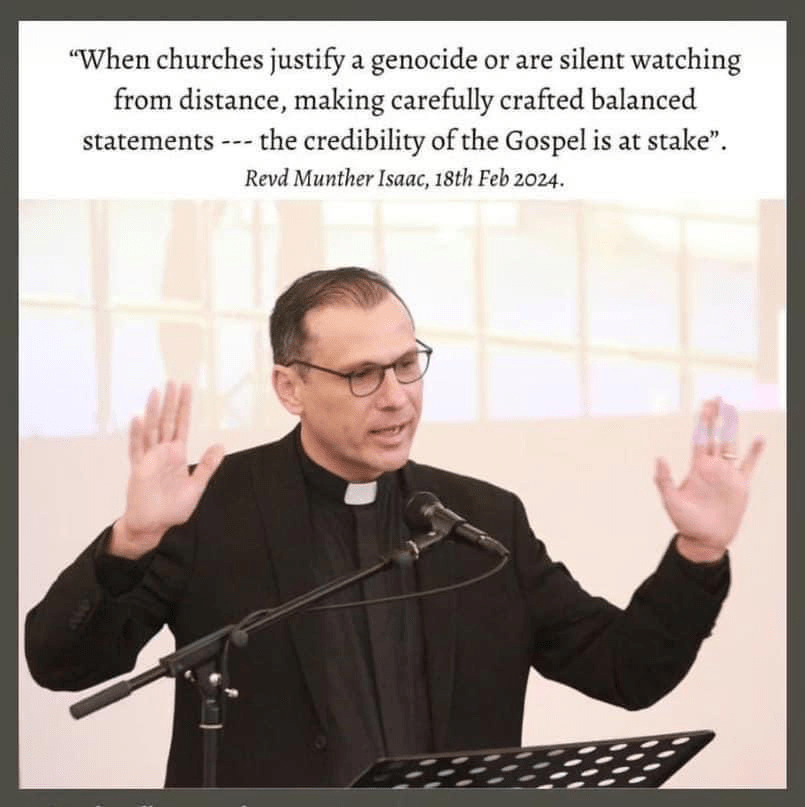
When churches justify a genocide or are silent watching from distance, making carefully crafted balanced statements, the credibility of the Gospel is at stake.
We need to repent from our racism, from our superiority, from our bigotry. This war confirmed to me that the world does not look at us as equals. They describe a genocide as a “misstep”. Biden said it’s “over the top”. War crimes and the killing of 30,000 are a “misstep”! We need to repent from the sin of apartheid – the idea that certain people are more entitled than others. To think that churches are promoting this is beyond my understanding.
In this Lent season, we are also called to reflect on our religious practices. I think of the meaning of fasting as we read in the prophecy of Isaiah, and the message is clear: piety that does not produce compassion and mercy is false piety! Piety that does not lead to hunger for justice is false piety.
“Is not this the fast that I choose:
to loose the bonds of injustice,
to undo the straps of the yoke,
to let the oppressed go free,
and to break every yoke?” ( Isaiah 58:6 )
How much of our world and our churches is full of false piety; a piety that lacks mercy, justice, and truth. Today’s reading from Isaiah is as if it he were talking about our world today. Isaiah challenges us to go beyond “charity”. And many Christians love to hide behind charity, to look like good ones, while being silent when the genocide is happening. This is about taking a stance and active participation to bring justice and liberation. This is not about making a statement when you see a genocide! Jesus did not say,
“I was hungry, and you prayed for me and made a statement!” Jesus said, “I was a prisoner and you came to me!”
This is not about “praying for peace”, “raising concern”, or “sending support”. Piety, religiosity, true spirituality means the active participation in loosing the bonds of injustice, undoing the straps of the yoke, letting the oppressed go free, and breaking every yoke. This is active solidarity; this is about action.
I ask: Is this what the church is doing today? Let us be honest with ourselves! I hope you understand why we, as Palestinian Christians, have been crying out, “where is the church?” The question when we face injustice and suffering should not always be “where is God in the midst of suffering?” Many times the question is “where was the church?”
We are occupied by religious practices, theological discussions. Moreover, I feel the thing we lack the most today is courage. And I hesitate to use this word because the courage needed to speak the truth is nothing to the courage the people of Gaza are showing us every day. We need courage to speak the truth. But we are not speaking many times. We fear the consequences. We fear the backlash!
We live in a time when the church wants to avoid controversy at any cost. Can you imagine if Jesus walked on earth avoiding controversy! Can you imagine if he was asked a question, he would craft a balanced statement that aimed at appealing to the Pharisees and the Sadducees and the disciples and the Romans (and, if possible, his heavenly father!). Isn’t this what the church is doing today?
The way church statements dance around the issue of “ceasefire” or (god forbid) condemning Israel is indeed amazing. They write two-pages long statements that basically say nothing other than unequivocally condemning Hamas!
Honestly, we should not be surprised; how many times did we, as Palestinian Christians, experience rejection from the Western church? How many times were invitations sent to us to speak in global venues and then these invitations were cancelled. Why? For fear of controversy.
There are church leaders who are willing to sacrifice us for the sake of avoiding the hassle of having to explain to outsiders why they are meeting with us Palestinian Christians! They’d rather not do that, so they don’t invite us. They don’t meet with us. They sacrifice us for comfort. It happened for me even on this trip.
Sometimes I joke, Jesus sat with sinners, so consider us sinners and listen to us and sit with us! It is amazing, the idea that church leaders fear having to explain to others why they met with Palestinian Christians because it’s “controversial” and then end up not meeting with us. It’s beyond my comprehension.
This is why when I say “courage”, I actually shouldn’t use the word “courage”. They sacrifice us for comfort, the same way they offered us as an atonement sacrifice for their own racism and antisemitism – repenting on our land over a sin they committed in their land!
All of this while we claim to follow a crucified saviour, who sacrificed everything, endured pain and rejection for the sake of those he loved! We claim we follow him but are not willing to sacrifice even our comfort. We just want to avoid controversy.
When the church does not want to lose its comfort, something is seriously wrong with our
Christian witness. When the church sacrifices truth for the sake of conformity and avoiding controversy – something is seriously wrong with our Christian witness.
So thirdly, this is a season in which we reflect on the mystery of Christ’s own suffering and consider our identity in the cross and as followers of a crucified yet risen saviour. We need to think of the meaning of suffering and the meaning of costly solidarity.
Jesus said: “If any wish to follow me, let them deny themselves and take up their cross and follow me. For those who want to save their life will lose it, and those who lose their life for my sake, and for the sake of the gospel, will save it. For what will it profit them to gain the whole world and forfeit their life? Indeed, what can they give in return for their life?”
Jesus here tells us what it means to be a Christian – a follower of a crucified saviour. Jesus says that a Christian is one who denies himself or herself, who carries the cross, and who loses themselves for the sake of Christ and the Gospel! He is the one who understands that if he wins the whole world, it has no value without saving himself.
Christianity without sacrifice is not Christianity. The first and most important thing we sacrifice is our “self” – the “I”. This is the logic of Jesus himself, and this is how he lived. He was the one who denied himself for us, and he was the one who was crucified for us humans, because he loved us. He wants the same from his followers.
Jesus never sought what was for himself, but always what was for others. This is the kind of love that says the other is before me and I am here for the sake of others. Have we forgotten what it means to be a Christian?
And Jesus says, “For what does it profit a man if he gains the whole world and loses his own soul?” When I think about the amount of wisdom hidden in this phrase! How many people have lost themselves and their souls, their values in pursuit of glory and power – or even comfort. I am not just talking about political leaders.
How many peoples lost their soul and values when they took the approach of power, the logic of might. Today we see it expressed in colonialism, genocide and exploitation. The approach of tyranny. How many leaders and peoples chose silence in the face of a genocide in order to win the world? To gain the world, but in reality, they lost their soul. This is why I say, what the world needs today is courageous leaders. People who are willing to sacrifice to speak the truth! How many politicians and religious leaders do we know who have been bought off and lack the courage to speak the truth? Is this how we follow Christ? They might have won the world, but they’ve lost themselves, as Jesus said.
Over my life I’ve met many people and I met many people who ended up becoming influential – either church leaders or even politicians in very influential positions. When we first met them, they were with us, they understood, they were for justice – “we will do everything for you”. But along the way, as they become more and more important and influential, they sacrificed Palestine. I know so many of these leaders.
I am tired and fed up of church leaders who share with me behind closed doors in confidentiality that they support us 100%, but that they are confined in what they can say in public! I hear this all the time, from church leaders and politicians! You know how frustrating it is? They know what’s happening, but they say they cannot speak up. Leaders in their comfort zone lack the courage to speak up, while the honourable people of Gaza risk everything for the sake of freedom and dignity. They have more honour and dignity than those politicians or faith leaders who are not speaking out.
Friends, I speak as a Christian. As followers of Jesus, we must be willing to risk all to speak truth to power. This is why in Palestine today, we do not only talk about solidarity; we talk about ‘costly solidarity’, because we know that sometimes there is a price to pay.
This war has shaken our faith – in humanity and sometimes in God. But we cannot lose our faith in God. We continue to search for a voice. I’ve found so much comfort in the psalms of lament, and we cry over Gaza: “My God, my God, why did you leave Gaza? How long will you forget her completely? Why do you hide your face from Gaza? In the daytime I call upon you, but you do not answer; by night we find no rest. Do not depart from the people of Gaza, for distress is near, for there is no one to help … Our souls and our lives approach the abyss … our eyes melt from humiliation. We call upon you, Lord, every day. We stretch out our hands to you. Why, Lord, do you reject our souls? Why do you hide your face from us?” (Adapted from Psalms 13, 22, and 88)
We search for God in this land. People ask me this question all the time, “Where is God in the midst of this genocide? How do we explain his silence?”
But away from philosophy and existential questions, I look at our history and I see that in our land, in Palestine, even God is a victim of oppression, death, the war machine, and colonialism. We see the Son of God on this land crying out the same question on the cross: “My God, my God, why have you forsaken me?” It’s the same prayer that Jesus prayed. Why do you let me be tortured? Crucified?
God suffers with the people of this land, sharing the same fate with us. This becomes our comfort in the midst of suffering – the idea of God’s presence amid pain, and even amid death. For Jesus is no stranger to pain, arrest, torture, and death. He walks with us in our pain and suffering.
God is under the rubble in Gaza. He is with the frightened and the refugees. He is in the operating room. This is our consolation. He walks with us through the valley of the shadow of death. My prayer has always been that those who are suffering will feel this healing and comforting presence of God with them.
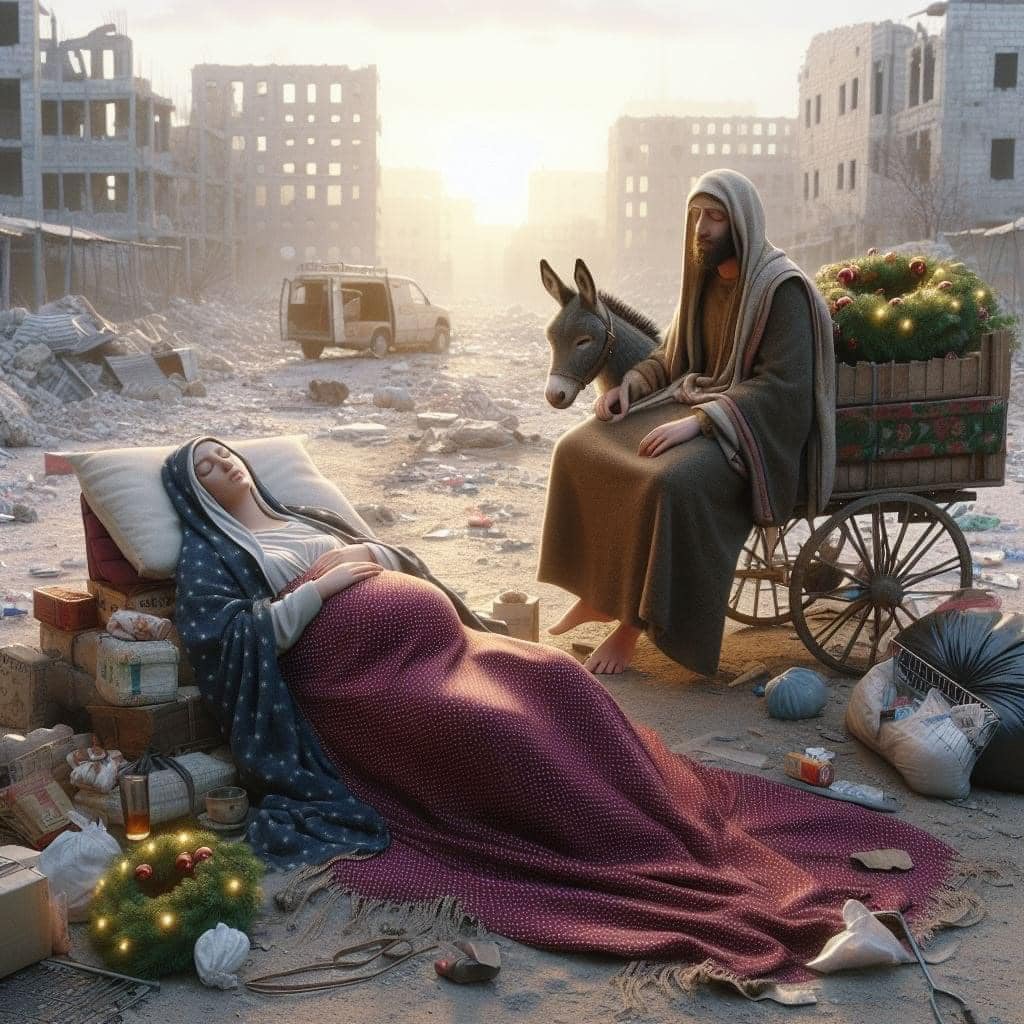
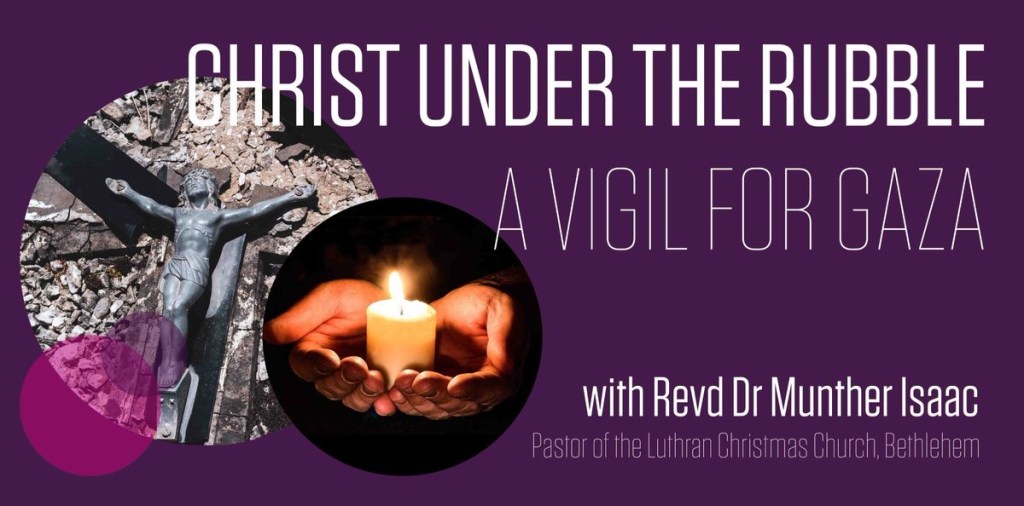
We said during Christmas, if Jesus were to be born in our world today, he will be in Gaza, under the rubble. Jesus under the rubble is the message of God identifying with humanity in its suffering and pain. It is about the God who sides with the oppressed, even being born among them, as one of them, becoming a refugee and a victim of the violence of Empire.
God is in solidarity with the marginalised and the oppressed. God takes sides; God is not neutral. And here is my message: God’s solidarity should become our solidarity! If God takes sides, so should we. Neutrality is not an option.
Today Gaza is indeed the moral compass of the world. This war has divided the world; and maybe this is good thing. We need to know where people stand. Gaza is the moral compass of the world. We either side with the logic or power and ruthlessness, with the lords of war, and with those who justify and rationalise the killing of children. Or you side with the victims of oppression and injustice, and those who are besieged and dehumanised by the forces of Empire and colonisation.
It is really a simple choice: you either support a genocide, turn a blind eye, or justify a genocide, or you cry out: “No! Not in our name. Stop this genocide!”
So, I come here to the UK and I want to challenge the church here: if we truly seek justice and righteousness, in obedience to the commandment of Christ, we must have the courage to speak up and call things by name! This is not a conflict. Israel is not exercising its right for self-defence. Rather, Israel is the coloniser. Israel is a settler-colonial entity. They have displaced millions of Palestinians. Israel was built on the ruins of the people of Palestine. We live under apartheid. What is happening in Gaza is a genocide, it’s ethnic cleansing. Continuing to repeat the Empire narrative only serves to empower the aggressors and maintain this injustice.
Can we continue to even speak about “peace” or even “resolution to a conflict”? Or should we really call an end to tyranny and injustice and apartheid. Vocabulary is important. We are not talking about a struggle between equal forces. This is not simply about a ceasefire; but putting an end to 76 years of ethnic cleansing. And today putting an end to this genocide.
If we are truly concerned and want an end, we must call things by name. I’m tired of diplomacy. This is a time to act. This is a time, to quote Isaiah again, “to loose the bonds of injustice, to undo the straps of the yoke, to let the oppressed go free, and to break every yoke.” It is time for the church to be the church!
I’m convinced that the way and how churches deal with what is happening today – this injustice, this genocide – will reveal a great deal about the identity of these churches. We do not exaggerate to say that the credibility of our Christian witness is at stake here. I recall here something the South African [theologian and thinker] Allan Boesak said, namely that “Palestine today is the gauge for churches and the conscience of churches today”. And he said this before October 7th, before this genocide. How much truer are these words today.
Before I conclude, having called out the church, I want to acknowledge the many of you who have been speaking out. The many of you who have been sacrificing, who have shown positive solidarity. We see you, we feel you and I want to say thank you from the bottom of my heart. We’re doing this together. Your actions, your prayers, your support means a whole lot to us, especially in the face of the rejection that we see. So thank you.
It has been my honour to work with you during this time and we cannot rest. So my call today is simple: We cannot rest until this genocide is over. End this genocide NOW. This is moral call. This is a moral call. It’s not about words, it’s about action. We cannot afford more death! We cannot rest until this genocide is over.
So, let’s act, let’s mobilise creative non-violent means. I encourage you to continue to speak out. To join demonstrations. To mobilise within your community and congregations. Put pressure on your political leaders through calls and written correspondence. Organise non-violent direct-action campaigns and sit-ins. Whatever it takes to compel your government and decision-makers to take action. This is beyond urgent.
We need to act. We cannot rest. We need accountability in the face war crimes. That’s why I said call things by name. Hold people and governments accountable. Injustice will continue as long as no one calls the aggressor accountable. The reports on apartheid must be taken seriously. The ruling of the ICJ must be taken seriously. We need to act. We need to invest morally. We need to implement the International Law. We need to boycott, if needed. We need to call for sanctions. We need to hold people accountable. Otherwise, all of our words just become empty words if we did not act them. Please consider what it means to be true peacemakers. It is time the church here in the UK moves from its shallow diplomacy and neutrality into prophetic peacemaking and costly solidarity.
You need to challenge your own churches. The prophet Isaiah says, “learn to do good” (not just speak good), “seek justice, rescue the oppressed, defend the orphan, plead for the widow.” (Isaiah 1:18) These are all active, participation words. They are not statements and prayers only.
I want to conclude by going back to a letter we wrote back in October, warning about the genocide, saying this is a vengeance campaign, calling for the church to repent seeing already that the church was complicit. I can’t believe that these words are still relevant in February. We saw it coming! We talked about the God who will “judge the world in justice” [Acts 17:31].
I want to read the conclusion of this, because it’s very powerful. Back then we said, and today I say: “We also remind ourselves and our Palestinian people that our sumud (our “steadfastness”) is anchored in our just cause and our historical rootedness in this land. As Palestinians and as Palestinian Christians, we also continue to find our courage and consolation in the God who dwells with those of a contrite and humble spirit (Isa 57:15). We find courage in the solidarity we receive from the crucified Christ, and we find hope in the empty tomb. We are also encouraged and empowered by the costly solidarity and support of many churches and grassroots faith movements around the world, challenging the dominance of ideologies of power and supremacy.
We refuse to give in, even when our siblings abandon us. We are steadfast in our hope, resilient in our witness, and continue to be committed to the Gospel of faith, hope, and love, in the face of tyranny and darkness.”
And quoting from the Kairos Palestine group: “In the absence of all hope, we cry out our cry of hope. We believe in God, good and just. We believe that God’s goodness will finally triumph over the evil of hate and of death that still persist in our land. We will see here ‘a new land’ and ‘a new human being’, capable of rising up in the spirit to love each one of his or her brothers and sisters”.
With this hope we carry on. With this hope we refuse to give in. With this hope we persist until justice prevails and until freedom prevails.
 Quaker Socialist Society
Leave a Reply