
by Seishi Morikawa.
Seishi Morikawa is a second generation ‘Hibakusha’ (a survivor of the atomic bomb dropped by an American pilot on the Japanese city of Hiroshima in 1945) and a campaigner against nuclear weapons. He came to London in July to speak at a meeting in Parliament planned by CND but this was cancelled because of the General Election. His speech was therefore never delivered, even though he had flown to London from Japan. To mitigate his disappointment and the disappointment of his audience, QSS offered to publish the speech on this website and now it can be read below. Seishi maintains that second generation survivors are not recognised by the Japanese government because of the financial implications. This has consequences for the children of others round the world whose parents have died as a result of traumatic bombing. QSS also took Seishi to Westminster Meeting House to meet Friends over a lunch of home-made soup (photograph below). Seishi is in the back row on the right.
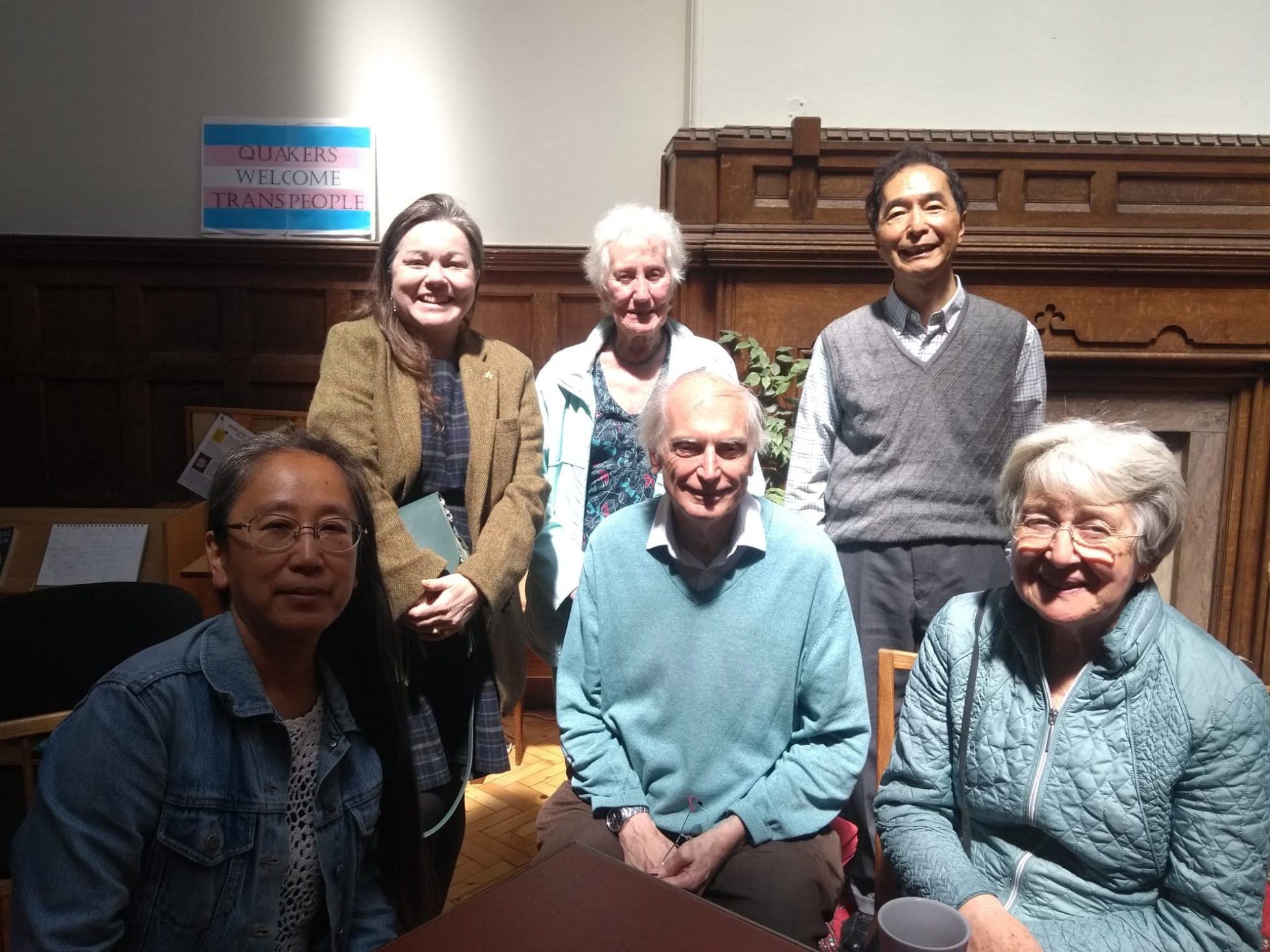
The following is the speech that Seishi Murokawa would have delivered at the meeting in Parliament if the General Election had not intervened.
Toward a Nuclear-Free Future! by Seishi Morikawa
Hello, everyone! Allow me to begin by introducing myself. My name is Seishi Morikawa. I’m Japanese and currently living in Japan.
I was born in Hiroshima in 1954 and, when I was 4 months old, I moved to the Tokyo metropolitan area of Japan. I have worked for Japan Post Holdings Company as a door-to-door salesperson for life insurance, and eventually became a sales instructor. After some time, I was promoted to the position of Vice Postmaster. And I retired 8 years ago. In 1945, My father was exposed to the atomic bombing in Hiroshima. He was at the NHK Hiroshima Central Broadcasting Station of Japan Broadcasting Corporation, which was only 1 km away from the hypocentre, which makes me a second-generation atomic bomb survivor. Most of the people in that area died immediately or within a few days, not only because of heat rays or the blast, but also because of initial radiation. Many who appeared uninjured developed disorders and died days or months later, due to acute radiation sickness. However, my father miraculously survived, and lived until 95 years old, though he suffered from a lot of illnesses. Given that, I believe that my life is a miracle of miracles.
Today, I would like to talk about the reality of the second-generation atomic bomb survivors, and I would like you to know one of the definitive characteristics of the nuclear disaster, which is that it causes pain and suffering across multiple generations. First of all, to make sure, please let me define “the second-generation atomic bomb survivors”. The second-generation A-bomb survivors means the people born of mothers or fathers who were exposed to the atomic bombing. Since the second generation was born after this historical event, they are distinguished from in-utero A-bomb survivors, namely atomic bomb victims who were exposed, while their mothers were pregnant with them.
Before talking about issues of the second-generation, I would like to tell you the 3 characteristics of atomic bomb damages and harm.
The Atomic Bomb and Its Victims
Until now, many atomic bomb victims have come forward to share their firsthand experience of the atomic bombing and have painstakingly advocated for the abolition of nuclear weapons. However, the retelling of these experiences have caused them unimaginable suffering. Nuclear weapons possess a set of radically different characteristics that are unprecedented by any other weapon previously created by the human race. These characteristics are heat rays, blast, and radiation – all of which have a devastating impact on the human body and the surrounding environment.
At 8:15 a.m. on August 6, 1945, the B-29 bomber Enola Gay of the U.S. dropped the atomic bomb on Hiroshima, and 43 seconds later, it exploded 600 m(meters) above Shima Hospital, located 300 m southeast of the originally targeted Aioi Bridge. Within one second of detonation, the fireball generated in the air grew to a radius of 200 m. It blazed for approximately 10 seconds. For 3 seconds beginning 0.01 seconds after detonation, the heat rays emitted in all directions by this fireball exerted powerful effects at ground level. Temperatures in the hypocenter vicinity reached 3,000°C–4,000°C.The surface of roof tiles within 600 m of the hypocenter melted and bubbled. Out to 1.8-2 km(kilometers), clothing on bodies or drying on lines ignited.
The atomic explosion created a super-high pressure of several hundred thousand atmospheres at the epicenter. Then the surrounding air expanded rapidly and enormously, which generated a shock wave followed by a powerful wind. The speed of the blast reached 280 m/s at 100m from ground zero. Once the blast had waned, the air at the center of the explosion thinned out, causing a powerful backdraft. Within a radius of 2 km from the hypocenter, almost all wooden buildings were flattened, and in reinforced concrete buildings, the windows were blown out, and the building interiors caught on fire.
One more characteristic of the damage caused by the atomic bomb is due to radiation, besides the aforementioned heat rays and blast. Penetrating deeply into bodies, radiation damaged cells, altered blood, diminished the blood generation function of bone marrow, and damaged the lungs, liver, and other organs. The initial radiation emitted within a minute of the explosion was lethal within 1 km of the hypocenter. Most in that area died within a few days. Many who appeared uninjured developed illnesses and died days or months later. The explosion left residual radiation on the ground for a long period of time. Consequently, those who entered the city after the explosion to search for family or co-workers, as well as those who entered to participate in relief activities, developed symptoms similar to those resulting from direct exposure. Many died. The City of Hiroshima estimates that by the end of December 1945, when the acute disorders had subsided, about 140,000 citizens had died. Radiation effects from the atomic bomb extended beyond the acute effects that appeared immediately after the bombing. It caused various disorders for decades and continues to threaten the health of survivors today. In early 1946, burn scars on some survivors began to swell into keloids. In-utero survivors, namely atomic bomb victims who were exposed, while their mothers were pregnant with them, were born with microcephaly, with its attendant intellectual disabilities and developmental delay.
Starting around 1950, the number of leukemia patients soared. Starting around 1955, the incidence of thyroid, breast, lung and other cancers increased. However, the mental anguish due to the atomic bomb far outweighed its physical pain. Those who had not experienced the atomic bomb were unable to understand the insurmountable depth of the victims’ suffering. Most atomic bomb victims not only carry the memory of the unimaginable hellscape that they witnessed after the bombing but are also tortured by immense guilt for having survived the bombing while deserting their family, friends, and acquaintances. When the bomb victims share their experiences, they recount painful memories that they would much rather forget.
To this day, atomic bomb victims frequently face social prejudice and discrimination. The general public knows little about the physiological effects of the atomic bomb, and very little information has been disclosed about the health status of the bomb victims, the radiation effects, and how atomic bomb-related diseases have manifested over the years. In addition, both the bomb victims and the general public were concerned about “how children of bomb victims would turn out.” Even when the bomb victims were able to conceive healthy children, many were concerned about the discrimination their children could face as second-generation bomb victims. According to recent media coverage, some bomb victims waited to apply for the acquisition of “Atomic Bomb Survivors Health Book” – or the Atomic Bomb Survivor’s Certificates – until after their children were married and their grandchildren (third-generation bomb victims) were born, so as not to publicize their status and expose them to the discrimination that they had endured.
Nevertheless, what drives the bomb victims to recall their past and subsequent suffering – topics that they would surely not want to recount let alone speak about in public – is their advocacy for nuclear abolition, their conviction that nuclear weapons should never be used again, and their enduring hope that they would be the last ones to experience such an atrocity. However, despite the bomb victims’ efforts, still more than 12,000 nuclear stockpiles continue to exist around the world. Moreover, the “nuclear deterrent theory,” which claims that peace is in fact maintained by nuclear deterrence, continues to be a dominant narrative within contemporary media. Although the Treaty on the Prohibition of Nuclear Weapons was adopted by the United Nations (UN) in July 2017 and entered into force in January 2021, the road to nuclear abolition remains an uphill battle.
What are the Problems Encountered by Second-Generation Bomb Victims?
At present, the number of people who can provide firsthand accounts of the atomic bombing is decreasing rapidly and the significance of accurately conveying the bomb victims’ experiences and preventing them from fading from our collective memory is increasingly paramount. Although second-generation bomb victims may not have experienced the bombing firsthand, they shared intimate ties with the bomb victims. In fact, the bomb victims were their parents who were the closest family members so that they have observed the victims’ lives since their early childhood. This is an experience unique to second-generation bomb victims. Thus, second-generation bomb victims are naturally qualified to convey the experiences of the first-generation bomb victims.
The average age of second-generation victims is now around 70 years of age. As they approach the latter half of their lives, they are encountering problems of their own. In the late 1960s, there was a series of leukemia-related deaths among second-generation victims. In order to demand subsidized medical coverage and financial support for second-generation victims, social advocacy groups were formed, for example in Hiroshima, the “Association for the Protection of In-Utero Atomic Bomb Survivors and Second-Generation Atomic Bomb Survivors”. Moreover, privately funded research on the hereditary effects of radiation began to emerge. Some of this research suggested that there is a significant difference between second-generation victims and the rest of the population. Second-generation victims from all over Japan began to mobilize to demand comprehensive physical examinations, subsidized medical coverage, allowances for health care and improving the quality of life. In response, the Ministry of Health and Welfare (so named at the time) suddenly announced in the autumn of 1978 that they would be conducting a nationwide “physical examination” of second-generation survivors. The purpose of said examination was outlined as follows: “Although our research conducted by the Radiation Effects Research Foundation (co-sponsored by American and Japanese governments) has proved that there is no conclusive evidence of hereditary effects due to radiation, a number of second-generation victims have expressed concerns about their health. In response, we will conduct a nationwide physical examination to dispel the second-generation survivors’ concerns, and to confirm once again that there is no evidence of hereditary effects due to radiation.” The Ministry of Health, Labour and Welfare has been conducting this physical examination since 1979 every fiscal year even in the absence of subsidized medical coverage including treatment.

Now, I would like to introduce you a tremendous investigative reporting article written by Ms. Misa Koyama who used to be a Mainichi Newspaper reporter regarding second-generation A-bomb survivors’ issues focusing on hereditary effects of radiation and the necessity of financial support for second-generation survivors. This article was published on June 4, 2022, in the nationwide edition of Mainichi Newspaper. Here is the article:
“A copy of the physical examination survey and research report on the children of atomic bomb victims which was written about 40 years ago was donated by Seishi Morikawa to The Mainichi Newspaper. Seishi Morikawa is a second-generation atomic bomb survivor. At the time, he urged Ministry of Health and Welfare not to disclose the report. Apparently, the Ministry of Health and Welfare chose not to disclose the report. Also, we ask why Seishi Morikawa chose to oppose the publication at that time but now decides to openly publish it. Unraveling the historical details, we can see the “deep chasm” that lies between the attitude of the nation and the current situation of second- generation A- bomb survivors. The donated document was a copy of “The 1979 Fiscal Year’s Survey and Research Report on the Health of the Second-Generation of the Atomic Bomb Survivors”. The Ministry of Health and Welfare commissioned Japan Public Health Association to prepare the report based on the results of the physical examinations of second-generation A-bomb survivors in fiscal 1979. They compared a total of 17,212 second-generation A-bomb survivors in 39 prefectures, including Hiroshima and Nagasaki with the results of the National Health Survey of the general public regarding their white blood cells, hemoglobin count, blood pressure, and other factors. According to the test values of the report, when comparing second generation A-bomb survivors in Hiroshima with the average values of Japanese as a whole, the number of white blood cells was about 20% less, and the proportion of abnormal urine proteins of elementary school girls was about five times higher. There were also deficiencies, such as the fact that the results of liver function that should have been tested were not noted. Nevertheless, the Ministry concluded that “the health condition of second-generation survivors is not at all different from citizens in general” and “It is the current academic fact that second generation A-bomb survivors have no health problems caused by A-bomb radiation”.
Seishi Morikawa said “I thought it was a survey to deny the necessity of financial support for second generation A-bomb survivors with the predetermined conclusion that there was no hereditary effect. Now, he is 68 years old, living in Kawasaki City, Japan. He is the person who donated the report and was the representative of Kanto Second Generation Atomic Bomb Survivors Liaison Council at the time. He and the group members were opposed to the investigation from the time of announcement by the Ministry of Health and Welfare. This was because the Ministry of Health and Welfare stated that its purpose was “to eliminate the anxiety of second-generation A-bomb survivors and as to confirm that there are no hereditary effects”. Therefore, they felt that it would not lead to subsidized medical coverage. On August 6, 1945, his father, Sadami Morikawa, then 29 years old, was exposed to the atomic bombing about 1 km (0.6 miles) east of the hypocenter of Hiroshima. Some years later, he moved to Kawasaki City as the result of a job transfer where he established an A-bomb survivors’ group. In 1971, he contributed to the realization of health checks and medical expenses subsidies for the second-generation A-bomb survivors by the Kawasaki local government, ahead of other municipalities or the Japanese Government.
Seishi Morikawa was born 9 years after his father experienced the bombing. He was prone to become feverish in his early childhood. The cause, however, was unknown. After entering elementary school, he suffered from diarrhoea, fatigue, general malaise, and acute bronchitis associated with whenever a cold worsened. Hereditary effects of radiation have not been definitely proven. However, the principle of the Atomic Bomb Victims Relief Law tells us, unless we can absolutely deny the possibility of hereditary effects, a certain degree of subsidized medical coverage and allowances for improving the quality of life must be provided. In fact, a considerable number of second-generation survivors are currently suffering from several diseases or symptoms. Thus, Seishi came to the conclusion that the second generation of the A-bomb survivors are definitely victims of the atomic bombings. In 1982, in order to reach an agreement regarding the publication of the report, the Ministry of Health and Welfare presented the health examination survey and research report to the organization, of which Seishi was president. However, Seishi could not find any basis for the conclusion that there is no hereditary effect. To begin with, tests of this health examination were so few that it was not adequate for verifying the health condition or identifying diseases precisely and comprehensively. He foresaw it would cause the spread of misinformation among citizens, and he and his group demanded that the Ministry not publicize the report. Kosei Takahashi, a lecturer of the Faculty of Medicine at the University of Tokyo attended the negotiations with the Ministry to support Seishi Morikawa’s group. He was well known for his activism in pursuing the issues of harmful effects of medicines and chemicals. He passed away at the age of 86 in 2004. During the negotiations, he indicated the abnormal numerical value in some inspection results such as urinary protein, and he affirmed “There is a definite abnormality though the Ministry denied this, and the Ministry’s conclusion is unfit and not based on scientific data”. In the end, the Ministry seem to not have made the report public, but the staff of the Ministry of Health, Labour and Welfare said that “it is difficult to confirm this because there are no staff members who were there at the time”.
Seishi stored the report carefully up until now. He was conflicted as to whether he should continue to withhold the report or to go ahead and publicize what he had once stopped. However, he finally decided to make it public because the report tells us that the point in dispute has not changed at all in 40 years. Issues such as the hereditary effects of radiation or the necessity of life support measures for second-generation survivors have been left unresolved. The Radiation Effects Research Foundation, which is jointly managed and operated by the governments of U.S. and Japan are planning to investigate health issues of second-generation A-bomb survivors with genome analysis from now on. However, they explain that the purpose is to “clarify the reason why the health effects of second- generation A-bomb survivors have not been recognized, and to respond to the anxiety of A-bomb survivors and second-generation A-bomb survivors.” On the other hand, even from within the Radiation Effects Research Foundation, there are voices questioning the necessity of the investigation. They said, “We cannot conclude statistically that there is no hereditary effect, and it’s impossible to reach an agreement on the necessity of support measures for second-generation A-bomb survivors purely based on the result of physical examinations and research.”
Seishi Morikawa appeals that “Many second-generation A-bomb survivors, including myself, have suffered from illnesses. If there were the financial support by the government, many lives would have been saved.” In June 2017, the Ministry of Health, Labour and Welfare offered a similar explanation during a negotiation with the Japan Confederation of A-and H-bomb Sufferers Organizations. Their position was unchanged since more than 40 years ago. Not only did they deny the need for governmental support such as subsidized medical coverage, but they also refused a request for more thorough physical examinations (such as the expansion of examination criteria, cancer screenings). They insisted that “the research by the Radiation Effects Research Foundation revealed no evidence of hereditary effects.” On the other hand, they concluded that they would continue their examinations because second-generation bomb victims are gradually ageing, and there might be a possibility of onset of illness due to late hereditary effects of radiation. Thus, the Japanese government has had a consistent position on the radiation problem since the end of the Second World War, exemplified by the Ministry of Health, Labour and Welfare’s statements.
① If the Japanese government acknowledges the hereditary effects of nuclear radiation on second and third generation victims, a significant budget would be required to administer the necessary support . In their view, subsidies related to nuclear radiation must be limited to first-generation atomic bomb victims. The issue might be expanded to the question of subsidized medical coverage or financial support for the descendants of first generation bomb-victims, and even for the victims of nuclear power plants accidents such as the TEPCO⦅Tokyo Electric Power Company ⦆ Fukushima Daiichi Nuclear Power Plant accident. It would also include the non-supported evacuees, who are defined as the Internally Displaced Persons from the high-radiation area of Fukushima, and the workers of nuclear power plants. Expanding the subsidies to include all of these people may cause several movements to become increasingly more active synergistically.
② If the hereditary effects of nuclear radiation are acknowledged, anti-nuclear sentiments may resurface among the Japanese people, making it increasingly difficult to promote nuclear development and build nuclear power plants for becoming and continuing to be a potential nuclear armed nation. Case in point: the 1954 Bikini Atoll nuclear tests stoked strong anti-nuclear sentiments among the Japanese people. The approximately 1,000 fishing vessels, including Daigo Fukuryu Maru (The 5th Lucky Dragon) were exposed to radioactive fallout from the U.S. hydrogen bomb test in March 1954. They were 10km away from Bikini atoll. It became a trigger for the movement against nuclear weapons in Japan. The next year (1955), The World Conference against Atomic and Hydrogen Bombs was held in Hiroshima , and 5,000 people from 11 countries participated. Moreover, in 1956, the Japan Confederation of A-and H-bomb Sufferers Organizations was established. In an effort to downplay the incident, the Japanese and the U.S. governments – both advocates for nuclear development – neglected to inform the public about the risk of being exposed to radiation. As a result, after Daigo Fukuryumaru incident, approximately 1,000 more fishing vessels entered the nuclear zone, and were exposed to radiation by the end of the year (1954). To this day, most Japanese people are not aware of this fact.
③ Hence the Japanese government maintains their “official position” that “there are no hereditary effects of nuclear radiation.” In reality, however, there is speculation that the Radiation Effects Research Foundation and the Ministry of Health, Labour and Welfare have obtained data exhibiting significant differences between second-generation bomb victims and the rest of the population during their “physical examinations” over the years. For the Japanese government, the examination results or the checked data are likely very valuable when pursuing further nuclear development programs, which explains why the government has continued to accumulate data through repeated “physical examinations.” While the government continues to claim that the Radiation Effects Research Foundation has revealed “no evidence of hereditary effects,” they have not fully disclosed the examination data to back up this claim. As the government continued to deny the existence of hereditary effects for many decades, bomb victims and activist groups advocating the abolition of nuclear weapons and even second-generation bomb victims began to have less conviction about the second-generations’ problem. Even though many still resist the government’s unsubstantiated claims, I am afraid that the government’s unresponsiveness has effectively stifled the movement, and any mention of hereditary effects has become increasingly taboo as it is associated with discrimination. Today, people generally avoid discussions about the second-generation bomb victims’ health status, let alone the existence of hereditary effects. Even second-generation bomb victims themselves avoid these topics, fearing that it would exacerbate discrimination against them and their community. After many years of advocating for their rights, they have fallen silent. That is the reality. These attitudes might also be affecting the behaviors of third-generation survivors. They are working hard to preserve the firsthand accounts of the atomic bombing experience and I would like to show my respects to them. However, most of their motivations stem from their grandparents’ experiences. They rarely mention their second-generation parents. The second-generation “problem”, so to speak, has been drastically minimized in our collective psyche – even the engaged third-generation activists will likely consider their second-generation parents as simply parents. They do not recognize their parents as “second generation bomb victims with second generation bomb survivor problems”. This is, of course, neither the second- nor third-generation victims’ fault. The sole responsibility falls on the government for downplaying the second-generation bomb victims’ experiences while using them to extract data that substantiates further nuclear development.”
As the time left for second-generation bomb victims becomes increasingly shorter, to say nothing of the original bomb victims, I fear that the problems suffered by second-generation bomb victims may fade into obscurity. The following is a passage from the “United Nations Scientific Committee on the Effects of Atomic Radiation, UNSCEAR2001Report to the General Assembly, with Scientific Annex: (titled) Hereditary Effects of Radiation.”
“Radiation exposure has never been demonstrated to cause hereditary effects in human populations. The absence of observable effects in children of survivors of the atomic bombings in Japan, one of the largest study populations, indicates that moderate acute radiation exposures of even a relatively large human population must have little impact. However, experimental studies in plants and animals have clearly demonstrated that radiation can induce hereditary effects. Humans are unlikely to be an exception in that regard.
The 2007 recommendation by the International Commission on Radiological Protection (ICRP) contains the following view. Regarding the Linear Non-Threshold (LNT) hypothesis of cancer caused by low-dose radiation, the hypothesis still holds that “the increase in the cancer and hereditary effect caused by radiation is proportional to the increase in dose” at the low-dose region of 100 mSv or less. (It is scientifically correct.). In other words, the ICRP acknowledges that, scientifically, it is correct to postulate that the rate of cancer or hereditary effect increases in proportion to the relevant organ or tissue’s extent of exposure in the low-dose region of around 100 mSv or less. Many second-generation bomb victims are facing the following problems and concerns.
① They are concerned about their parents’ health, and the welfare of first-generation bomb victims at large.
② They are also concerned about their own health and how possible illness may impact their livelihood.
The illnesses and symptoms common among second-generation bomb victims are diverse, unique for each victim, and are not limited to typical radiation illnesses such as leukemia, thyroid cancer, multiple myeloma, and other types of cancers. Instead, problems range from digestive disorders, heart diseases, respiratory problems, nosebleeds and asthma, abnormal white blood cell counts, and small wounds that are difficult to heal and get infected easily.
③ Second-generation bomb victims face social prejudice and discrimination. Some have experienced discrimination from potential spouses or discrimination in job interviews from potential employers when they were younger. Even after marrying and having children, they may be concerned about the health of their children and worried about the discrimination they may be subject to as third-generation bomb victims. In addition, if their children marry, they are concerned about the health of their grandchildren, who would be fourth-generation bomb victims. As one can see, one of the frightening aspects of nuclear weapons – a continued threat to the survival of humanity – is that they inflict serious harm on subsequent generations.
The threat of nuclear weapons is not limited to wars. Nuclear radiation, in fact, is an increasingly ubiquitous threat that is already spreading around the globe exemplified by 1) nuclear weapons tests, 2) radiation exposure via working in uranium mines. A requirement for the operation of nuclear power stations used for plutonium extraction, which is a necessary resource for nuclear weapons production, 3) radiation exposure via working in nuclear power stations, and 4) radiation exposure via nuclear power plant accidents, which afflict residents in the area. Furthermore, subsequent generations are already feeling the damaging impact of nuclear radiation.
I have met many second-generation bomb victims through founding the Association of Second-Generation Bomb Victims and via various other second-generation bomb victim organizations. Through these networks, I have conducted many interviews about their lives and their health statuses. While some second-generation victims were relatively healthy, I also heard many accounts of a diverse range of illnesses. I am one such victim myself. An individual I met was sickly and often bedridden, therefore he had difficulty maintaining a regular job. He had no choice but to work in a commission-only job that he was only able to do when he was relatively healthy, resulting in an unstable income. Several second-generation bomb victims I was close to passed away in their 20s and 30s due to leukemia, liver cancer, tongue cancer, or heart disease.
Furthermore, upon reading my book “Toward a Nuclear-Free Future: Message from a Second-Generation Atomic Bomb Victim” published in December 2018, which discusses my life, health challenges, clinical history and characteristic symptoms, many second-generation bomb victims have sent sympathetic messages my way. One such comment read: “I always thought my clinical history and health problems were due to my individual constitution and had nothing to do with the fact I am a second-generation bomb victim. However, my symptoms overlap with the problems the author has been experiencing. For instance, my injuries are hard to heal and they get infected easily, I have a weak stomach and often suffer from diarrhea, I tire easily, my white blood cell count is low, my bones break easily, I have frequent nose bleeds, etc.. I believe that many other second-generation bomb victims suffer from similar health problems and live with pain and concerns. The book made me realize the necessity for second-generation bomb victims to share their experiences with a wider audience.”
Moreover, it is becoming more common in recent years to hear about the many health issues of third-generation bomb victims, and even those of fourth-generation bomb victims.
3. Toward a Nuclear-Free Future
The operation of nuclear power plants and the production of the nuclear weapons necessarily discharge nuclear wastes which emit radiation. Therefore, nuclear weapons are harming the people of nuclear armed nations through the process of production even if they are not being used as arms. The dismantled weapons need adequate facilities for their temporary storage, and eventually permanent disposal. Environmentally safe ways to permanently dispose of nuclear weapons are currently non-existent.
Each of these points have strengthened my conviction. The hereditary effects of radiation are irrefutable. We, the descendants of atomic bomb victims, are living proof! It is clear that the human race cannot coexist with nuclear weapons, nuclear power plants, nuclear submarines ships, and carriers. It is therefore of utmost urgency to abolish nuclear weapons and remove previously mentioned nuclear power from this planet. The first step we must take toward this goal now is the ratification of the Treaty on the Prohibition of Nuclear Weapons adopted in 2017 and came into effect in 2021.
It’s an urgent issue to have all of the nuclear armed countries and potential nuclear-capable nations such as Japan ratify the treaty so that the treaty becomes substantially valid. As a second-generation bomb victim and global citizen, I ardently hope that many countries, including Japan and the U.K., neither of which participated in the treaty negotiations, will ratify the treaty immediately, and paving the way for nuclear abolition. Moreover, every victim of nuclear radiation – regardless of whether their exposure was a result of nuclear weapons, nuclear tests, uranium mining, working at nuclear power stations, or accidents at nuclear power plants – along with their descendants, should be entitled to receive medical, and welfare support to guarantee their right to a decent quality of life.
We simply cannot realize a society where nuclear victims are properly looked after (through compensation, treatment, and support) without abolishing nuclear weapons and nuclear power. Nuclear abolition and the human rights of victims are two sides of the same coin; we cannot discuss one without the other.
Thank you for listening!
Seishei Murokawa
 Quaker Socialist Society