
by Priscilla Alderson.
Review: Jesus in His Time (2024) by Elizabeth Coleman and Beyond the Spirit of the Age (Swarthmore Lecture 1996) by Jonathan Dale.

In Elizabeth Coleman’s very clear, readable book, Jesus’s friends and family, and a few critics, vividly describe his life and teaching through personal accounts. Jesus in His Time relies on early records of his actual words and actions and death, which many historians consider are reliable. The final section criticises Pauline Christianity, which invented mysteries about Jesus’s life: the incarnation, miracles, divine sacrifice, the Trinity. These myths attracted numerous followers for centuries, but today they tend to deter and confuse would-be followers of Jesus. A book review in The Friend 21st February mainly considers religious aspects of Jesus in His Time.
This is also a political book, drawing on Hyam Maccoby’s (1973/1980) Revolution in Judea: Jesus and the Jewish Resistance, which sees Jesus as a leader of the Jewish resistance against the Roman Occupation. Maccoby contends that St Paul’s partly misleading, anti-Jewish, pro-Roman Christianity sowed the seeds of anti-Semitism.
To be clear, Jesus in His Time does not refer to the following ideas on Jesus’s relevance to later times. Yet this beautiful, resonant book with the fresh direct look at Jesus led me to think about early Quakers and Quakers today.
Elizabeth Coleman makes very clear Jesus’s dedication to real justice and equality, forgiveness and peace, his generous giving away of possessions, and care for sick people and anyone oppressed or in need. There are his friendships with all kinds of people including social outcasts, and the solidarity (today’s gender-free term for fraternity, brotherly love) among his friends (those who ‘do as I command’, John, 15:14). There is the passionate truth and integrity he inspired to the extent that, like him, many suffered imprisonment and death for their belief in the promised Kingdom.
The first Friends in the 1650s and 1660s followed this example with a quaking intensity we can hardly imagine. With the Levellers and others, they hoped and worked for revolutionary political change towards God’s kingdom on earth, promoting values that were later associated with socialism. Yet soon, the prosperous merchant class took over the Quakers, with different lifestyles and values from those of Jesus, of his followers, and of the early Friends.
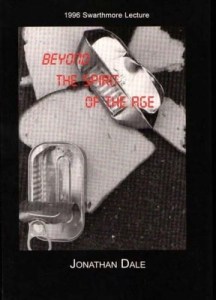
Jonathan Dale wrote his 1996 Swarthmore lecture the year before the Blairite Labour government was elected, when there was still hope that Labour might promote socialism. Dale traces the decline, over centuries, of Quaker social concern and active witness originally powered by the values of the Kingdom of God on earth. He highlights our choice: further decline, or renewal through expressing our faith more fully in our daily lives and in politics and dissent. We could work internationally for ‘much more radical equality, a community of people equal in dignity and much more equal in wealth and…power’. Instead, today we are further away from that dream, and far more endangered by the poly-crises Dale wanted real action on: climate crisis, loss of species, erosion of democracy and public services, rising rates of illness and of police violence, greed and corruption, betrayal of public trust, with ever growing anger and violence in oppressed areas. Quakers cannot stay silent and ‘hole up in the comfortable world of a spirituality of moods and relationships’ and ‘personal growth’, because opting out means supporting all this injustice and distress. ‘We should seek ways of bringing our vision of the good society much more actively into the political arena.’
Dale identifies three main growing barriers that underlie our loss of faith in progress towards the kingdom of God on earth.
Relativism blurs our insight into right or wrong, justice or injustice, crucial or trivial. ‘It weakens commitment to anything’ and is ‘death to the prophetic and to any powerful leading testimonies’. ‘Relativism fragments our understanding of what we are for and what we can do.’
Secularism swamps hard moral and sacred challenges with easy greedy materialism. It ‘saps our spiritual power and undermines our testimony to the sacramental nature of the whole of life’.
Individualism increases selfish indifference to others and limits spiritual growth through respectful and compassionate interactions with others. Spiritual and political dimensions in daily decisions are then forgotten – what we eat, to use a car or a bus or a bike, for instance.
The main political parties oppose the Quaker testimonies in promoting austerity, war, injustice, massive inequality and hostility to immigrants. Dale considers that Friends who want to be respectable and ‘not ruffle any feathers’ need to see that active testimonies involve dissent, joining demonstrations, and working with militant non-violent political organisations, such as the Socialist Workers Party. These have more knowledge, members and resources than we have. ‘Respectability is not next to godliness’ and inaction makes the testimonies ‘a sham’ and hypocrisy. ‘Unless we struggle against the world’s kingdom of self-interest our spirituality risks being irrelevant…Dissent therefore becomes a necessity in lifestyle, in politics and in testimony.’ ‘Where are the agents of change?’, he asks. How can today’s Friends rediscover the radical testimony, spiritual vision and courage of early Friends and Jesus’s first followers?
Beyond the Spirit of the Age is even more powerfully relevant to read and discuss today than it was in 1996. It gives contemporary political and practical frameworks to help us to apply the values and actions celebrated in Jesus in His Time.
Priscilla Alderson, March 2025.
 Quaker Socialist Society
Leave a Reply