
by Priscilla Alderson.
At a recent Quaker Socialist Society (QSS) meeting, three members responded to this question, followed by a general discussion. Socialism is widely attacked and wrongly linked to repressive communism although it promotes democracy, peace and justice. How relevant is socialism to Friends today?
Ian Martin, co-clerk of QSS, welcomed 39 people online.
Christine Green began: Quaker testimonies, the gospel message, socialism – one and the same? Jesus would have been a socialist!

Christine has been an active environmental and peace campaigner for 50 years and she was recently vice chair of the Movement for the Abolition of War. She is a former Labour member, currently a Green member, and was an Anglican until she became a Quaker in November 2018.
Christine cannot imagine a Quaker belonging to any other political system than socialism, which once guided the Labour Party, and is now adopted more by the Green Party. ‘As a Quaker, I would only ever be a socialist.’ The Oxford English Dictionary defines socialism as ‘a set of political and economic theories based on the belief that everyone has an equal right to a share of a country’s wealth and that the government should own and control the main industries’. Quaker testimonies of truth, simplicity, equality and peace express socialist values. Socialism is not perfect, but it is a means of organising society that is most likely to result in our testimonies being lived out in all of society.
Capitalism is most directly opposed to socialism and to our testimonies. Long before the term ‘socialism’ was introduced, and according to liberation theology, Jesus was a socialist in his ethics and his communal way of living. He would not have joined a political party, being nonpartisan and open to all, but he had the heart and intent of a socialist.
Ruth Kettle-Frisby: Socialism is an Effort of the Will, Spurred by the Truth.

Ruth is an unpaid carer to her eldest of two young daughters, who has a severe neurodevelopmental condition, CDKL5. Ruth is a trustee for the charity CDKL5 UK. She is a writer with a background in philosophy, and also a disability and carers rights activist, a clean air campaigner, and co-founder of Clear the Air in Havering and CND Essex. A full copy of Ruth’s talk is on this QSS website.
Is socialism a ‘love of hopeless causes’, a pipe dream, the desperate hope that the Left will at last unite and work for social equity in a cohesive progressive movement? Eco-socialism should aim for our Quaker values of peace and justice and include:
• fair redistribution of wealth and resources, and degrowth for happier, healthier people and a thriving, sustainable planet
• renewable energy ending neocolonial fossil fuel extraction
• a wealth tax, reparations, and cancelling of global south countries’ debt
• Equal access to clean air, land, water, food, social housing, health care, a decent education, support and opportunities
Instead, we have destruction and injustice for endless economic growth, scapegoating of vulnerable people trapped in poverty, and austerity.
Ruth asked if ethical socialism could help to reinvigorate political socialism, making it more publicly acceptable and, for example, increasing public support for refugees. She sees morality, ecology, democracy and feminism as tenets of socialism. Eco-socialism is a political movement, working with other framings of socialism to turbo-boost concrete solutions to poverty, injustice and inequality, and to uphold universal human rights.
Ruth’s wise friend, Fer’ha Syed, said, ‘I don’t think you can be pro-environment without being a socialist; I don’t think you can be a good Muslim without being socialist.’ Ruth believes being a good Quaker entails being socialist. For the sake of the inmost Light that resides in all of us; peace, justice, equity, truth and simplicity can work through socialist politics through humility and care, whether or not you formally follow Jesus of Nazareth. ‘For me, socialism and my faith are separated only superficially; arbitrarily, even.’
Ruth’s eldest little girl’s crushing neurodevelopmental diagnosis and other troubles in ‘a perfect storm of disillusionment, music, patterns of oppression, and matters of conscience’ led her to seek out the first radical Quakers, who chimed with her life-long socialist beliefs. Socialism is not about charity or even compassion, but it is solidarity that opposes injustice and identifies with the oppressed. It may enlarge our understanding of the privileged too. Would we do any differently in their position? We can hope so. Ruth reflected on how the Light ‘sometimes flickers and fades, then roars back into fullest fire when fuelled with sadness and rage upon witnessing atrocities. ‘The Light requires oxygen; the space away from fear, anxiety and hardship to wait and listen.’ Capitalism can break spirits ‘when ‘the Light – most visible in children, I think – is choked’. We need to reject entitlement and greed and instead embrace simplicity, which entails dignity for everyone, honesty, humility and real equality.
‘Socialism is an effort of the will, spurred by the truth. We are complicit in neoliberal structural injustice unless we find meaningfully, practical ways to join together and fight it.’ Ruth discussed other vital questions, shown in the full copy of her talk.
Chris Newsam: Creatively Is There a Vision for Our Time in Quaker Socialism?
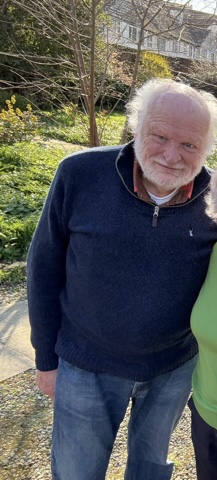
Chris has been a ‘convinced’ Quaker of more than 25 years. He is an Eco-Socialist, Interfaith Minister, Pacifist and Human Rights Campaigner. Here is Chris’s record of his talk:
As Quakers we are different, often holding quite diverse views from one another. I contend we need vision and hope. Today, sadly, politicians and other leaders often appear to be rather hope-less, lacking in vision for a positive future. We Quakers, corporately and individually, are at our best when we hold to a positive vision. Quoting the Bible: ‘Where there is no vision the people perish’.
Much of the news is very negative especially the appalling and disturbing reports from Gaza and many other places. These can leave us disheartened and largely hopeless. The concept of combining Quakerism with Socialism might make many Friends uncomfortable especially when socialism is often, mistakenly in my view, conflated with the repressive regimes of the former Soviet Union under Stalin or with Marx’s seemingly negative view of religion as the ‘opiate of the masses’. Socialism is a broad-ranging way of looking at the world and one which often seeks a fairer and more peaceful world. Socialism has been likened to ideas taught by Jesus.
I recognise that holding a vision can be dangerous, but also hopeful in helping us to find a meaning in life. George Fox’s vision of that of God in everyone means we are all essentially of one kind, whatever our background or skin colour. At Malton, in North Yorkshire, where I live, George Fox preached at the parish church in 1651 and had such an effect that soon a group of several hundreds calling themselves Quakers gathered in worship for several days on end and soon after decided to burn in the marketplace their items of expensive garments to protest at what they saw as the inequalities between rich and poor.
Quakers, I would contend, were practising what we would now call socialist principles from their beginning. Our Testimonies to Peace, Simplicity, Equality and Truth for me are those integral to Ethical Socialism. Quakerism offers to Socialism the way of peace as the way. Robert Owen, who first used the word ‘socialism’ in the 1820’s, is often credited with founding what has subsequently been termed ‘Utopian Socialism’. He said, ‘There is but one mode by which man can possess in perpetuity all the happiness which his nature is capable of enjoying, and that is by the union and cooperation of all for the benefit of each.’* Owen became known as the father of the Cooperative movement – that led to the formation of the Independent Labour Party and much of the trades union movement.
So I would contend that Socialism is much misunderstood and often deliberately maligned. I think that as a philosophy and practice it dovetails nicely with Jesus’s teaching ‘the first shall be last and the last first’, and points to a time when society is more equal and peaceful. The small Quaker Socialist Society has something to share creatively within Quakers and beyond. Echoing John Lennon, ‘You may say I’m a dreamer – but I’m not the only one’. Thank you’.
Discussion
The discussion began with Friends emphasising economic aspects of socialism as a cooperative movement where everyone equally owns the means of production and any profits from their work. Similarly, George Fox, guided by the inner Light, rejected hierarchies and embraced justice, honesty, anti-violence and pacifism. He also rejected ‘frivolities’ such as maypole dancing and theatres, but he did want compassionate conduct in all.
Socialism is rooted in Jesus’s teaching, all based on love as are the Quaker testimonies. We are all brothers and sisters. Quakers do not say enough about inequality. We should end percentage pay rises that constantly increase great and growing salary inequities, and instead have flat rate pay rises. If we called people stakeholders instead of shareholders that might make people more equal. We should replace the highly regressive tax system with a progressive one when the rich pay more, and we should use tax to recirculate national wealth.
An Attender who is a Marxist pacifist said we do not need either Quakerism or socialism. How can we not have both? Why do we need QSS? We all want peace, equality and love. How can we achieve them without socialism or Marxism? Quakers and socialism run hand in hand.
A Labour councillor spoke about massive changes in social housing. There used to be local pride in everyone’s right to a good home, welfare, and good health, before Thatcher destroyed that. Socialist Tony Benn thought that the properly run NHS was pure socialism, free for everyone with no discrimination. The councillor had a ‘run-in’ during a church sermon with a Vicar who said, ‘Communism will never work’, and he replied, ‘It’s never been tried!’ He believes more people should challenge the clergy.
One Friend regretted that the beautiful village she had enjoyed as a child 70 years ago is now an awful mess with neglected houses and gardens and closed-down shops. She had many years of school and university education, all free thanks to socialism even though it is a dirty word to many people. Another Friend enjoyed social housing in the 1960s and believes Christianity equals socialism, though he knows many disagree. A third Friend said the Quaker testimonies speak against capitalism. Austerity continues, he said, because ‘we tinker with the symptoms but don’t change the problems’ of the national economy. Marx’s edict, ‘From each according to his ability, to each according to his needs’ was seen by one Friend as a religious avowal, valuing the communal over the individual with hope for everyone. Although he thinks some Christian conservatives feel they are ‘isolated beacons of righteousness in a world of Sodom and Gomorrah’, they forget to prioritise community.
We were reminded that William Morris, the Victorian socialist (whose inspiring lectures can be read online), said it is not so much about ‘the what’ as about ‘the how’. We had heard about visions, but how can we achieve them, move the little grains of sand, even risk getting arrested for our work? How can we undermine the current greedy system and change things when there are so few Quakers and even fewer socialist Quakers in Britain? Ideas are great but we need people to act. What can we older people leave behind that is of lasting change and value – doing it more than talking about it?
A second Labour councillor recalled helping to create a large council estate in a very poor part of England, with games areas, a youth club, a Sure Start centre and other amenities to draw communities and generations together. Though he said his views on war and peace are not very socialist or Quakerly, his practical socialism was about getting elected and spending money to make positive changes.
An older Quaker said that though she was no longer active, ‘I’m with the protest marchers in spirit’. Like other speakers, she was less interested in theoretical faith than in being a Quaker ‘as a way of life. I live as a socialist.’ Quakers differ over whether to join loud marches or defend Quakerly silence, which the brave Friends who are being arrested for Palestine protests do.
One Friend thought the solemn, peaceful, powerful, loving, solidarity of the protest marches, everyone united in moving forward, though they are noisy, can feel like a gathered Meeting. Others said that socialism works through talking with people who have different views and don’t all have to agree. One said, ‘I try to have a Quakerish kind of life and a socialist kind of life. Neither of these groups I belong to knows I am a member of the other, and I laugh with each of them’.
 Quaker Socialist Society
Leave a Reply