
by Rebecca Hardy, Joseph Jones and Elinor Smallman.
QSS Editor: At last year’s Yearly Meeting of Quakers in London there was a protracted debate about Gaza. It ended with British Quakers becoming the first British church to say they “believed” that Israeli actions in Gaza constituted a ‘genocide’. Since then there has been fevered debate about Palestine Action, islamophobia, antisemitism, and the attacks in Manchester and on Bondi Beach. Now, with preparations under way for the Yearly Meeting in May 2026, a Quaker ‘Guide to Antisemitism’ has been issued. As this will surely renew the controversy, it may be useful to remind Quaker socialists what Quakers actually decided last year and how meticulously they discussed it.
[The report below appeared in the Friend magazine of 30 May 2025. It was written by Rebecca Hardy (journalist), Joe Jones (Editor of the Friend), and Eleanor Smallman. Anyone interested in Quakers should subscribe to the Friend, a weekly magazine running since 1843. Every week it covers a range of spiritual and ethical issues, as well dealing with topics as diverse as poetry, protest, climate change, and world affairs.]
Rebecca Hardy, Joseph Jones and Elinor Smallman: Report on Yearly Meeting 2025 (Gaza):
Monday 26th May 2025: Session 6 picked up where Session 5 ended, with some nominations business shunted into the later session to make space for deep (and protracted) discernment. Fred began by reading from The Background to Quaker Work at the United Nations by Duncan Wood. It is a profound piece of writing, and was well chosen: ‘Since we are not in a position of power, [some] dilemmas are not ours to solve. The choices not ours to make. From time to time at the United Nations we are brought close to those who have to find the solutions and make the choices. On such occasions, it may or may not be given to us to make suggestions which promote the better of two choices or solutions. It is more important that we express our conviction that decisions affecting the lives of multitudes cannot be dictated by worldly expedience, but must be taken as we would express it: under concern. We must suppose that those in authority are unaware of this, but we must recognise that their liberty of action is often circumscribed by the nature of their office. The powerful are not necessarily free. We who are freer than they are to follow what we believe to be the will of God may at times be called upon to stand beside them as they seek for light on the road to peace.’ In the following worship Friends were ready to offer vocal ministry, but the elders were not moved to take any.
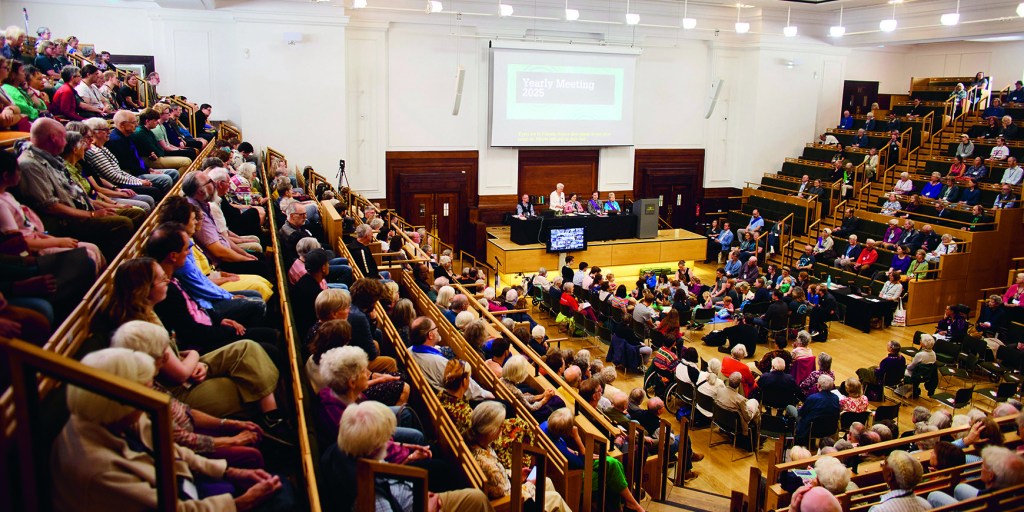
[Yearly Meeting 2025. Photograph, in the Friend, by Mike Pinches of BYM.]
The Meeting then heard from the Epistle from Southern Africa YM, 2025: ‘Many spiritual journeys take us through difficult and winding ways… to beauty… What binds us together, what pulls us apart? Our willingness to constantly seek the path to righteousness and service to others.’
‘We will get where we will get,’ said Adwoa. ‘Unity does not mean unanimity.’ She then re-read the minute on Gaza under discernment, with its use of the word “genocide”.
There was ‘much I feel able to unite with’, said one Friend. ‘But I don’t think that means it’s right…For me, radical peacemaking must go to the roots of the situation. [It] must draw on the spiritual roots of our discipline… I feel like in using the word “genocide” there is a judgment that certain people should be locked up – a judgment that we no longer intend to be in community with them.’
Another referenced the analogy Friends had heard earlier in the Meeting of the two hands, one saying stop and the other reaching out. ‘This minute has a lot of stop and not a lot of reaching out,’ she said.
One wondered ‘how it might be received by my Palestinian friends… I don’t think the passive voice is right’. He wanted to include more Palestinian voices.
‘Our testimonies are like a braid,’ said a Friend from QUNO. ‘But there is a testimony that could help us: equality’. How can we be a light in darkness? she asked.
Friends had lots of ministry to offer, with several Friends standing or raising hands online. One wanted more focus on Palestinians being forced to move from their homes. Another referenced Mary Lou Leavitt in Quaker faith & practice, pointing out the value of naming things. He wondered if it would be more helpful to say that it was Friends belief that this was genocide – the only people who could declare it as such were at the International Criminal Court (ICC).
At one point an elder stood to speak. These things were clearly distressing, she said, and quoted Isaac Penington: ‘Heed not distressing thoughts when they rise ever so strongly in thee; fear them not, but be still awhile, not believing in the power which thou feelest they have over thee, and it will fall on a sudden. It is good for thy spirit and greatly to thy advantage to be much and variously exercised by the Lord. Thou dost not know what the Lord hath already done and what he is yet doing for thee therein.’ At this point all three clerks were deep in conversation at the table, with Oliver Robertson, who manages QPSW and therefore the EAPPI programme.
Eventually Adwoa stood. She wanted to test something: was the Meeting minded to unite behind the idea that ‘we believe it’s genocide’? Many Friends stood again, with Fred calling ministry sensitively and carefully – a reassuring sign given that he will clerk YM 2026.
The wording ‘we believe’ avoided Friends ‘trying to make lawyers of ourselves’, said one, and so the clerks continued to work on a minute. By the time Adwoa stood again it was past the time that the session was scheduled to end. She asked Friends if they were content to overrun. They were. She tried a revised minute. Was there more ministry we needed to hear? Apparently, lots.
One Friend wanted it noted that the British government ‘is complicit and colluding with this genocide’.
Another referenced the long history of antisemitism, predating European colonialism. One Friend ‘would like to see deep repentance… it would show humility’.
Adwoa asked again if there was unity. She heard mostly ‘hope so’ but a few ‘hope not’. She wanted to hear from the latter group. One Friend elaborated on their inability to unite with the minute. She was concerned about ‘the effect of whatever public statement we may choose to make here’.
Adwoa tried again, but Friends wanted to speak further. She asked them to consider their leadings carefully. One then made what seemed like an impactful contribution. She worked with the Quaker Committee for Christian & Interfaith Relations (QCCIR). Friends were a tiny church, she said, but sometimes spoke with a loud voice. They were taken ‘extremely seriously in interfaith landscape… Our words carry a huge amount of weight, if we time it right and speak it right’. QCCIR had had ‘run-ins with our fellow churches and interfaith friends…Those relationships are fragile and varied and complex.’ She had ‘worried a lot’ about how using the word ‘genocide’ would affect those relationships ‘But I want to say with every leading and sincerity I can find: we can live with this statement… [even] with all the troubles and breakages that it might bring.’
Finally, an hour after the session had been due to finish, the clerks believed they had the sense of the Meeting and the minute was accepted.
(read it in full at: https://quaker.org.uk/documents/yearly-meeting-2025-minute-30).
QSS editor: At Yearly Meeting, on Sunday, May 03, the Salter Lecture 2026 will be delivered by Rachel Shabi, an internationally famous journalist and the author of ‘Off White’ (2025). The topic will be: ‘The Middle East – A Moral Catastrophe?’. This looks likely to be one of the most highly attended Salter Lectures QSS has ever organised. It will surely attract not just QSS members but all Quakers interested in contemporary ethical issues. Don’t miss it.
 Quaker Socialist Society
Leave a Reply