
by Nicola Grove (Feb 06), and then David Wright, Ken Cohen, Roger Bartlett, Priscilla Alderson, Ol Rappaport, Mike Beranek, Denis Cullington, and Gareth Dale (March 19).
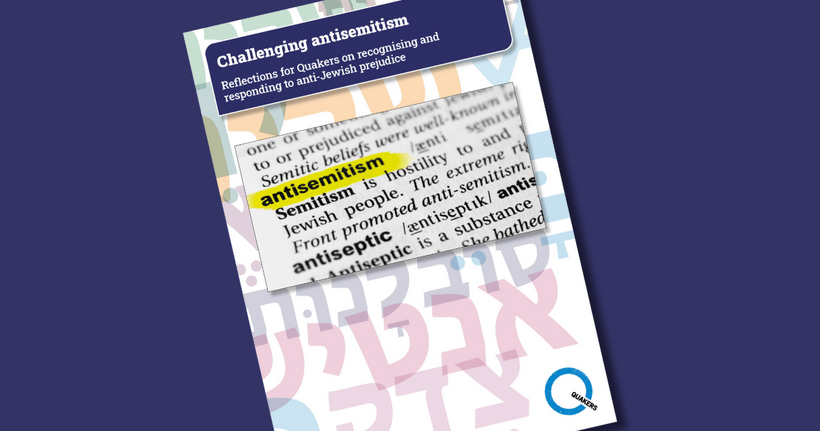
Editor: Since the publication of ‘Challenging Antisemitism’ by Quakers in Britain and the response to it by Priscilla Alderson, a QSS member, there has been an extensive debate, either in website comments, comments in the Friend magazine, or comments on social media. This post shows how the debate evolved in February and March. None of the contributors, it should be stressed, represents QSS. Within QSS there is a division of opinion. Some believe the document is inadequate by virtue of its inaccuracy and bias. Some believe it should not have been issued without an accompanying document on Islamophobia. Some believe ‘Challenging Antisemitism’ should never have been issued at all: since the 1970s ‘antisemitism’ has been politically weaponised against the critics of Israel, including many Jewish critics of Israel, and the term has therefore lost its original meaning.
Gareth Dale (19 March 2026). Comment sent to QSS website:
“It is staggering that Quakers are disseminating a pro-Zionist pamphlet during Israel’s genocide against the Palestinians, and that it does not mention that genocide once. Even worse: in the ‘recommended reading’ section ALL the recommended books and pamphlets are written by Zionists. (And they all – literally all of them – were leading voices in the witch-hunt against the Labour left during Corbyn’s tenure as party leader.) It is appalling, too, that five of the six Quaker MPs refused to vote in the Commons against Israel’s genocide. Without any serious rebuke from the Society of Friends. Does the British Society of Friends wish to be seen as complicit in genocide? Certainly its most prominent figures are.”
Nicola Grove (March 2026): This is a short version of an in-depth analysis of ‘Challenging Antisemitism’, sent to Oliver Robertson by Nicola Grove, with evidence and references. It is available from QSS on request:
“I have deep concerns regarding the “Guidelines on Antisemitism” produced by Friends House. We gather that Friends have been asking for these guidelines for some time, and that they were informed by consultation with Jewish groups who use our premises. At a time when all forms of racism are on the rise, including antisemitism and Islamophobia, practical information for Quakers that reinforces our commitment to equality, the value of every human being, and to social justice, is indeed to be welcomed. Unfortunately the document is not an appropriate educational tool for a faith community committed to active peace work, to hearing and respecting and different perspectives on complex and tragic conflicts, and speaking truth to power.
By failing to take account of the many Jews in Britain and globally who do not hold zionist beliefs, and alternative traditions such as the belief that Judaism means belonging in the diaspora, and the orthodox traditions that oppose zionism, the guide fails to respect diversity or indeed to show anything more than a superficial acquaintance with Judaism.
In the Guide there is active disparagement of socialism, neglecting the vital antifascist contributions of Jewish working class socialists. There is utter failure to recognise the targeting of Jewish activists for Palestinian rights and peace in the Labour party. Ideas redolent of hasbara (Israeli propaganda) are perpetuated. The downgrading of genocides other than the Jewish holocaust (of Roma and Sinti peoples; disabled, black and LGPT people) to “victims of Nazi persecution” is shocking – I wonder if any of these communities were consulted by the writers to ask how they view this relegation of atrocities committed against their ancestors.
Finally, I regard it as antisemitic to assume that Jewish people – like other sentient, empathetic human beings – would not be horrified by the actions of the Israeli government in Palestine, with the active complicity of the US, Europe, India and shamefully the UK.
Friends who still think anti-zionism aligns with antisemitism are recommended to read this article by Robert Rosenthal, The Progressive Jew; this article on 130 years history of Jewish anti-Zionism, and watch Peter Beinart’s webinar on what it means to be Jewish in the face of genocide.”
Denise Cullington (March 2026): letter to Quake Editors, Oliver Robertson and BYM in general:
“I was pleased and interested to see your recently published guide – and then dismayed. Clearly anti-semitism is an important and contentious topic, and differentiating what is that and what is legitimate disagreement with Israeli politics over the last 2 1/2 years is essential. Sometimes confusion is just that, but it can also be used as a political tool – and I think this is likely what has happened in this case. (Sometimes the action is more direct, like UK Lawyers for Israel threatening to take charitable Institutions to court if they make any public reference to the impact of genocide, as happened to my Institution in the area of child and mental health).
In line with all our impressive history of speaking truth to power, Quakers last year came out admirably and called what was happening in Gaza ‘genocide’. This new document in contrast, is unclear and unhelpful. Can I offer you three examples?:
The IHRA v the Jerusalem Declaration on anti-semitism: Your doc describes how “some have explained that the Jerusalem Declaration is used mainly by politically left-wing groups and that many Jews will immediately suspect a document which promotes it….(and add) we’re here informing readers about them rather than endorsing any particular definition – but in fact the Jerusalem Declaration was developed by a group of scholars in Holocaust history, Jewish studies and Middle East studies and has over 370 signatories in that field ‘to strengthen the fight against anti-semitism by clarifying what it is, and how it is manifested (and ) to protect a space for an open debate about the vexed question of the future of Israel/Palestine’. Your explanation invites readers to distrust a highly regarded document, dismissed only by an undocumented “some”.
The Jewish Lobby: in fact the IHRA and the Jerusalem both state the ‘myth’ or the ‘grossly exaggerated…fantasy’ of a Lobby is anti-semitic. I am not sure how phantasmagorical the idea of the Lobby needs to be, but certainly (as you state) there are many powerful well-funded and presumably inter-connected lobbies, run over 70 or more years and documented by Ilan Pappe among others, funding and pushing politicians in the UK and the US (and presumably elsewhere) to support pro-Israeli positions in the defence and intelligence industry and in the media. And we are finding out more as the Epstein scandal continues to unravel. That is fact, not anti-semitism. Your guidance is obfuscating.
The need for a Jewish homeland: ‘having a nation in their ancestral homeland deeply matters to many Jews, a place where they can feel safe from the antisemitism and persecution felt and experienced in the rest of the world’ is fair enough, but you ignore what the Jerusalem Document points out, the native Palestinians: they say ‘it is not anti-semitic to support arrangements that accord full equality to all inhabitants “between the river and the sea” … in whatever form’. Your document does not mention them, nor the historical context and history of the violence.
I do hope that you will welcome feedback and agree the need for more threshing before hopefully putting out a revised version – and one that is authored and acknowledges your sources. Thanks for all that you are doing. I do hope this important discussion can be continued.
And lastly, separately, I read a most impressive piece over the weekend by Avraham Burg a former speaker of the Knesset, which is a thoroughly muscular argument for why peace not war.”
https://observer.co.uk/news/opinion-and-ideas/article/i-wont-remain-silent-on-this-cynical-war
Mike Beranek (March 2026): letter to Oliver Robertson, Head of Witness & Worship, Quakers in Britain:
“Although I write in a personal capacity, I must state that I have not restrained myself from mentioning to local Friends my profound objection to the document currently being circulated by Quakers in Britain – ‘challenging anti-Semitism’
I believe it represents one of the most maladroit, untimely, and reactionary publications I have ever seen from Quakers, and I have encountered several problematic positions held by BYM in the past, in particular, above even major misunderstandings around the proxy war against the people of Russia and of Russian ethnicity by US/NATO and the UK/EU.
This document – challenging anti-Semitism – amounts to an apology for Zionism. Though it may not state this in so many words, it tends toward what is known as ‘Jewish exceptionalism’—the suggestion that the experience of Jewish people in the Holocaust (term only allowed for the Jews) and all ongoing discrimination is of a unique nature that cannot be compared to any other crimes against humanity, neglecting to credit for instance the mass murder of Roma, Slavs, communists, Hungarians, the disabled and people of all ethnicities during the Nazi regime last century, or indeed, to the wide variety of other peoples around the world now faced with ongoing genocide – not to mention the around 70,000 indigenous people already killed in Gaza by the Zionist entity of Israel.
It now seems especially untimely considering now that we have the attack by the Zionist entity on the people of Iran, largely on millions of Shia Muslims which was kicked off by the murder of of around 100 school children this week. The subtext of this document represents a tendency to suppress valid criticism and opposition to the racism and militarism of the state of Israel by utilizing this position of Jewish exceptionalism, and one has to wonder what kind of ‘advice’ and resources (propaganda) were used in constructing this document.
This position also reminds me of the tactics used by the ‘Labour Together’ faction within the Labour Party, which effectively destroyed a genuine popular Labour movement headed by Jeremy Corbyn — a charge of anti-Semitism being a convenient way of suppressing valid debate about all kinds of racism and militarism, in particular, opposition to the Islamophobia that remains endemic in British society.
I am sorry, but it is very hard to find anything positive about this document, and I cannot recommend that it be given much weight in our local meeting. I am suggesting to any Friend who really wishes to understand and discern the nature of the issues in this report that they look at the work on this, the response to this, by the Quaker Socialist Society.
In this critique of this BYM publication, Priscilla Alderson argues that the document’s attempt to address the issue is deeply flawed and unbalanced. She contends that the report promotes “Jewish exceptionalism,” relies on anonymous authorship, and obscures the distinction between anti-Zionism and antisemitism by implicitly adopting a framework that labels criticism of Israeli state policies as inherently biased. Furthermore, Alderson highlights the report’s failure to include Palestinian voices or incorporate critical historical contexts regarding the occupation, suggesting instead that the guidelines prioritize a form of “neutrality” that ignores power imbalances and effectively silences dissent. Ultimately, she calls for a comprehensive revision that engages a more diverse range of Jewish and Palestinian perspectives to better reflect the realities of the ongoing conflict. (Gemini summary)
If this document is to be properly discussed, I believe these kinds of criticisms need to be aired for Quaker discernment, and I am not getting the feeling that this is currently being done.
I would be grateful to hear your feedback on these concerns.”
Ol Rappaport (Friend, 2026 Feb 27):
“I have read the Quaker Socialist Society’s criticism** of the new ‘Challenging antisemitism’ guide. But it misrepresents the booklet, and judges it against expectations it never claimed to meet.
The booklet is a short, practical guide for Quakers in Britain, focused on recognising and responding to antisemitism in a UK context. Its concision is a strength. A longer, more theoretical document would be read by far fewer readers and achieve much less.
It does not ask to be accepted uncritically, nor does it deny other forms of racism or create a hierarchy of oppression. It simply addresses antisemitism in its own right, recognising that different prejudices have different histories and dynamics.
Much of the criticism centres on the booklet’s treatment of Israel and Zionism. In my reading, the booklet is careful and explicit that criticism of Israel is not automatically antisemitic, while also insisting that context matters. This is not about silencing debate, but about ethical attentiveness.
The criticism appears uncomfortable with the idea that antisemitism can be unconscious, particularly among those committed to justice, but being a Quaker or a socialist offers no exemption from unconscious prejudice.
I write as a Quaker and a practising Jew. From that position, I believe the booklet handles a complex and sensitive subject with care and restraint, aiming at understanding rather than enforcement.
Quakers addressing antisemitism seriously in our own communities are not prevented from opposing other injustices. These commitments belong together, working together.”
[**Editor: Ol has misunderstood. Articles on the QSS website are always signed by the author. They do not represent the policy of QSS. Priscilla Alderson’s article no more represented the views of QSS than Ol’s article represented the views of the Friend.]
Priscilla Alderson (Friend, 27 Feb 2026)
“The recent Britain Yearly Meeting guide on challenging antisemitism is welcome for addressing this tragic problem. Antisemitism as hostility or violence towards Jews involves cruelties that every Quaker abhors.
Many Jews say it is vital to contrast antisemitism with anti-Zionism, when military and colonial forms of Zionism can increase antisemitism by bringing all Jews into disrepute however unfairly. These Jews stand for rights and justice for Jewish people everywhere, and against wrongs and injustice to Palestinians and oppressed peoples anywhere. The new report appears to support Zionism by defining it solely in positive terms: ‘the national liberation movement of the Jewish people’, ‘a religious/spiritual concept about reviving a profound Biblical ideal of a homeland grounded in justice and peace’.
This seems to contradict Yearly Meeting Minute 30. Can further discussion be had? We hope Friends will read the response to the report on the Quaker Socialist Society website.”
Ol Rappaport (Friend, 2026 Feb 21):
“Nicola Grove’s response misses a central point of my article: my concern was not primarily political but theological. I apologise if I didn’t make this clearer.
For the record, I did not deny other genocides, nor label particular responses sentimental; my concern was with how Holocaust memory is used. The Holocaust nonetheless remains historically distinctive in its industrialised, bureaucratic machinery of extermination.
It confronts faith traditions with the brutal challenge that human beings systematically murdered others not for what they had done, but for who they were — a slaughter carried out by people in whom Quakers nonetheless affirm “that of God”. The brutality of the Holocaust, and of other genocides, forces me to ask how such language survives contact with history, or how it must be deepened to remain truthful.
This was the question I sought to raise. Other lessons may indeed follow, but they cannot replace the prior work of facing this moral and theological crisis itself. The disturbing truth is that ordinary people, often formed by religious or moral frameworks, can participate in annihilation while believing themselves justified.
Recognising this does not diminish compassion for present suffering. But if remembrance is to be more than symbolic, it must first confront us with the theological and moral chasm such events represent.”
Nicola Grove (Friend, 2026 Feb 20):
“I consider Ol Rappaport’s argument confused in his reply (13 February) to my letter (6 February). I also find his use of the term ‘sentimental’ as borderline offensive in the circumstances, and his claims misleading: we do in fact have closely documented evidence of other genocides.
My letter points out precisely what Ol claims is the message of the Holocaust for us all: ‘ordinary religious people participate in atrocities whilst maintaining a sense of moral righteousness’. If we cannot apply this truth to contemporary conflicts, I fail to see how it can have any force at all. It is sad to see the implication that the work of the Etty Hillesum Trust, and an account of the terrible murder of Hind Rajab and her family, dismissed as ‘sentimental’. The Jewish historian Nira Yuval-Davis describes a tension in Judaism between exceptionalism and universalism in relation to the Holocaust, which interested Friends can read (www.jewishvoiceforlabour.org.uk/article/against-jewish-exceptionalism>). It is clear to me which of these two positions accords with our Quaker testimonies.”
Roger Bartlett (Friend, 2026 Feb 16):
“Ol Rappoport (today) wishes to cast the Holocaust as a uniquely clear case of genocidal evil. I have some sympathy with that view, but not if it precludes reflection on other equally clear cases which pose his question just as much as the Nazi project. He says: “The Holocaust was an ideologically-driven, continent-wide project to eliminate an entire people.” Replace ‘continent’ with ‘from the river to the sea’ and you have B. Smotrich. He continues: “Holocaust remembrance exists precisely because it confronts us with an enduring and unsettling truth: that ordinary, often religious, people can participate in atrocities while maintaining a sense of moral righteousness.” Netanyahu? Certainly members of the IDF. And other genocidal atrocities pose the same question. Placing the Holocaust at the head of a list is not “instrumentalising Jewish trauma” or “collapsing history”. It is to say that the Nazi project is the most egregious example of a much wider and tragic human problem.”
Ol Rappaport (Friend, 2026 Feb 13):
“Nicola Grove’s response (Letters, 6 February) to my article ( ‘A human project’, 23 January) expresses sincere compassion for Palestinian suffering. But it misses the purpose of my article, and raises a serious concern about historical and theological clarity.
My article addressed how faith traditions confront the Holocaust as a uniquely-documented example of intimate, human-to-human evil: neighbours murdering neighbours, parents and children betrayed by those around them, and ordinary people participating in systematic extermination. The question I raised was theological: how belief survives, and must change, when confronted with humanity’s capacity for such acts.
Introducing Gaza as a direct parallel to the Holocaust risks obscuring, rather than illuminating, that moral challenge. The Holocaust was an ideologically-driven, continent-wide project to eliminate an entire people. Drawing equivalence between this and a contemporary conflict, however tragic and deadly, flattens crucial historical distinctions and risks turning Holocaust remembrance into a rhetorical device within present-day political debate.
Recognising this distinction does not diminish Palestinian suffering. Compassion is not a finite resource, and moral seriousness requires us to acknowledge all human suffering honestly. But using Holocaust memory primarily to frame modern political conflicts risks instrumentalising Jewish trauma rather than learning from it.
Holocaust remembrance exists precisely because it confronts us with an enduring and unsettling truth: that ordinary, often religious, people can participate in atrocities while maintaining a sense of moral righteousness. If theology or public reflection turns away from that challenge, it risks becoming sentimental rather than truthful.
‘Never again’ demands not comparisons that collapse history, but honest engagement with the human capacity for evil that the Holocaust so starkly revealed.”
Ken Cohen (Friend, 2026 Feb 06):
“As a Jew, I particularly welcome the new guide on recognising and challenging antisemitism (see ‘Challenging antisemitism’, 23 January). The range of references and resources in the text was truly impressive. But I was disappointed that the authors failed to give a mention to the important work being done by the Birkbeck Institute for the Study of Antisemitism, part of the University of London, one of only two university centres in the whole of Europe dedicated to understanding this phenomenon.”
David Wright (Friend, 2026 Feb 06):
“The dire situation in Gaza has understandably angered many Quakers, and their condemnation of the Israeli government has in turn attracted condemnation as being antisemitic. This raises a serious question as to what is the appropriate Quaker response to such egregious oppression and violence against fellow human beings.
It’s particularly challenging when religion is invoked to justify violence, as in the crusades, and the ‘troubles’ in Northern Ireland. To the extent that the Israeli government relies on religious text to justify its actions, it is bringing Judaism into disrepute. So who is being antisemitic?”
Nicola Grove (Friend, 2026 Feb 06): in response to an article by Ol Rappaport in the Friend.
“Ol Rappaport (‘A human project’, Friend, 23 January) presented us with a detailed, harrowing and immensely moving set of personal stories to commemorate Holocaust Memorial Day on 27 January. As he rightly reminds us, these atrocities were not carried out from a distance, but by human beings on other human beings: close, personal encounters that happened in many different countries – by neighbours, by mothers, by fathers, sons and brothers who had come to see their fellow citizens, from babies to elders, as vermin to be exterminated.
On that same day, Etty Hillesum Cards began broadcasting its third vigil, naming the names of 18,454 children killed in Gaza since 7 October 2023. The readings by 370 people take more than two-and-a-half days to read and commemorate what one Jewish reader described as ‘the Holocaust of another nation’. We cannot forget that 29 January is the third anniversary of the up-close-and-personal murder of six-year-old Hind Rajab as she waited for rescue by paramedics in a car filled with the dead bodies of her family. You can listen to the six hours of her desperate phone call on YouTube.
On social media, someone describing themselves as a Quaker Friend of Israel posted that Hind’s family were to blame for ignoring IDF instructions. But the reality was that they desperately attempted to do as they were told, but ran into a murderous road block. This is only one of the thousands of atrocities carried out against the Palestinian people, which parallel those that Ol so vividly describes. Never again means never again for all peoples.”
Note: To see previous comments, click on the number in bold below.
 Quaker Socialist Society
Leave a Reply