Quaker Socialists Reject Loyal Address

by Ruth Kettle-Frisby.

This article in the Friend (below) by reporter, Rebecca Hardy, records that two Quaker groups were opposed to delivering a ‘Loyal Address’ to the new king: 1) Young Friends; 2) The Quaker Socialist Society. Beneath the article is a statement agreed by the QSS on March 05 and sent to the Friend in the form of a letter written on behalf of the Quaker Socialist Committee by Ruth Kettle-Frisby.

The QSS arrived at their opposition after a thorough debate on the Committee in which the historic links to Charles II in the 17th century were acknowledged – he was indeed supportive of Quakers and saved them from being executed – but it was nonetheless felt that Quakers should no longer be doing a Loyal Address in 2023, when the historical circumstances were quite different. It was also acknowledged that some Quaker bodies felt that meeting the King was a good way of getting publicity for issues such as racism and homophobia but, again, the QSS Committee disagreed. They did not feel it right for Quakers, with their commitment to equality, to be countenancing the social privileges of royalty.

The Friend, 16 Mar 2023, by Rebecca Hardy

– Quaker Leasa Lambert addresses the king (Ian Jones) –

The Religious Society of Friends is one of just twenty-seven ‘privileged bodies’ which retain the historic right to present an address to the British sovereign in person.

Quakers from Britain and Ireland visited Buckingham Palace last week after being invited to offer a ‘Loyal Address’ – a historic entitlement to address the monarch.

On 9 March, Quakers thanked the king for speaking out on the environment, emphasising that a just solution to the climate crisis requires disrupting existing economic systems. Read by Leasa Lambert, of the Black, Brown & People of Colour Quaker Fellowship, the address observed that Quaker communities welcome trans and gender – diverse people.

Noting the Quaker commitment to make reparations for past involvement in slavery, the address said there is a moral imperative on us all to repair the harm done.

It also, as with so many Loyal Addresses over the centuries, reiterated the Quaker Peace Testimony. ‘We may think wars end through force of arms or negotiation, but peace is maintained by building relationships, mutual dependency and shared prosperity.’ 

As happened at the last Loyal Address, the delegate, this time Leasa Lambert, nodded, rather than bowing or curtseying.  

The delegation included Adwoa Burnley, clerk of Yearly Meeting (YM); Fred Langridge, first assistant clerk of YM; Teresa Parker, engagement and faith in action lead for BYM; Robert Card, clerk of Meeting for Sufferings; Pleasaunce Perry, a representative of Ireland Yearly Meeting; Katherine Stephenson, a representative of Ireland Yearly Meeting; Angela Stather, a representative of General Meeting for Scotland; Erica Thomas, a representative of Crynwyr Cymru – Quakers in Wales; Yvonne Estop, a representative of Quaker Rainbow; and three representatives of the Black, Brown & People of Colour Quaker Fellowship: Leasa Lambert, Marghuerita Remi-Judah, and Elinor Kershaw. 

The Religious Society of Friends is one of just twenty-seven ‘privileged bodies’ which retain the historic right to present an address to the British sovereign in person. Nowadays this right is restricted to significant occasions in the life of the monarch.

The last time Quakers made an address was in 2012, when Elizabeth Windsor celebrated her Diamond Jubilee. The first was in the late seventeenth century.

Britain Yearly Meeting (BYM) acknowledged that ‘the Quaker relationship with being identified as a privileged body is a difficult one, along with the idea of making a “Loyal Address” to the monarch. Quakers uphold a testimony to equality, which is at odds with hereditary monarchy. But the address offers a rare chance to catch the ear of power.’

Writing on the Quakers in Britain website, BYM noted that ‘through the centuries the attitude has varied from ingratiating to formal. In 1872, a Birmingham Quaker pointed out there were Quakers “who consider a republic the better model”.’

Paul Parker, recording clerk for BYM, said: ‘Margaret Fell addressed Charles II in 1660 saying, “We are a people that follow after those things that make for peace, love and unity; it is our desire that others’ feet may walk in the same.”

‘For others to “walk in the same”, we must talk to them, and in that spirit, we chose to accept the invitation in order to raise issues of concern to Quakers today.’

Some Friends did not agree that Quakers should be taking part in the address to the monarchy. These included Young Friends General Meeting which was invited but declined to take part, responding ‘that participating legitimises an institution at odds with Quaker values, that making a “loyal” address would not be truthful, and that our presence would be tokenistic rather than following the movement of the Spirit’.

The Quaker Socialist Society also spoke out against the address: ‘We believe it to be appropriate to make a clear stand in rejection of the monarchy. We don’t need this relic, and we shouldn’t be validating its existence in any way.’

‘History is useful for remembering and strengthening our core values. On the other hand; love, truth and justice require us to approach it with caution. When Quakers first started making “loyal addresses” the dynamics were different; the monarchy held and wielded power in different ways to now, and inevitably – with lives at stake – early Quakers wanted their influence to be instrumental for the common good.’

The statement suggests that the king’s power and extreme wealth ‘rests on a deeply troubling history of his predecessors’, and the British monarchy ‘today upholds a history of imperialism and colonialism (which caused climate change)’. Highlighting recent claims of racism by Harry and Meghan, and criticising the king for spending ‘phenomenal amounts of taxpayer money on his coronation during a cost of living crisis’, the statement says: ‘living our faith requires us to be part of movements in place that support social equity’ and ‘see past the entitled practices’.

The Full Statement on behalf of the QSS Committee by Ruth Kettle-Frisby

“In Friendship, please find our statement, which arose in the form of ministry, below:

On 9 March, a Quaker delegation will go to Buckingham Palace to present a ‘loyal address’ to Charles Windsor. As Quaker Socialists, we believe it to be appropriate to make a clear stand in rejection of the monarchy. We don’t need this relic, and we shouldn’t be validating its existence in any way.

History is useful for remembering and strengthening our core values. On the other hand; love, truth and justice require us to approach it with caution. When Quakers first started making ‘loyal addresses’ the dynamics were different; the monarchy held and wielded power in different ways to now, and inevitably – with lives at stake – early Quakers wanted their influence to be instrumental for the common good. 

It seems to us that Charles Windsor’s power rests on a deeply troubling history of his predecessors, his extreme wealth, and traditions that elevate his status beyond what can reasonably be suggested of any of us.

The British monarchy today upholds a history of imperialism and colonialism (which caused climate change); Charles is the Head of the Church of England (with its brutal history and current unacceptably slow social progress); and we must take seriously recent claims about the Firm made by Harry and Meghan about racism. 

I’d argue that living our faith requires us to be part of movements in place that support social equity; to see past the entitled practices that help to maintain the establishment, and ultimately to reject social institutions that cause harm according to progressive Quaker principles.

Charles is spending phenomenal amounts of tax payer money on his coronation during a cost of living crisis. In today’s climate our efforts for social change are best spent supporting social movements for change that do not involve colluding in any avoidable way with the monarchy.” 

Ruth Kettle-Frisby

Leave a comment

Slavery and the Holocaust

by Joyce Trotman.

A Letter to Canon Hawkey from Joyce Trotman

To Rev. Canon James Hawkey, Westminster Abbey, 20 Dean`s Yard, London, SW1P 3PA

Dear Canon Hawkey,

                             A Meditation marking this season of Holocaust Memorial

At the Church-of-England Grammar School I attended in British Guiana,

now Guyana, during the 1940`s, the girl who sat next to me in class was a white 

girl whose name was Judith Faerman. Until I met her I thought that all white

people were English of Scottish like the Headmistress and members of staff

 of the school, or like the pastor of the Congregational church I attended. Her 

name was Judith Faerman and she told me that she had come from Romania,

a country that at that time I did not know existed. When she did not return to

school after one holiday, I asked for her, (I missed her), I was told that the 

family had emigrated to a country in South America. I was about twelve or

thirteen years old. It was a long afterwards,  that I realised that she was Jewish

and that  Romania was a country in Europe, and that maybe, her presence in 

the country  and subsequent departure must have had something to do with  

Hitler and  “his final solution for Jews”.

During my adult years when I first met my friends Joyce and Irving Adler, 

now deceased, their surnames meant nothing to me, until I discoveed that they 

had been victims of McCarthyism. They too were Jews. When the first candle

was lit  I was reminded of Judith  and Joyce and Irving.

The following Meditation speaks for itself.

Do forgive me if I have imposed on your time. I am just sharing.

Best wishes.

Yours sincerely, Joyce Trotman

Lest We Forget: A meditation marking this season of Holocaust Memorial by Joyce Trotma                        

Part One

That person would be severely lacking in empathy who was not moved spiritually by the Meditation  marking the season of  Holocaust  Memorial to mark the atrocities of the Nazis and  other genocides: European Jews, Armenians, people of Rwanda, Srebrenica, Uyghur Muslims in China, and LGBT victims of the Holocaust. The candle lightings were interspersed with prayers and readings and the address was given by Rev Canon James  Hawkey, Theologian of  Westminster Abbey. 

But as I listened I recognised  the fact that the prayers, readings and the music were all important elements of the Meditation, yet I had the feeling that something was missing. It is a  paradox that the  British Government was not in any way responsible for the atrocities meted out to the  people for whom the candles were lit. It generously made it possible for a Sunday Morning  Meditation, which marked the genocides committed in the 20th and the  21st centuries by  other governments. What was missing was  the  marking of the “genocides” committed by  successive British governments for  three centuries, from the 16th  to the 19th centuries, as part of this Meditation.

The Rev. Canon James Hawkey opened his address by mentioning Belsen, Auschwitz, Srebrenica. I added  Barbados, British Guiana, Jamaica, Trinidad, St Lucia, and  other  islands of the Caribbean as  the countries connected with this form of British “genocide”.

 In my  imagination I lit the seventh  candle first, for our African ancestors who for three centuries suffered and died as a result of the dehumanising effects of the British slave trade and the special system of chattel slavery, in which white human beings including members of both Church an State, converted black human beings into beasts of burden and in some cases branded them like cattle to express that ownership; next, for those who survived to be further exploited as “children” of the Empire; and,  lastly, for their  present day descendants- the Windrush generation.

It is my hope that  a seventh candle be lit for them at any future observance of  Holocaust Memorial Day.

Lest we forget. 

Part Two

“Come to Meeting for Worship with heart and mind  prepared” says number 9 of our Advices and Queries, and I often look upon the Sunday Worship on BBC 4 as my preparation. Thus it was that when I joined my fellow Quakers for our Meeting for Worship the solemnity and sacredness of this meditation occupied my thoughts as I centred down into the silence of our worship, conscious of the reminder that we “enter with reverence into communion with God and respond to the promptings of the Holy Spirit”. As often happens when the Holy Spirit is at work among us and guiding us, a Friend in the Meeting with thoughts of the Meditation that she too had listened to, read number 32 of our Advices and  Queries as her response to what she had heard. I quote:

                       Bring into God`s light those emotions, attitudes and  prejudices in yourself which lie at the root of destructive conflict, acknowledging your need for forgiveness and grace. In what ways are you involved in the work of reconciliation between individuals, group and nations?

            After the reading I remembered a very sincere, soulful ministry that touched my heart. 

At another Quaker Meeting for Worship that I was visiting a young man earnestly spoke, “If, as we say, there is that of God in every person, nobody gets hurt.” I concluded that if we really kept  this in  mind and acted accordingly, nobody would get hurt and everybody would be loved as God loves us.

    “Beloved let us love one another: for love is of God.” The Holy Bible: New Testament. John 4:7

 I look forward to the lighting of the seventh candle.  

Lest we Forget.

– Joyce Trotman (of Croydon Quaker Meeting, London)

Leave a comment

Celebrating the Salter Centenary 2022

by Sheila Taylor (Salter Centenary Co-ordinator).

When 2022 was approaching, we wanted to mark the centenary of Ada Salter becoming Mayor of Bermondsey and Alfred being elected MP. The Salters’ political activism was always rooted in Quaker principles and the ethical socialism of the old ILP (Independent Labour Party). So we envisaged perhaps a conference with political speakers? In fact, nothing like that has happened! Instead, there has been a stream of cultural events throughout the year, with all sorts of people volunteering to arrange all sorts of activities in memory of Ada and Alfred. 

How visionary the Salters were – on environment, housing and public health – has become increasingly evident as our world faces climate crisis, worldwide homelessness and global pandemic. Their insights resonated with everyone we spoke to, and people were inspired to do something which would in some way help spread the values and principles of the Salters. 

So there have been walks and bike rides, concerts and art exhibitions, films and plays, planting of trees and hedges, school lessons and children’s books, a street mural, tea towels, a podcast, etc. Virtually every month there has been something, and this article gives a brief overview.  (For details: www.saltercentenary.org.uk.)

The Salter story for children
We foundthere was no teaching material to tell thestory of Ada, Alfred and Joyce to youngsters growing up in the area, despite its fascination and relevance.So Karen Metcalf and Sarah Mason produced a set of school lessons, freely available on the internet, encouraging teachers to take their classes to see the Salter statues and learn about their local history.
For pre-school children, Sue and Peter Rogers have written an utterly charming little book, ‘Ada and Alfred’, also available free of charge.

Bike rides
were definitely the most unexpected aspect of the centenary year! Bruce Lynn of Southwark Cyclists proposed the ‘Salter sites of Bermondsey’ as a new Saturday morning ride. It was great fun, with Bruce leading the cyclists to each stop where I told them about the Salter story. That took place in June, but had a spin-off in October when one of the participants, John Clements, organised a repeat tour for his Dulwich U3A Bike Group.
Meanwhile in August Andy Bates set up a far more ambitious ride: to Fairby Grange in Kent. The London Clarion Cycling Club assembled at Southwark Park and rode to the Salter cottages and statues for introductory talks, before being waved off on their strenuous ride. (An easier visit, by coach, took place in July. See article on page ////.)

Ada’s birthday concert
To honour Ada suitably requires performers who share her ethos. Eleanor Thorn of TunedIn London found the perfect pair: celebrated singer-songwriters Silvia Balducci and Adam Beattie, and they together created a moving celebration in the packed City Hope Church. Silvia sang of working conditions and human rights, drawing parallels with the Salters’ Bermondsey, and Adam’s performance culminated with his amazingly appropriate ‘Song of One Hundred Years’, making adeeply emotional impact on the audience.

Our Local History Society
featured the centenary at two meetings. In July members joined Salter themed walks led by tour guides Oonagh Gay and Sue McCarthy. Then in September we enjoyed a talk by Southwark Archivist Patricia Dark, on living conditions and health in inter-war Bermondsey, including the medical innovations of Dr Salter and his colleagues. 

Art exhibition: ‘The Spirit of the Salters Lives On’ (10 September – 9 October)
Southwark Park Art Gallery named their designated community room the ‘Salter Space’, and invited us to curate its first exhibition. Contributions flowed in. Local artist Nigel Moyce painted the first ever portraits of the Salters. Eugene Ankomah, artist at the Salmon Youth Centre, told young people about the Salters and they created a collaborative installation. Leanne Werner took photos of environmentalists. Karin Wach included her trauma sketches as a testimony to pacifism. Over the month, the gallery had 747 visitors.
(The exhibition handout is on our website.) 

Town partnership
Friendship has grown between Ada’s two homes: Raunds, the country town where she was born and Bermondsey, where she spent most of her life. We had exchanged visits twice, in 2016 and 2018. For 2022 we invited the Mayor of Raunds, their Brass Band and other residents to join us for celebrations. Sadly two days before the event the Queen died, civic dignitaries were withdrawn from all official duties and the council banned our concert (no jolly music in public places, please). Fortunately the rest of the programme went ahead as planned and everybody had a lovely day. 

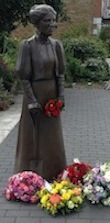
Alfred’s great-niece Jo Crawshaw and husband Sebastian were with us to greet the Raunds group, which included Amanda Mauro and husband Andy Farrow, current owners of Ada’s Thorpe House. Following a reception by Canon Gary Jenkins at St James’s Church, we walked via the Wilson Grove estate, with a glimpse inside one of Ada’s garden cottages, to the Salter statues on the riverfront.

After a buffet lunch at Cherry Garden Hall, the afternoon was spent in Southwark Park. Gary Magold and Pat Kingwell told us some park history, and we welcomed the installation of a new (historically accurate) information board in the Ada Salter Garden. At the Lakeside Art Gallery we had tea and cakes with a private view of our Salter exhibition. A walk then took us to Sands Film Studios for an early evening performance of ‘Red Flag Over Bermondsey’, Lynn Morris’s striking play depicting Ada’s early years in Bermondsey.  

We were delighted that the Town Partnership was thus strengthened during the centenary year. Both sides hope to continue the happy link in future. 

School film ‘Ada’
On 3 November 2022 a headline in Southwark News announced: ‘Bermondsey school kids star in film about Salter family to mark centenary celebrations of historic couple’. The report explained how Joyce attended school on the site where Compass School stands today, and this fact sparked off the idea of making a film. Ben May, Head of Drama, said, ‘The film captures the legacy of Ada Salter through the eyes of her daughter, Joyce, as she travels through time witnessing the changing landscape of Bermondsey…. our film celebrates the extraordinary vision and legacy of Ada.’ 

The Principal, Marcus Huntley, said, ‘The school is incredibly proud to play its part in the Salter Centenary celebrations. We are committed to ensuring the Salter legacy continues through our history curriculum… including our new Ada Salter-inspired Chess Club…’. Southwark News quoted my reaction: ‘I never dreamt that the sadness of Joyce’s death could inspire such a beautiful little film. To see her come alive and play with kids who would have been her classmates at Keeton’s Road School brought tears to my eyes!’ (See it on YouTube: youtu.be/CkqytP80wZQ)

What a joy it is to have as patron Dame Judi Dench, a Quaker and environmentalist like the Salters. After hearing of our exhibition, she wrote to the artists with congratulations and thanks for participating. Nigel, Eugene and the young people at the Salmon Centre were amazed and so thrilled to receive personal letters signed by Judi! 

In November Southwark Council are displaying Nigel’s portraits of Ada and Alfred in the atrium of the council offices at Tooley Street to mark their November 1922 elections. Then the centenary celebrations slip over into next year and culminate with a grand finale, when the People’s Company perform John Whelan’s specially written Ada Festival play at Southwark Playhouse on 12, 13 & 14 January 2023.

Throughout the year I kept remembering how historians described the Independent Labour Party, the Salters’ old ILP. It was less of a political party than a way of life, they said: full of fun and fellowship, kindliness, good humour, equality, beauty, peacefulness, human unity, cooperation. During 2022 I had an extraordinary sense that this spirit had come alive again and was moving people in a way that the Salters would have recognised and loved.

For full details, see website: www.saltercentenary.org.uk

Leave a comment

Ada Salter Tea Towels

by Sheila Taylor.

Announcing an exciting Salter Centenary tea towel! This year Ada has joined the prestigious collection on offer from the Radical Tea Towel Company.


Buy online for £6.75, plus VAT & postage.

With the kind permission of Paul Butler, the Radical Tea Towel Company has taken Ada’s image from the centre of his 2022 mural for Bermondsey and added some of her remarkable achievements, together with her famous saying: ‘The cultivation of beauty should be considered a civic duty’.

A thought-provoking addition to every kitchen!

Leave a comment

Salter Centenary – A new website has been launched

by Graham Taylor.

Organisers of the Salter Centenary Project have launched a new website to highlight a year-long series of events throughout 2022 celebrating Quaker Socialists and ILPers Ada and Alfred Salter.

The project marks the 100th anniversary of the Salters’ dramatic electoral breakthroughs. Ada became Mayor of Bermondsey – the first woman mayor in London – and Alfred MP, both in November 1922. This inaugurated the series of radical municipal reforms known as the ‘Bermondsey Revolution’.

As Quaker Socialists (though they called themselves Socialist Quakers in those days) and as members of the Independent Labour Party (ILP), they dedicated their lives to the poor of Bermondsey. They transformed the grim environment of the appalling slums, demolished them where they could, planted trees and flowers everywhere, filled open spaces with playgrounds, and built innovative council houses still beautiful today. Alfred Salter as a doctor brought free medicine to Bermondsey some decades before the National Health Service, and Ada, on the London County Council, helped introduce housing and environmental improvements (including the Green Belt) across London as a whole.

This project has attracted the support of Dame Judi Dench, a Quaker environmentalist herself, and she has agreed to be its patron. The project’s mission, according to the website, is “to revive the Salter inspiration”. Alfred was a doctor ahead of his time. Ada Salter was a ‘green before the Greens’, says the website: “She knew that contact with nature is vital for mental health. She brought trees, flowers and green space to the inner-city.”

The website aims to be a hub of information about all the Salter centenary events taking place in 2022 including a series of planting initiatives called ‘Beautifying Bermondsey’; a number of specially themed guided walks; a set of online primary school lessons about the Salters; and a new booklet reflecting on the lives and work of Ada and Alfred, to be published by the ILP.

Other events, some in co-operation with Raunds in Northamptonshire (Ada’s home town), include a tree walk, a bike ride, a birthday concert and cricket match, as well as plays, films and a drama festival.

Details of all the events can be found here.

Leave a comment

Quaker Socialist Society Newsletter (Spring 2022)

by Ian Martin (editor).

Contents

Creating Welcome to counter the hostile environment for people in detention by Anna Pincus and Pious Keku……… Page 1.

So what’s Corrymeela like then…? by David Grundy……… Page 7

QSS Book Group……… Page 10

Recognising all of who we are by Davy Marcella……… Page 11

Ada Salter Community Fund……… Page 15

Credits……… Page 16

Countering the Hostile Environment

On the evening of 22nd November 2021 fifty-one people, from all over the UK and various other parts of the world, took part in the second Salter Seminar which was held on Zoom.

The speakers were Anna Pincus, who is Director of the Gatwick Detainees Welfare Group (GDWG) and Pious Keku who is a trustee of the charity and a former detainee. The aim of the GDWG is
to improve the welfare of people being held in indefinite immigration detention in
the detention facilities near Gatwick Airport (which are run by the outsourcing company SERCO). The group offers friendship, support and also advocates for the fair treatment of detainees.

The correct name for detention centres is Immigration Removal Centres (IRCs). The Gatwick IRC can hold up to 700 people at any one time. There are ten IRCs in various parts of the UK and we were told that approximately 26,000 people are being detained nationwide. The buildings are stark and are built on the category B prison model, with razor wire surrounding them. Anna said that detainees are often traumatised by the buildings and the regime, as they are reminded of past experiences in their countries of origin. Pious Keku said that from the outside they look like warehouses and inside people are kept in small cubicles with sealed windows, so there is no fresh air. It is part of the “hostile environment” policy and Pious described being inside as “terrifying”…. 

For free copies of this Newsletter, which is sent to members regularly as part of their subscription, please contact us via the contact page on this website: http://www.quakersocialists.org.uk.

Offers of contributions to the Autumn newsletter are very welcome.

Leave a comment

The Visit by William and Catherine to the West Indies

by Joyce Trotman.

Joyce Trotman, now 94 years of age, a descendant of slaves held in Guyana, writes as the descendant of great-grandfather, Ben Conright (survivor), and great grandmother, Seebucka Trotman (daughter of survivors), and on behalf of all descendants of the British holocaust known as Chattel Slavery.

Which Government department decided that a visit by William and Catherine to the territories of the Caribbean was a good idea for the Queen`s Platinum Jubilee?

Were visas required for them to enter those territories?

Any Commonwealth member of the Caribbean would need a visa to enter the United Kingdom, once known as the Mother Country.

Were they reminded that the people they were going to visit are descendants of the survivors of three centuries of the British holocaust known as Chattel Slavery?

That the word ‘chattel’ accurately describes the particular system of British slavery in which these people’s ancestors were branded as beasts of burden: the letters DY on human beings enslaved by the then Duke of York (David Olusoga, Black and British: A Forgotten History), the letter S on those enslaved by the Society for the Propagation of the Gospel in Foreign Parts, the missionary arm of the Church of England, absentee enslaver in Barbados (Adam Hochschild, Bury the Chains, pp 62- 68).

Punishments of enslaved Africans included whipping, burning, shackling, mutilation, hanging, beating, rape, imprisonment, murder. Were the royal visitors reminded that the chief and earliest perpetrators of this crime against humanity were the royal ancestors of William, members of the royal houses of Tudor and Stuart, important members of the Church of England? And that, in exchange for granting freedom to the enslaved Africans the British enslavers were given substantial compensation for the loss of their human property?

Were they reminded of the 1831 uprising of the enslaved Africans of Jamaica (Hochschild, pp. 340) and the 1832 uprising of enslaved Africans in Demerara (Thomas Harding, White Debt), both of which were brutally put down by the British authorities? Some hanged, some shot down, some sent to England for transportation to Australia (Kenneth Joyce Robertson, The Four Pillars: A Genealogical Journey).

Were they told that the various shades of brown skin colour among Caribbean people, the fact that they have English, Irish, Welsh and Scottish surnames, that their religion is, for the most part, Christian, the Creolese and Patois languages they speak, now provide material for academic studies in university Departments of Linguistics? All this would have been essential preparation for such a visit.

I admire the zeal, sincerity and commitment that William brings to the conservation of endangered animals in Africa. He could now show that same commitment on behalf of the mixed-race (European-African) human beings of the Caribbean who under the Commonwealth Immigration Act of 1962 are deprived of the right of entry and abode in a country that was built on the labour of their black African ancestors. In addition, he could urge the perpetrators of the Windrush scandal to pay full compensation, not just apologise, to those who were subjected to this gross injustice.

Recently I wrote on this same issue to William’s father, in his capacity as Patron of the Holocaust Memorial Day Trust, quoting the words of Maria Ressa, 2021 Nobel Laureate: ‘Nothing is possible without the facts.’ I now say to William, as I said to his father: ‘Action is possible, now that the facts are known’. No more condescending diplomatic mouthings about ‘that appalling atrocity’, no more ‘profound sorrow’, etc, etc, etc! Words, words, words. 

The time to act is overdue. The patronage that his father is endowing on the descendants of the German Holocaust survivors, William could now likewise endow on the descendants of the British holocaust survivors. This would be an appropriate Thank You for the hospitality that he and Catherine enjoyed during their visit.

April 2022

Leave a comment

2022: A Centenary Year for the Quaker Socialists, Ada and Alfred Salter

by Matthew Brown (ILP).

This article is taken from the website of the ILP (Independent Labour Publications), which celebrates the history of the pre-1945 Independent Labour Party (also ILP), political home not only of Keir Hardie but also of many Quaker Socialists, including Ada and Alfred Salter.

Teas, Talks and Trees: Southwark Gets Set to Celebrate the Salters’ Centenary

The lives and achievements of ILPers and ethical socialist pioneers Ada and Alfred Salter are to be celebrated with a year-long series of events in south-east London where the Salters led their ‘Bermondsey Revolution’ in the early decades of the 20th century.

The Salter Centenary Project will mark the 100th anniversary of Alfred Salter’s election as a Labour MP in November 1922 when Ada also made history by becoming mayor of Bermondsey, making her the first woman mayor in London and the first Labour woman mayor in Britain.

The brainchild of Sheila and Graham Taylor, whose acclaimed biography of Ada Salter was published in 2016, the project has won cross-party backing from Southwark Council and is supported by the Quaker Socialist Society and the ILP, plus many other local and national organisations.

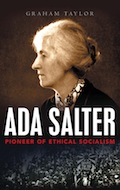
Graham’s book, Ada Salter: Pioneer of Ethical Socialism, helped to resurrect the memory of Ada and her impact on the community around her, including her ‘beautification’ of London slums with trees, flowers and music; her children’s playgrounds and model housing; and her defence of dockers and factory workers from dreadful pay and conditions. She also fought against conscription and spent a lifetime struggling for women’s equality and world peace.

Graham’s book described in detail how she worked selflessly over decades for the people of Bermondsey and London alongside her equally dedicated husband, a noted MP and innovative doctor, whose work for the poor prefigured the National Health Service.

The project’s ambitious programme kicks off on 10 January, when Graham leads a Quaker Socialist Society online discussion of his book. That will be followed by an imaginative series of events designed to remember the Salters’ remarkable legacy in putting ethical socialist ideas into practice in a local setting, while highlighting their continuing relevance today.

“Our aim is not just to celebrate what the Salters did a hundred years ago,” explains Sheila, who is coordinating the project, “but to connect their concerns with the issues of today, ones that remain highly relevant and vital, not only locally, but nationally and globally too.”

Three themes

Based around three themes of environmentalism, housing and public health – areas where the Salters’ groundbreaking ideas made a major difference to working people’s lives a century ago – the plans encompass everything from talks to walks, bike rides to theatre events, including cricket matches, picnics, pamphlets, tea parties and tree-planting initiatives.

Alfred’s birthday on Sunday 19 June will be marked by a cycle ride from Southwark to Fairby Grange, the 17th century farmhouse (now care home) run by the Salters as a plant nursery and convalescent centre for the Bermondsey poor, while Ada’s birthday on 16 July will be celebrated by an evening of women’s stand-up comedy.

Southwark Council will host a ‘civic day’ in honour of the Salters on Saturday 10 September when representatives of Ada’s hometown of Raunds will be guests of honour along with the Raunds Temperance Band and members of the town’s local history society.

Events that day  include the opening of a children’s orchard, a bandstand concert in Southwark Park, a tea party in Ada’s Wilson Grove Estate (where she built model public housing), speeches at the Salter statues on the banks of the Thames, and a performance of the play ‘Red Flag Over Bermondsey’ at Sands Film Studios.

Plans are also in train for a week-long celebration of Ada’s life at Southwark Playhouse in October, including three performances of a new drama in the 300-seat venue.

Organiser John Whelan, director of the People’s Company community theatre group, says the festival aims to “animate Ada’s life and commitment to the people of Bermondsey through a newly devised play, workshops, talks and art-based responses to this important part of our local history”.

Other activities to mark the year include 100 new street trees planted around the borough, primary school history lessons on the Salters, and a touring exhibition devised by the Southwark Local Studies Library. A new website dedicated to the Salter Centenary Project is due to be unveiled early in 2022.

[See the Independent Labour Publications website. Recommended.]

Leave a comment

The Plight of the Gatwick Detainees

by Anna Pincus.

“I didn’t know such things could happen in this country”, was one appalled reaction to watching the attached video about the ‘indefinite’ detention of Gatwick detainees. The video shows this year’s Salter Seminar, presented to the Quaker Socialist Society on Zoom at the end of November 2021 by Anna Pincus.

[This series is part of the campaign to end the practice of indefinite detention in the UK]

The title of the seminar was: “Creating welcome to counter the hostile environment for people in detention“.  Anna is Director of the Gatwick Detainees Welfare Group, a group which aims to improve the welfare and well being of people held in indefinite immigration detention at the facilities near Gatwick Airport run by SERCO. Anna’s group offers friendship and support to the detainees, some of whom are detained for years, and also tries to secure fair treatment.

This is the link:https://1drv.ms/v/s!BOzmqALjpLL-gZMCBz43zbciXcGQCA?e=qX1QO2JAxkic7rmoUO6jIA&at=9

Leave a comment

Universities and Colleges on Strike

by Laurence Hall.

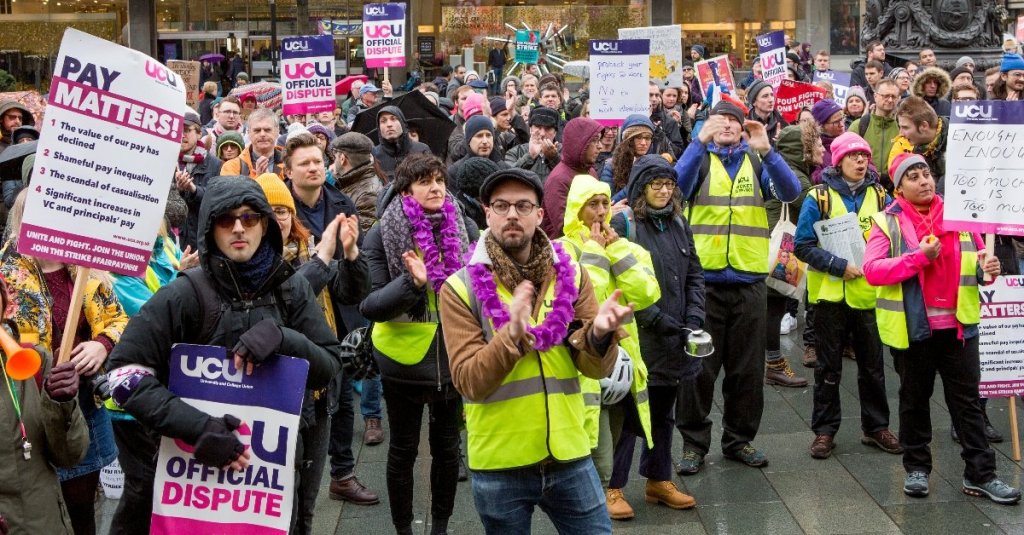
The Committee of the Quaker Socialist Society has issued this statement, prepared by Laurence Hall: “Quaker Socialists have always sought to live our faith by witnessing to and struggling against exploitation and inequality.

Insecure contracts, heavy workloads, low and decreasing pay, poor pensions and sizeable inequalities of race, gender & class that so define much of our economy are just such injustices we as Quakers are called to resist.

Our spiritual testimonies of equality, peace, simplicity and integrity demand that we stand in solidarity with one of the few British trade unions taking national sector-wide strike action against the horrors of precarious work that so badly affect their workplaces. Therefore, we the committee of the Quaker Socialist Society stand in solidarity with the members of the University & College Union in their national strike on 1st, 2nd and 3rd December 2021.

https://www.ucu.org.uk/article/11894/Following-the-action Follow all this week’s strike action and post your solidarity messages and picketline pics with #OneOfUsAllOfUs or #UCUStrikeUCU.ORG.UKFollowing the action!Live highlights on the action in higher education over pay & conditions and USS pens

Leave a comment