What does Quakerism have to do with Socialism?

by Tim Gee.

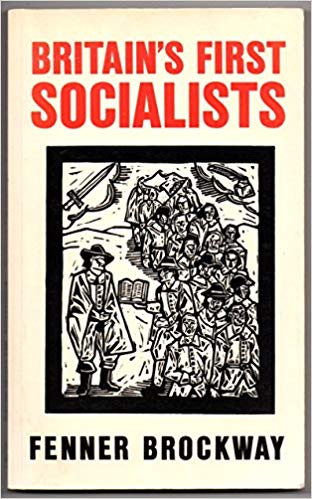
Picture: Cover of ‘Britain’s First Socialists’ by Fenner Brockway, with a foreword by Tony Benn

What does Quakerism have to do with socialism? It’s a question we get asked fairly frequently. The answer is, ‘a lot’.

The seventeenth century radical groups of the English Revolution are often referred to ‘Britain’s First Socialists’ (see picture) as well as forerunners to modern movements for human rights and environmental justice. Amongst these were the Levellers who demanded political and civil liberties to be extended beyond the landowners and the Diggers who redistributed land through direct action.

Many Levellers and Diggers, including some of their most prominent spokespeople, went on to become Quakers, who were another emergent group of the time who believed that the equality they demanded in the world should be expressed in their faith communities too. As a testament to the divine equality of all people, they met without priests, without set sermons, and – perhaps most radically for their time– with the full expectation that women or men might equally speak their truth.

These actions were seen as revolutionary and were not welcomed by the political or church establishment. Quakers were persecuted remorselessly, especially after 1660 when Britain’s brief republic came to an end. Nonetheless, the movement continued to grow.

One of the first generation to grow up as part of this new faith community was John Bellers, who elaborated a reform of society that was distinctly ’socialist’ (although the word was not used until later). Bellers devised practical measures for a national system of hospitals, a system of local ‘colledges’ where people would have education and employment, and a continental body on which each country would have proportional representation, that would ensure peace in Europe. Socialists as different as Robert Owen, Karl Marx and Eduard Bernstein all read and referenced Bellers. The modern reader might recognise in Bellers’ ideas an anticipation of the NHS, the Welfare State and the founding ideals of the European Union.

Yet for all the fervour of their first earliest years, the Quakers began to look inwards. This was in part an act of self-preservation. It was also linked to a theological shift. The group had first blossomed in the belief that the egalitarian society described by Jesus as the Kingdom of Heaven on Earth was imminent. In this state of being ‘The last would be first and the first would be last’. Yet a new order of merchant aristocrats and City financiers was now very much first, and that did not seem likely to change any time soon.    

So a period of ‘quietism’ began. If you have in your head any stereotypes about the peculiar customs of Quakers, the chances are that they stem from this time. Many Quakers wore ‘plain dress’ – typically grey so as not to be seen to be showing off. In continuity of a tradition begun by earlier Friends they addressed all in the familiar ‘thee’ and ‘thou’ rather than the formal ‘you’ in order to emphasise their commitment to equality.

The increasingly insular nature of the group also allowed for efficient community organising. The first British campaigns against slavery emerged at this time, with Quakers amongst the first groups of non-enslaved people to commit to the cause. Many of the female slavery abolitionists went on to become advocates for women’s suffrage, including Essex Quaker Anne Knight who wrote the first British pamphlet demanding the right to vote for women. 

Although no longer being imprisoned for their beliefs they were still barred from university. As a result many Quakers entered business. No longer in opposition to wealthy elites they increasingly became them, and instead of pursuing radical change channeled their efforts into less challenging philanthropy. As the industrial revolution took hold, the Quakers increasingly became separated from the working classes and their associated movements.

There were still some connections– for example a Quaker helped to finance Robert Owen’s attempt in New Lanark which modelled better conditions for workers and pioneered primary education. In Birmingham the Cadbury family built a village for their workers – a project that to some extent foreshadowed the Welfare State. In York Joseph Rowntree began funding studies into the systemic causes of poverty. Taken together though, the most prominent Quaker figures reflected a reforming wing of the wealthier classes rather then agitators for change from below. Occasionally, they were not even as enlightened as that – most notoriously at the Bryant and May match factory in Bow – and trades unions were formed to challenge their power.

Involvement in politics was still frowned upon by many in the Quaker community, and those who did become MPs tended to be industrialists with a liberal outlook. Nevertheless, they succeeded in being of use to the more radical movements. For example while John Bright MP, was not a prominent part of the Chartist movement, he spearheaded the campaign against the hated Corn Laws, and then later guided the Second Reform Act through parliament which extended the ballot to many working class voters, going some way to enacting the first of the Chartists’ demands.

In the late nineteenth century intellectual reading groups grew, from which emerged the Fabian Society, of which a Quaker – Edward Pease – was amongst thefounders. It took the birth of a radical Christian Socialism though, as represented by the charismatic working-class leader Keir Hardie, to bring the movements back together. Spurred an opportunity to enact the social gospel and Jesus’ teachings of peace, Quakers flocked to join the Independent Labour Party, and many ILP-ers in turn became Quakers.

The First World War helped cement this relationship, when the Quakers became one of the only British faith groups to oppose it and the ILP the only major British political group to do so. Prominent anti-war activists such as future Labour leader George Lansbury toured public meetings in Quaker Meeting Houses, which also provided much of the physical infrastructure of the No Conscription Fellowship.  The Cadbury and Rowntree families also provided financial support for one of the largest peace groups of the time, the Union for Democratic Control, headed by future Labour leader Ramsay MacDonald, which called – prophetically – for peace terms that would not lead to another world war. 

The Quaker couple Ada and Alfred Salter were also active in opposing the war.‘Patriotic’ mobs attacked their meetings. Nevertheless, Ada – already co-founder and President of the Women’s Labour League -went on to become the first female mayor in London and the first female Labour mayor in Britain. From this position she devoted herself to improving housing provision and beautifying the city. Alfred – a doctor – treated poverty-stricken patients for free and imported into Bermondsey the latest medical clinics and facilities, creating in miniature an ’NHS before the NHS’. In 1922 he was elected as Labour MP for Bermondsey.

They suffered most for their peace activism – which is what Quakers are still probably best known for today, from the Campaign for Nuclear Disarmament, long supported by Quakers, to the coalition to stop the wars in Afghanistan and Iraq, which had its opening meeting at the giant main hall of the Quakers’ Friends House building in London. 

Each year (usually) in the same room, a lecture is given in honour of the Salters, organised by the Quaker Socialist Society. Often this has been given by a Quaker politician – such as Catherine West MP (2019), Molly Scott Cato MEP (2017) or Jude Kirton Darling MEP (2015). On other occasions it has been given by a thinker who shares Quaker values, including, in 2010, Tony Benn.

Writing in 2011 and reflecting on Quaker activism, Guardian columnist Anne Karpf shared her view that Quakerism is “more like a political movement or even party – a kind of wish-the-Labour-party-were-like-this party.” In this she was slightly wide of the mark. There are Quakers today of many political parties, and the UK’s parliamentarians (MPs and MEPs) currently include five Quakers in total, spanning the Greens, Liberal Democrats and Labour. The Quaker Socialist Society too is not party-political.

Yet there is also a commonality. The very foundations of Quakerism were moulded in opposition to the political establishment, as were the foundations of socialism. It’s true that on the whole socialist movements do not practice collective stillness. But perhaps that could change. After all, Quakers like to share.

Leave a comment

Solutions for a Divided Society

Catherine West

I am honoured to give this year’s Salter Lecture, following in the footsteps of Molly Scott Cato MEP, whose speech in 2017 highlighted the peace argument for staying in Europe. The focus of my speech today is not Brexit, but it would be impossible to talk about solutions for a divided society without speaking its name, particularly in light of yesterday’s European Elections. The referendum split the population in two and the ensuing negotiations have laid bare the inadequacies of the Parliamentary process. It would be easy for me, as a Remainer, to wish that the whole thing had never happened, but to do so would be to deny Brexit’s political salience and to ignore the context of austerity which, I believe, gave the Leave Campaign its edge in June 2016.

Many who voted to leave did so as a response to unfettered inequality and as a rejection of those who appeared to defend it. The high number of Leave voters in the regions of England, particularly in the North, could not be a clearer statement of the fact. In the decade since the financial crisis, advanced economies have disappointed on many fronts. The government’s choice to bail out bankers and to keep interest rates artificially low for a decade exposed the myth of the self-sustaining free market. The continual concentration of wealth and power in the City of London has alienated a huge chunk of the country, and the in-fighting and squabbling in the House of Commons has only served to exacerbate disillusionment. I fear, however, that if we leave the EU the very same people who are disenchanted with politics and who voted to leave stand to lose the most.  

Two years ago, I delivered the Swarthmore Lecture, which I wrote with my friend Cllr Andy Hull. Our thesis was that inequality is bad for everyone, not only undermining important human notions of worth, self-esteem and respect,[1] but is also economically damaging. What’s more, unequal societies tend to be less trusting, more violent and suffer more from ill mental health.[2] We dedicated this work to Jo Cox, a dear friend and colleague who was assassinated by a white supremacist for what he perceived to be failing to put Britain first, when all Jo ever wanted to do was to make her country a better place for everyone. Jo’s legacy, embodied by the statement that “we have far more in common with each other than things that divide us”,[3] resonates with a Quaker sense of inclusivity. Since Jo’s death, the world has borne witness to a great many more tragedies fuelled by hate. I wish to pay tribute to the victims of these senseless killings and to their families and friends, because the deep thread running through all of this is division and inequality, which breeds contempt and fear.

I have spent my working life trying to build a more equal society. From using my language skills to help asylum seekers for whom English was not their first language, to working as a caseworker for David Lammy MP, as a councillor and eventually Leader of Islington Council, and now as an MP. Working with some of the most vulnerable people in society in neighbourhoods of wealth and inequality, I see the same problems time and time again: housing need, money worries and a lack of access to secure employment. It has, throughout my career, been my desire to see politics address the needs of deprived and disadvantaged communities, to address the scourge of low pay and the blight of pensioner poverty. Today, I wish to put forth solutions to this deep divide. I wish to tell you that there is hope: that with political will and innovative policies we have the power to make transformative change.

In what follows I will lay out solutions to three of the most insidious issues of our time. I will demonstrate how truly affordable, decent housing can be the rule, not the exception, and provide a stable base from which everyone can thrive; how a living wage and a clampdown on unscrupulous employers can ensure the eradication of poverty pay, and how a public health approach to violent crime can save lives by addressing the problem at its source.

Housing

Having an affordable, stable home should, in 21st Century Britain, be a given. Yet we’re faced with a housing crisis of epic proportions. Not only is it the result of a highly unequal society, it also reinforces it. The tragedy of the preventable Grenfell fire in one of London’s wealthiest boroughs is a stark reminder of the glaring gap between the haves and the have nots. Since 2010 in England, homelessness has risen by 60% and rough sleeping has risen by 134%.[4] In the same period, the rise in the cost of renting privately has surged ahead of wage growth.[5] Moreover, there are 1.2 million people on the social housing waiting list, but fewer than 6,000 homes were built last year.[6] The government spending £12 million on a luxury New York apartment for a British diplomat to live in while he negotiates trade deals with the US is a slap in the face to those sleeping rough or who have been on social housing waiting lists for years: [7] for those who are told a magic money tree doesn’t exist only to find that it does if you are deemed important enough.

At the heart of the housing crisis is the overall lack of affordable homes, and an increasing reliance on an expensive, insecure and often unprofessional private rented sector to house families on typical incomes is behind the rise in homelessness in the UK. But it doesn’t need to be this way. The government made a step in the right direction by banning no-fault evictions in England, which enabled landlords to evict tenants without a reason after their fixed-term tenancy had ended. Building more council housing, offering secure long-term tenancies and toughening up on planning so that we can get the homes we really need rather than unaffordable luxury penthouses would all go a long way in tackling this country’s housing crisis. The government needs to provide consistent, long-term funding in order to provide a new generation of public homes at low rents.

One of my constituents was faced with a desperate situation recently. The Council tried to relocate her and her disabled child hundreds of miles away from London to Telford in Shropshire because of a lack of social housing in the borough. This would have been away from the child’s hospital and all of the constituent’s support networks. We won that battle and kept that constituent and her child in their home borough, but sadly her case isn’t unique. My caseworkers and I frequently have to fight to keep vulnerable constituents in Hornsey and Wood Green from being pushed out of London to areas with more social housing stock. The need to build more social housing could not be more urgent. With adequate funding from central government, we would be able to embark on a programme of mass social house building. But this requires bold action; as the Mayor of London has said, we need four times the current annual government funding for genuinely affordable homes. There also need to be changes in the law to allow councils to buy up land more cheaply and reforms to private tenancies to give tenant security of tenure and to stop landlords hiking up rents.

Some councils are doing excellent work to ensure that local residents reap the benefits of new developments. Islington Council, for example, implemented their new homes local lettings policy for all homes built on existing estates in 2014, which prioritises the lettings of new homes to people currently living on the estates on which they are being built. This could be replicated by councils across the country.

I believe we should also explore rent controls for the private sector to tackle the untenable situation of out of control rents. Rent control measures hand local authorities the power to regulate rent levels, stripping private landlords of the ability to overinflate the amounts they charge. That said, rent controls can only ever be a stopgap for a healthy housing market. The long-term solution to the housing crisis is to eliminate the shortage of homes.  

Wages

The concentration of wealth and job opportunity in London creates vast inequalities between the Capital and the rest of the UK. Career progression and better-paid work is more likely if people move regions – particularly if they go to London.[8] Too often provincial towns and cities don’t have the employment infrastructure to ensure career progression, notably in professions like law and accountancy. Those from wealthier backgrounds are more likely to be able to make that kind of move, with the resources and support to grab opportunities wherever they may be. Meanwhile, most people living in the regions cannot afford to move to London, let alone pay the higher living costs. Devolving power and prestige to local government and combined authorities would be a way to ensure a more even spread of growth and new jobs – and would make our economy less reliant on London.[9]

Meaningful, secure work and a decent wage underpin a fair society. Yet the UK has one of the highest rates of income inequality in Europe.[10] While unemployment is at a 44-year low,[11] in-work poverty is shamefully rampant, causing record numbers of households to rely on food banks.[12] Indeed, a record 1.6 million emergency food parcels were given out by the Trussell Trust last year, widely believed to have been the result of benefits cuts, Universal Credit delays and rising poverty.[13] UK households have experienced flatlining living standards due to a lack of economic and pay growth, and average incomes are not likely to rise materially over the next two years either.[14] This is of course inextricably linked to the housing crisis, as for people on average wages, rent is unaffordable and getting on the property ladder is almost impossible without recourse to the bank of Mum and Dad.

What is clear is that Universal Credit has been a total failure. Along with other MPs and experts, I am continuing to call for the five-week wait for the first payment to be scrapped and for benefits to be uprated in line with the cost of living, which they have not been since 2016. I believe that the rollout, which will only serve to widen the gap between rich and poor, should be halted immediately.

A cocktail of insecure, low-paid work and stagnant wage growth has pushed millions into a permanently precarious financial position, leading to a consumer debt crisis. Rather than being about people living beyond their means, as some would have us believe, it is about people whose incomes have been squeezed so tight for so long that they cannot make ends meet, however hard they try. This couldn’t be illustrated more clearly than by the fact that NHS and council workers are among the biggest users of payday loans.[15] Real wages are lower now than they were in 2010, and nearly 10 million people – a third of the workplace – are in insecure work,[16] characterised by zero-hour contracts. Rather than offering people flexibility and control by allowing employees to choose their own hours to suit their needs, zero-hour contracts put people in a precarious situation where they don’t know how much money they will receive from week to week. While real wages in the finance sector have grown by as much as £120 a week, [17] average working people are £800 a year worse off than they were a decade ago.[18]

In-work poverty is not only morally wrong, but economically illiterate. In 2014, taxpayers spent £11 billion pounds a year topping up low wages paid by UK companies, eleven times the cost of benefit fraud that year.[19] Rather than attacking benefit claimants for ‘sponging off the state’, we must hold corporations accountable. There needs to be proper enforcement of the National Minimum Wage as a bare minimum. One way to help to do this would be to devolve responsibility for enforcing compliance with the National Minimum Wage to local authorities. HMRC is too distant from communities to deal effectively with the many sharp practices that occur at local level. Closer to the ground, local authorities have existing, multifaceted relationships with employers and with workers in their area.

An even better solution to eliminating in-work poverty would be a commitment from both the private and public sector to pay a living wage to all of its workers, because a prerequisite of any sustainable industrial strategy should be a resolute rejection of poverty pay. Yet one in five UK workers, over five million people, earn less than the living wage. The living wage, which is £9 per hour in the UK and £10.55 per hour in London, is independently calculated based on the actual cost of living. Paying a living wage is, as the name suggests, about allowing workers to truly live, not just survive; it’s a wage, not just a handout; it’s about earning, contribution, reciprocity and the dignity of work.

As leader of Islington Council I brought our cleaning team in-house and increased their pay. When I suggested this proposal, no one argued, but when I stated that I would do this by cutting the pay of the chief executive by £50,000, a chorus of naysayers erupted to tell me how we would never be able to find a good chief executive again.

Not only is paying employees a living wage the decent thing to do, it’s also good for business. According to a study carried out by the Living Wage Foundation, 86% of businesses stated that paying a living wage improved the reputation of their business, 75% said that it increased motivation and retention rates for employees, and 58% said that it improved relations between managers and their staff.[20]

Going beyond a living wage, some companies have taken exemplary steps in creating a more egalitarian relationship with their staff. The home entertainment retailer Richer Sounds is the latest British company to adopt an employee ownership model, following in the footsteps of John Lewis and Riverford Organic Farmers.[21] By transferring shares into a trust, Richer Sounds employees (minus the directors) will receive a £1,000 bonus for each year they have worked for the retailer, to thank employees for their loyalty and hard work, and to give them a more reciprocal relationship in which they can have their say on the running of the business. More companies could adopt this model: not only to give workers a financial boost, but to create a less hierarchical working environment.

The government should also require all employers to publish their internal pay ratios between the highest- and lowest-paid (as opposed to average paid) employees, bringing much-needed transparency to the low-pay-versus-high-pay debate. The political economist Will Hutton has suggested that, under normal circumstances, no public-sector employer should exhibit an internal pay ratio higher than 1:20.[22] When I was leader of Islington Council I got our pay differential down to 1:11.

As you can see, there’s a lot we can be doing in Parliament to ensure that everyone gets a fair wage. Starting by publishing internal pay differentials would encourage businesses to narrow the gap between the lowest and highest paid employees. Paying everyone a living wage would be a huge step towards eradicating in-work poverty. Supporting businesses to adopt an employee ownership model would also create a more egalitarian work environment while simultaneously increasing pay. In the long-term, I believe there should be a move towards ensuring an even spread of new jobs outside the Capital so that people don’t feel the need to move to London just to get a good job.

Knife Crime – A Public Health Approach

Countries that exhibit high levels of inequality between groups are more likely to experience violent conflict than more equal countries.[23] It is unsurprising, then, that we are in the throes of a knife crime epidemic. After falling for several years, knife crime in England and Wales is rising again. Homicides in the last year rose to their highest level in over a decade, with 732 people killed in England and Wales. Offences involving knives also rose by 6%.[24] Some of the knife crime incidents in the Capital have happened in my own constituency, and the impact has been horrific. I’ve also received dozens of letters and emails from constituents fearing for their children’s lives. It’s a sorry state of affairs when people don’t feel safe in their own communities, and I’ve been working hard to tackle this issue in Parliament.

A public health approach to violence has, for some time, been considered to be a way of tackling its root causes. By analysing the risk factors for committing violent crime, we can see that income inequality is a significant driver for knife-carrying. [25] Young people who live in very deprived areas and have few educational or employment opportunities may be less likely to see potential for their future and therefore more vulnerable to claims that crime is an option for achieving status and resources. That is why I have proposed the allocation of a special fund for pupils at risk of school exclusion. We know that there is a link between school exclusion and knife crime. We also know that being at risk of school exclusion, or worse, being excluded is detrimental to young people’s mental health. It makes young people feel like the system has given up on them and can make them feel as though all they can do is resort to a life of crime.

A public health approach to violence is preventative. Rather than focusing on changing individual behaviour, as traditional strategies to tackle violent crime have done through criminalisation, it is aimed at transforming health-damaging circumstances,[26] thus providing the maximum benefit for the largest number of people. These health-damaging circumstances include material deprivation, adverse childhood experiences, experiencing violence and substance abuse.  This does not mean that public health ignores the care of individuals. Rather, the concern is to prevent health problems and to extend better care and safety to entire populations.

One success story comes from the city of Cali in Colombia. Rodrigo Guerrero, a public health specialist, won the 1992 mayoral election on the promise that he would reduce the rising levels of violence, which he did – reducing the homicide rate by 30% between 1994 and 1997. [27] He set up a programme in which risk factors for violence were identified, which shaped the priorities for action. Another part of the programme was to provide education on civil rights matters for both the police and the public at large, including television advertising at peak viewing times highlighting the importance of tolerance for others and self-control. Over the course of the programme, special projects were set up to provide economic opportunities and safe recreational facilities for young people. Proposals were discussed in consultation with local people, and the city administration ensured the continuing participation and commitment of the community. This reduction in the number of homicides allowed the law enforcement authorities to devote scarce resources to combating more organised forms of crime. Furthermore, public opinion in Cali shifted strongly from a passive attitude towards dealing with violence to a vociferous demand for more prevention activities.

Closer to home, and more recently, Scotland managed to reduce knife crime dramatically by adopting a similar approach. In 2005, Scotland had the second highest murder rate in western Europe and Scots were more than three times more likely to be murdered than people in England and Wales.[28] Between April 2006 and April 2011, 40 children and teenagers were killed in homicides involving a knife in Scotland; between 2011 and 2016, that figure fell to just eight.[29] Tougher sentences and stop-and-search weren’t behind these dramatic decreases. Rather, these sorts of criminalising measures have been shown to widen the gap between the police and those targeted, and one of the key aims of Scotland’s public health approach to violence was to rebuild trust within communities.[30] The focus was on offering routes into employment so that those at risk of knife violence could get their lives back on track. By targeting prevention through education and early-years support, we can also address the adverse childhood experiences that define the lives of so many future offenders.

Taking heed of lessons learned in Scotland and in concert with Scottish public health experts, last year the Mayor of London Sadiq Khan launched his Violence Reduction Unit, which comprises a variety of services and involves communities to be a part of designing and working towards solutions. The idea is that a healthy, safe start in life for children could save lives by keeping them in a positive educational setting and providing life opportunities. It’s about supporting vulnerable young people and preventing them from going into crime in the first place.

Conclusion

Just as the problems of a divided society are interlinked, so too are its solutions. Striving towards a society in which work is meaningful and offers decent pay is not only a laudable goal in and of itself, but is a step towards tackling the disillusionment among young people which has been proven to be linked to knife crime.

What we need is bold, transformative and joined-up policymaking. We need bottom-up approaches. We need to listen to local people. To tackle housing inequality, we must invest in a programme of mass social house building, explore the possibility of rent controls, and toughen up housing planning regulations. We must also address income inequality, which would, in turn, be a step towards ensuring that everyone can afford a decent place to live. By enforcing the living wage, publishing pay differentials and taking tough action against unscrupulous employers, work can be meaningful and provide a fair wage so that people can enjoy their lives, not just worry about paying their bills. Finally, adopting a public health approach to violent crime could not only cut the number of homicides, but also transform young people’s lives in some of the most deprived areas in the country.


[1] T. Piketty, Capital in the twenty-first century (Boston: Harvard University Press, 2013).

[2] K. Pickett and R. Wilkinson, The Spirit Level: Why More Equal Societies Almost Always Do Better (London: Allen Lane, 2009).

[3] J. Cox, Speech in the House of Commons – Devolution and Growth Across Britain, 19 June 2015, https://www.theyworkforyou.com/debates/?id=2015-06-03d.674.0, accessed 4 May 2019.

[4] National Audit Office, Homelessness, 13 September 2017, https://www.nao.org.uk/wp-content/uploads/2017/09/Homelessness.pdf, p. 14. 

[5] Ibid.

[6] Shelter, Building more affordable homes, October 2018, http://england.shelter.org.uk/__data/assets/pdf_file/0011/1597709/2018_10_19_Shelter_briefing_-_Building_more_affordable_homes_.pdf, accessed 15 April 2019.

[7] Government buys £12m luxury New York apartment for diplomat, BBC News, 27 March 2019, https://www.bbc.co.uk/news/uk-47717397, accessed 21 May 2019.

[8] ‘State of the Nation Report: Inequality ‘entrenched from birth’’, BBC News, 30 April 2019, https://www.bbc.co.uk/news/uk-48103017, accessed 30 April 2019.

[9] M. Easton, ‘State of the Nation report: Inequality in the UK ‘entrenched’’, BBC News, 30 April 2019, https://www.bbc.co.uk/news/uk-48103017, accessed 30 April 2019.

[10] ‘Income inequality in the UK’, House of Commons Library, 15 March 2019, https://researchbriefings.parliament.uk/ResearchBriefing/Summary/CBP-7484#fullreport, accessed 13 May 2019.

[11] Office for National Statistics, Labour market economic commentary: April 2019 https://www.ons.gov.uk/employmentandlabourmarket/peopleinwork/employmentandemployeetypes/articles/labourmarketeconomiccommentary/april2019, accessed 20 April 2019.

[12] Joseph Rowntree Foundation, Budget 2018: tackling the rising tide of in-work poverty, 12 October 2018, https://www.jrf.org.uk/report/budget-2018-tackling-rising-tide-work-poverty, accessed 25th April 2019.

[13] P. Butler, ‘Food bank network hands out record 1.6m food parcels a year’, The Guardian, 25 April 2019, https://www.theguardian.com/society/2019/apr/25/food-bank-network-hands-out-record-16m-food-parcels-in-a-year, accessed 25 April 2019.

[14] Resolution Foundation, Child poverty risks hitting record levels, 20 February 2019, https://www.resolutionfoundation.org/media/press-releases/child-poverty-risks-hitting-record-levels/, accessed 25th April 2019.

[15] R. Booth, ‘NHS workers top list of those applying for payday loans’, The Guardian, 18 April 2018, https://www.theguardian.com/money/2018/apr/18/nhs-workers-top-list-of-those-applying-for-payday-loans, accessed 1 May 2019.

[16] R. Partington, ‘Real wages fall despite low levels of unemployment’, The Guardian, 18 October 2017, https://www.theguardian.com/business/2017/oct/18/real-wages-fall-despite-low-levels-of-unemployment, accessed 1 May 2019.

[17] R. Partington, ‘Britain risks heading to US levels of inequality, warns top economist’, The Guardian, 14 May 2019, https://www.theguardian.com/inequality/2019/may/14/britain-risks-heading-to-us-levels-of-inequality-warns-top-economist, accessed 14 May 2019.

[18] K. Ahmed, ‘Workers are £800 a year poorer post-crisis’, BBC News, 12 September 2018, https://www.bbc.co.uk/news/business-45487695, accessed 1 May 2019.

[19] J. Meadway, ‘Taxpayers spend £11bn to top up low wages paid by UK companies’, The Guardian, 20 April 2015, https://www.theguardian.com/sustainable-business/2015/apr/20/taxpayers-spend-11bn-to-top-up-low-wages-paid-by-uk-companies, accessed 22nd April 2019.

[20] E. Heery, D. Nash and D. Hann, The Living Wage Employer Experience, Living Wage, https://www.livingwage.org.uk/sites/default/files/Cardiff%20Business%20School%202017%20Report.pdf.

[21] Z. Wood, ‘Richer Sounds founder hands over control of hi-fi and TV firm to staff’, The Guardian, 14 May 2019, https://www.theguardian.com/business/2019/may/14/richer-sounds-staff-julian-richer?CMP=share_btn_link, accessed 14 May 2019.

[22] ‘Best-to-worst public sector pay link proposed by Hutton’, BBC News, 1 December 2010, https://www.bbc.co.uk/news/business-11879059, accessed 1 May 2019.

[23] Institute for Public Policy Research, Shared Destinies: Security in a globalised world (London: Institute for Public Policy Research, 2008), https://www.ippr.org/files/images/media/files/publication/2011/05/Security%20Commission%20Interim%20Report_1666.pdf?noredirect=1.

[24] Office for National Statistics, Homicide in England and Wales: year ending March 2018https://www.ons.gov.uk/peoplepopulationandcommunity/crimeandjustice/articles/homicideinenglandandwales/yearendingmarch2018, accessed 25 April 2019.

[25] R. Grimshaw and M. Ford, Young people, violence and knives – revisiting the evidence and policy discussions, UK Justice Policy Focus, Issue 3, https://www.crimeandjustice.org.uk/sites/crimeandjustice.org.uk/files/Knife%20crime.%20November.pdf.

[26] P. Draper, (ed.) Health Through Public Policy: The greening of public health (London: Green Print, 1991), p.7. 

[27] Krug et al. World Report on Health and Violence, Volume 1 (Geneva: World Health Organisation, 2002).

[28] G. Seenan, ‘Scotland has the second highest murder rate in Europe’, The Guardian,26 September 2006, https://www.theguardian.com/uk/2005/sep/26/ukcrime.scotland, accessed 2nd May 2019.

[29] G. Younge and C. Barr ‘How Scotland reduced knife deaths among young people’, The Guardian. 3 December 2017,https://www.theguardian.com/membership/2017/dec/03/how-scotland-reduced-knife-deaths-among-young-people, accessed 2nd May 2019.

[30] S. Jones, Scotland is showing how to win the fight against knife crime, The Guardian, 14 December, https://www.theguardian.com/commentisfree/2018/dec/14/scotland-knife-crime-public-health-issue-violence-uk accessed 22 May 2019.

Stop Trump (2019)

by Tim Gee.

On Tuesday 4 June Donald Trump will be visiting Britain for a state visit. To mark the occasion, hundreds of thousands of people will take to the streets to show that we reject the misogny, racism and climate denialism that he is a manifestation of.

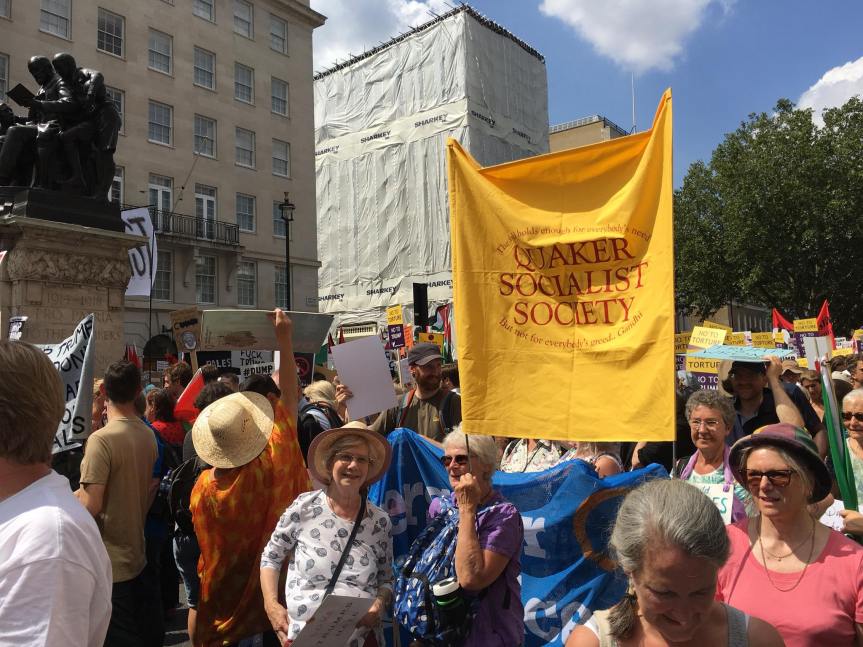
Quaker Socialists at the Trump demonstration, 2018
Quaker Socialists on the march against Donald Trump

Quaker socialists will meet at 11am by the steps of St Martins in the Fields church, near Trafalgar Square. It’s likely we’ll be there until around 12 before joining in with the wider movement. Look out for the Quaker Socialist Society banner.

We recommend bringing a drink, snack, suncream and hat (just in case). There is a co-op nearby, and there is a coffee shop (with toilets) in the crypt of the church.

We are not organising a Quaker Meeting for Worship this time, but if you need some quiet time, Westminster Friends Meeting House (3-5 minute walk) has its regular Tuesday Meeting for Worship from 13.00 – 13.30, see https://westminsterquakers.org.uk/ . There are also toilets there.

The Fellowship of Reconciiation and Peace Pledge Union will be meeting at the same location as us, and we are happy to be amongst friends.

We look forward to seeing you there

More info: https://www.stoptrump.org.uk/

Leave a comment

Quaker Meeting during Labour Party Conference (2019)

by Tim Gee.

The Quaker Socialist Society and Brighton Quakers extend a welcome all visitors to and residents of the Brighton area on 22 September.

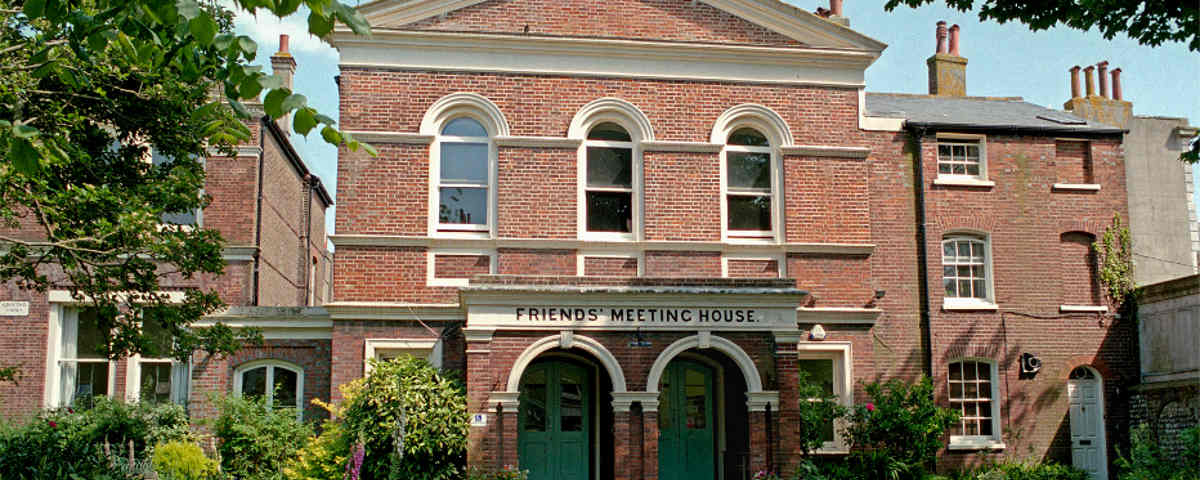
Whether you are attending Labour Party Conference or not, you are invited to join us in stillness in a Meeting for Worship at 10.30am on Sunday morning at the Friends Meeting House, Ship Street, BN1 1AF, followed by refreshments. Everybody is welcome.

The Quaker Socialist Society provides fellowship and a forum for people who believe that political affairs are an essential part of Quaker life. We stand for ethical socialism, social justice and a fair, safe and peaceful world. We are not politically partisan.

This is the first time we have helped organised a Quaker Meeting during a party conference, and if it goes well it opens the possibility of organising others with other parties.

If this will be your first time at a Quaker Meeting, you might find the below video helpful, made by QuakerSpeak – a project of Friends Journal in the USA.

Leave a comment

Quaker Socialist Society AGM (2019)

from Mick Langford (Clerk, QSS).

Our AGM will take place on Friday, 24 May 2019, at 3pm, at St Pancras Church Hall, Euston Road, London, just a few hundred yards away from Friends House

DRAFT AGENDA

  1. Minutes of the AGM held on 9 June 2018 (attached)
  2. QSS Committee report
  3. Appointment of Officers (see list overleaf)
  4. To agree a QSS constitution (draft attached)
  5. Membership subscriptions
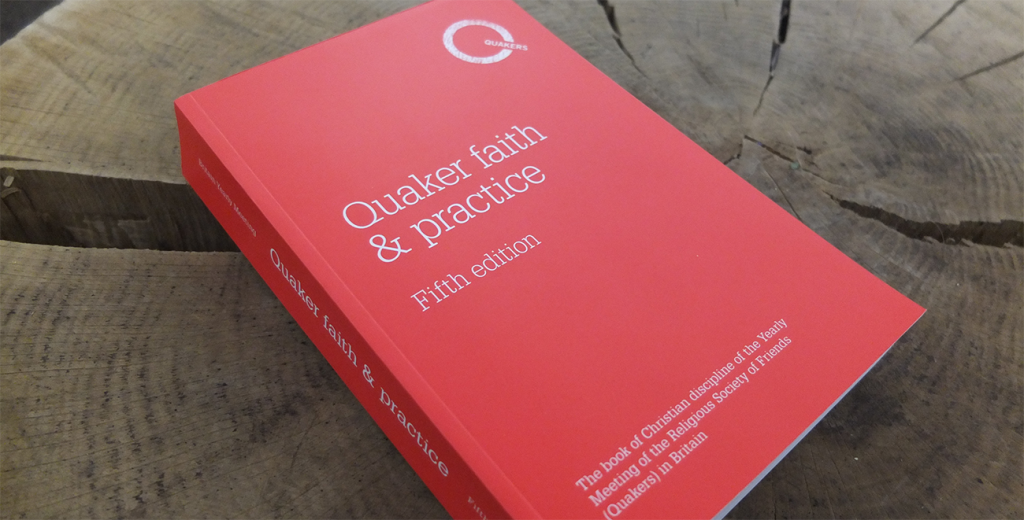
  6. Revision of Quaker Faith and Practice – social testimony
  7. Future events
  8. Date and venue of next AGM

All are welcome to come, and if you are not a member of the Quaker Socialist Society yet, you can join on the day


Leave a comment

Revision of Quaker Faith and Practice: a digital response (2019)

by Tim Gee

What we learnt when we posted Quaker Faith and Practice quotes on social media

Last year it was decided that Quaker Faith and Practice – the anthology of Quaker spirituality – would be revised beginning in 2019. There’s a substantial section in the middle of the book on social action in which Quaker Socialists take a special interest. So to start preparing our contribution to the process we tried posting a passage every day to the Quaker Socialist Society Facebook page along with a picture, to see what would happen.

There’s a difference between social media interactions and traditional Quaker discernment. Nevertheless, part of our politics is also based on participation. With around 1000 followers of the Quaker Socialist page, we were interested in what we’d learn by freely inviting people to ‘like’, comment or discuss in an open way. As it turned out we learnt a huge amount. Here are some of the headlines: 

There’s a lot of it

It took us from the start of the year to the middle of April to get through a single chapter (and it’s a 29 chapter book!). Interest dipped at times, and long verbose sections got very little traction at all. The length is potentially a problem if the book is to become something that a reader might peruse before coming to their first Quaker Meeting.

We could be much more feminist than this     

The most popular three quotes by individuals (rather than groups) are all by women: namely Ursula Franklin, Elizabeth Fry and Eva Pinthus. Nevertheless, despite being the chapter that explores women’s rights, only one in three contributors to the chapter is a woman, and in the first 30 entries only two women are featured at all. To make matters worse, too much of the language of the male writers suffers from being gendered.

For a faith group that is majority female and has a long association with feminism, we can do much better than this, and this revision is an opportunity to do so. 

We need to address white privilege  

Despite several passages about racism and privilege, and a section on the Quakers’ anti-slavery activism, as far as we know there are no quotes by non-white individuals at all in this chapter. In the context of live conversations about power and privilege in Britain Yearly Meeting, including whose voices are heard and whose voices aren’t, this must be an urgent wake-up call, through the revision process and beyond. We can do much much better than this.

In fact we need to address privilege in general 

Many of the contributions on poverty and unemployment come from those who seem to be richer, that exclude by implication some readers who are not. Although Quakers are known for philanthropy, many well meaning passages have not aged well, attracting such descriptions as ‘condescending’, ‘patronising’, and in some cases, even ‘uninformed’. This revision again offers a chance for reflection, and amending those sections that don’t represent who we would like to be.

We still love the classics

Our book is improvable – which is why we’ve decided to improve it. Even whilst acknowledging the problems though – for example of gendered language – some parts of it remain well loved classics.

The top ten most ‘liked’ quotations are listed here.

Leave a comment

Top Ten Quotes from Quaker Faith and Practice

by Tim Gee and Graham Taylor.

In light of the current review of Quaker Faith and Practice, for 103 days we posted the whole of the ‘social responsibility’ section of Quaker Faith and Practice on social media, one per day, inviting you to like and comment.

Now we’ve had chance to go through and compare, we can reveal the most popular ten quotes:

1.

“I have never lost the enjoyment of sitting in silence at the beginning of meeting, knowing that everything can happen, knowing the joy of utmost surprise; feeling that nothing is pre-ordained, nothing is set, all is open. The light can come from all sides. The joy of experiencing the Light in a completely different way than one has thought it would come is one of the greatest gifts that Friends’ meeting for worship has brought me.

I believe that meeting for worship has brought the same awareness to all who have seen and understood the message that everyone is equal in the sight of God, that everybody has the capacity to be the vessel of God’s word. There is nothing that age, experience and status can do to prejudge where and how the Light will appear. This awareness – the religious equality of each and every one – is central to Friends. Early Friends understood this and at the same time they fully accepted the inseparable unity of life, and spoke against the setting apart of the secular and the sacred. It was thus inevitable that religious equality would be translated into the equality of everyday social behaviour. Friends’ testimony to plain speech and plain dress was both a testimony of religious equality and a testimony of the unacceptability of all other forms of inequality.” – Ursula Franklin, 1979

2.

“It is the sense of this meeting, that the importing of negroes from their native country and relations by Friends, is not a commendable nor allowed practice, and is therefore censured by this meeting.” – Yearly Meeting in London, 1727

3.

“Much depends on the spirit in which the visitor enters upon her work. It must be in the spirit, not of judgment, but of mercy. She must not say in her heart I am more holy than thou, but must rather keep in perpetual remembrance that ‘all have sinned and come short of the Glory of God’.” – Elizabeth Fry, 1827

4.

“The duty of the Society of Friends is to be the voice of the oppressed but [also] to be conscious that we ourselves are part of that oppression. Uncomfortably we stand with one foot in the kingdom of this world and with the other in the Eternal Kingdom.” –
Eva I Pinthus, 1987

5.

“Much of current philanthropical effort is directed to remedying the more superficial manifestations of weakness and evil, while little thought or effort is directed to search out their underlying causes. The soup kitchen in York never has difficulty in obtaining financial aid, but an enquiry into the extent and causes of poverty would enlist little support.” – Joseph Rowntree, 1904

6.
“Then I came to Waltham and established a school there for the teaching of boys, and ordered a women’s school to be set up at Shacklewell to instruct young lasses and maidens in whatsoever things were civil and useful in the creation.” – George Fox, 1668

7.

“True godliness doesn’t turn men out of the world, but enables them to live better in it, and excites their endeavours to mend it… Christians should keep the helm and guide the vessel to its port; not meanly steal out at the stern of the world and leave those that are in it without a pilot to be driven by the fury of evil times upon the rock or sand of ruin.” – William Penn, 1682

8.

“The word ‘testimony’ is used by Quakers to describe a witness to the living truth within the human heart as it is acted out in everyday life. It is not a form of words, but a mode of life based on the realisation that there is that of God in everybody, that all human beings are equal, that all life is interconnected.

It is affirmative but may lead to action that runs counter to certain practices currently accepted in society at large. Hence a pro-peace stance may become an anti-war protest, and a witness to the sacredness of human life may lead to protests against capital punishment.

These testimonies reflect the corporate beliefs of the Society, however much individual Quakers may interpret them differently according to their own light. They are not optional extras, but fruits that grow from the very tree of faith.” – Harvey Gillman 1988

9.

“I think I have wasted a great deal of my life waiting to be called to some great mission which would change the world. I have looked for important social movements. I have wanted to make a big and important contribution to the causes I believe in. I think I have been too ready to reject the genuine leadings I have been given as being matters of little consequence. It has taken me a long time to learn that obedience means doing what we are called to do even if it seems pointless or unimportant or even silly. The great social movements of our time may well be part of our calling. The ideals of peace and justice and equality which are part of our religious tradition are often the focus of debate. But we cannot simply immerse ourselves in these activities. We need to develop our own unique social witness, in obedience to God. We need to listen to the gentle whispers which will tell us how we can bring our lives into greater harmony with heaven.”
– Deborah Haines, 1978

10.

We are all the poorer for the crushing of one man, since the dimming of the Light anywhere darkens us all” – Michael Sorensen, 1986

Leave a comment

Salter Lecture 2019 by Catherine West MP

by Mick Langford (Clerk, QSS).

Catherine West MP will deliver the Quaker Socialist Society Salter Lecture 2019, at 12.30 on Friday, May 24, at the start of Yearly Meeting at Friends House, London.

The title of the Salter Lecture this year will be ‘Solutions for a Divided Society’ and it will be delivered by Catherine West, the Labour MP for Hornsey and Wood Green.

At a time when, after nine years of severe austerity, British society has become polarised not only between rich and poor but also between the socially disenfranchised and the metropolitan elites, Catherine will examine from a Quaker Socialist perspective the problems austerity has left us, and offer her own distinctive solutions.

Past Salter Lecturers have included Molly Scott Cato MEP, tax justice pioneer Richard Murphy and socialist campaigner and writer Tony Benn.  This year’s lecture will be introduced by Haifa Rashed.

To attend, visit the Yearly Meeting website. Although attendees at Yearly Meeting are usually either members or attenders of the Society of Friends (Quakers) you do not need to be a Quaker to attend the Salter Lecture.

Leave a comment