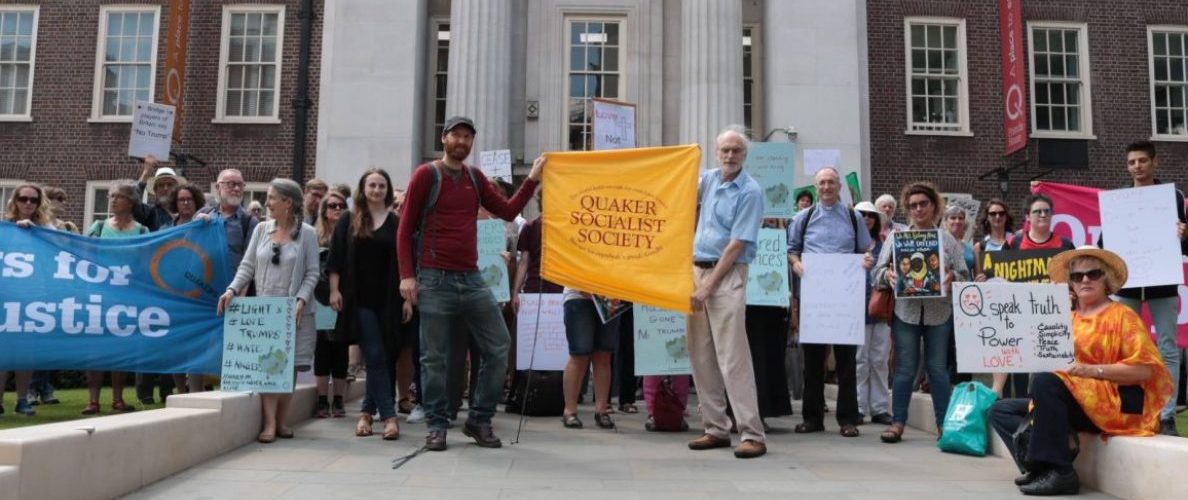
Quaker Socialist Society submission to the Book of Discipline Revision Group

by Tim Gee.

The collective book of testimony, Quaker Faith and Practice, is currently in the process of being updated. Following a process of conversations and discernment spanning more than a year, this is the Quaker Socialist Society’s submission to it.

About 

The Quaker Socialist Society is a recognised group of Britain Yearly Meeting, the representative organisation for Quakers in Britain. QSS is not affiliated to any political party and is open to all those who on ethical grounds wish for an egalitarian, peaceful, green and democratic society. 

We aspire to encourage the practice of ethical socialism in everyday life, and organise the annual Salter Lecture, which is delivered as part of the Yearly Meeting programme. 

Quaker Socialist Society hopes that its objectives and activities will inform the spiritual and material development of Quakerism and bring Quakerism to the notice of the wider world. 

Revision of Quaker Faith and Practice 

We welcome the revision of Quaker Faith and Practice and are grateful for the opportunity to feed into it. We relish the prospect of a readable, user-friendly volume Friends could make available at events which explains to newcomers what Quakers are about and might interest readers in coming to further Quaker gatherings.   

In the spirit of participation and preparation, in the first months of 2019, we posted every single passage from the current ‘Social Responsibility’ chapter to social media, one per day, inviting people to ‘like’ or comment. From this we were able to identify some particularly popular quotes from the present version as well as some themes from the comments, in particular the current under-representation of women and people from ethnic minorities in the text. 

We also noted that some of the passages are overlong and that the political and social activity of the Society of Friends since 1919 could be better reflected. The trade union, anti-racist and feminist movements after 1919 are not referred to, but the anti-slavery, women’s suffrage and CO movements before 1919 are. This leads to a party-political bias, with Liberal MPs quoted but not Labour or Green. The suggestions that follow seek to address these observations. 

Recommendations 

1. Audit of the current text.

We are aware it could be easier to find content to add than to cut, and don’t want to risk perpetuating this problem through this submission. 

We are also aware that, particularly in sections addressing – for example – inequality, a great deal of the current language has become rather dated, and can sound somewhat patronising – even condescending. There is also a significant amount of strongly gendered language, not reflective of the insights of feminism. 

Rather than suggest particular passages for removal we propose an audit of the current material, identifying any passages which don’t reflect our modern understandings of equality, and to prioritise these for taking out. 

We realise that this could imply the need to say a fond farewell to the ‘origins of a Quaker Social Order’ from the next iteration of QFP which while still inspirational in its message now appears sufficiently dated in its language that it may be ready for updating.

If this is too radical a suggestion then perhaps each chapter’s quotes could be laid out chronologically, demonstrating the evolution of Quaker thought.

2. History chapter 

The format of the current book as an anthology means that there are a number of longer passages which appear to have been included because of the history they convey rather than because of their spiritual content. We propose stripping these out, and replacing them with an introductory historical chapter, giving an overview of the Quakers’ development. 

In addition to the stories of Margaret Fell and George Fox, we hope that this might mention social radicals such as Gerald Winstanley and John Lilburne of the Diggers and Levellers respectively, both of whom went on to join the Quakers.

In the second generation we hope mention might be made of John Bellers who elaborated a Quaker reform of society which prefigured universal education, the NHS and the Welfare State. Bellers has been hailed as the first Quaker Socialist since, unlike Lilburne and Winstanley, he had an understanding of labour and a social programme to help the poor.

In the nineteenth and twentieth centuries we hope the history chapter would include mention of moderate Quaker reformers such as Elizabeth & George Cadbury and more radical ones such as Ada & Alfred Salter. We also hope this will take a global perspective, rather than a narrowly British one.  

A history chapter would also provide a means for QFP to honour ‘friends of the Friends’ such as Sojourner Truth, Mohandas Gandhi and Martin Luther King among others, all of whom had close associations with Quakers and whose ministry has shaped the witness of our society significantly.

3. Social Responsibility 

The new Quaker Faith and Practice needs to be able to engage with people where they are, including online. This was part of our thinking in committing four months to online conversations about the section on Social Responsibility. Below these introductory comments are listed the ‘top ten’ most popular passages in order. 

Through this process we noted that only one in three contributors to the present social responsibility chapter is a woman, and that in the first 30 entries only two women are featured at all.  Despite this, the most popular three quotes by individuals (rather than groups) are all by women. We also note that some of these passages (E.g. William Penn 1682, Michael Sorensen, 1986) reflect the male-gendered language we have highlighted above as problematic. 

Searching for pictures of contributors revealed that, despite being the chapter that covers Quaker attitudes to tackling racism, not a single named contributor to this chapter at present is a person of colour. 

The following are the texts currently included in Quaker Faith & Practice which were most welcomed by our respondents. 

1 – Ursula Franklin, 1979 

“I have never lost the enjoyment of sitting in silence at the beginning of meeting, knowing that everything can happen, knowing the joy of utmost surprise; feeling that nothing is pre-ordained, nothing is set, all is open. The light can come from all sides. The joy of experiencing the Light in a completely different way than one has thought it would come is one of the greatest gifts that Friends’ meeting for worship has brought me.

I believe that meeting for worship has brought the same awareness to all who have seen and understood the message that everyone is equal in the sight of God, that everybody has the capacity to be the vessel of God’s word. There is nothing that age, experience and status can do to prejudge where and how the Light will appear. This awareness – the religious equality of each and every one – is central to Friends. Early Friends understood this and at the same time they fully accepted the inseparable unity of life, and spoke against the setting apart of the secular and the sacred. It was thus inevitable that religious equality would be translated into the equality of everyday social behaviour. Friends’ testimony to plain speech and plain dress was both a testimony of religious equality and a testimony of the unacceptability of all other forms of inequality.” 

2. Yearly Meeting in London, 1727

“It is the sense of this meeting, that the importing of negroes from their native country and relations by Friends, is not a commendable nor allowed practice, and is therefore censured by this meeting.” 

3. Elizabeth Fry, 1827 

“Much depends on the spirit in which the visitor enters upon her work. It must be in the spirit, not of judgment, but of mercy. She must not say in her heart I am more holy than thou, but must rather keep in perpetual remembrance that ‘all have sinned and come short of the Glory of God’.”

4. Eva I Pinthus, 1987

“The duty of the Society of Friends is to be the voice of the oppressed but [also] to be conscious that we ourselves are part of that oppression. Uncomfortably we stand with one foot in the kingdom of this world and with the other in the Eternal Kingdom.” 

5. Joseph Rowntree, 1904

“Much of current philanthropical effort is directed to remedying the more superficial manifestations of weakness and evil, while little thought or effort is directed to search out their underlying causes. The soup kitchen in York never has difficulty in obtaining financial aid, but an enquiry into the extent and causes of poverty would enlist little support.”  

6. George Fox, 1668 

“Then I came to Waltham and established a school there for the teaching of boys, and ordered a women’s school to be set up at Shacklewell to instruct young lasses and maidens in whatsoever things were civil and useful in the creation.”  

7. William Penn, 1682 

“True godliness doesn’t turn men out of the world, but enables them to live better in it, and excites their endeavours to mend it… Christians should keep the helm and guide the vessel to its port; not meanly steal out at the stern of the world and leave those that are in it without a pilot to be driven by the fury of evil times upon the rock or sand of ruin.” 

8. Harvey Gillman 1988 

“The word ‘testimony’ is used by Quakers to describe a witness to the living truth within the human heart as it is acted out in everyday life. It is not a form of words, but a mode of life based on the realisation that there is that of God in everybody, that all human beings are equal, that all life is interconnected.  

It is affirmative but may lead to action that runs counter to certain practices currently accepted in society at large. Hence a pro-peace stance may become an anti-war protest, and a witness to the sacredness of human life may lead to protests against capital punishment. 

These testimonies reflect the corporate beliefs of the Society, however much individual Quakers may interpret them differently according to their own light. They are not optional extras, but fruits that grow from the very tree of faith.” – 

9. Deborah Haines, 1978 

“I think I have wasted a great deal of my life waiting to be called to some great mission which would change the world. I have looked for important social movements. I have wanted to make a big and important contribution to the causes I believe in. I think I have been too ready to reject the genuine leadings I have been given as being matters of little consequence. It has taken me a long time to learn that obedience means doing what we are called to do even if it seems pointless or unimportant or even silly. The great social movements of our time may well be part of our calling. The ideals of peace and justice and equality which are part of our religious tradition are often the focus of debate. But we cannot simply immerse ourselves in these activities. We need to develop our own unique social witness, in obedience to God. We need to listen to the gentle whispers which will tell us how we can bring our lives into greater harmony with heaven.”  

10. Michael Sorensen, 1986

“We are all the poorer for the crushing of one man, since the dimming of the Light anywhere darkens us all”

4. Additions for consideration

We suggest the following passages for consideration as additions which could be included in the upcoming text. 

1. George Fox, 1659, translated into Modern English by Rex Ambler

Let all those abbey lands and glebe lands that are given to the priests be given to the poor of the nation, and let all the great houses, abbeys, steeple houses and the palace of Whitehall itself become houses for the care of the needy, or for some use other than they have now, so that the blind and disabled can go there. Let all these fines that get paid to the lords of the manors be given to poor people instead, for the lords have enough already. Let the poor, the blind and the disabled be provided for by the nation, so that there needn’t be a beggar in England.”

2. Anne Knight, anti-slavery activist and early campaigner for women’s right to vote.

“Brothers, if only your declaration of principles would proclaim loudly the complete abolition of all privileges of sex, or race, or birth, of caste and of fortune, you would soon see in your ranks women of spirit and intelligence who would uphold your heroic efforts and help you to triumph.” 

By linking the issues of race, wealth and gender she prefigured what might now be referred to as an intersectional approach.

3. Alfred Salter, 1914 

“Look! Christ in khaki, out in France thrusting his bayonet into the body of a German workman.  See! The Son of God with a machine gun, ambushing a column of German infantry, catching them unawares in a lane and mowing them down in their helplessness.  Hark! The Man of Sorrows in a cavalry charge, cutting, hacking, thrusting, cheering.  No! No! That picture is an impossible one and we all know it!”

4. Bayard Rustin

“We need in every community a group of angelic troublemakers. Our power is in our ability to make things unworkable. The only weapon we have is our bodies and we need to tuck them in places so the wheels won’t turn” 


5. Barrington Dunbar, 1970 

“I can identify with Jesus, a man of deep commitment and with a revolutionary strategy, who gathered together a disciplined people in his effort to share with them his vision of the beloved community, of the Kingdom of God, freed from the barriers of race, clan or creed. 

I can identify with Jesus the revolutionary who was put to death on a cross because he proved to be a threat to the existing social order, as he sought to remove the barriers which separated Jews from Gentiles, the taxpayer from the fisherman. 

As I identify with Jesus the revolutionary, and with the historical circumstances of his human life, I see an example of a personal encounter through which God makes himself known”

6. The Quaker Women’s Group, 1986

“Wars are not isolated phenomena; there are ways of leading up to them and away from them, behaviour which provokes them and which calms or stops them. They are part of the human process of relationships on an individual, a national and an international scale” 

From the Swarthmore Lecture ‘Bringing the Invisible in to the Light\

7. Helen Steven, 2005

We can view Jesus’ whole ministry as a life lived in deliberate opposition to the domination of his time. It was not enough to show compassion for the poor and dispossessed, the whole system of oppression which left people in poverty and despair had to be challenged”.

8. Esther Mombo, 2006 

“Some readers have wondered whether the Bible can ever liberate women from a patriarchal, male-chauvinistic system of oppression…those who embrace a reader-centred approach – like most African women theologians would argue differently…Quakers included, African women have embraced the Bible and use it to analyse their particular situation of triple sexism: sexism in the African culture, sexism in the colonial culture, and sexism in the biblical culture…the Bible as such is not an instrument of oppression of women, but rather a lopsided interpretation of the Bible which has been vested with ulterior motives”

From ‘The Quaker Bible Reader’

9.  Vanessa Julye, 2019

Our past is not divorced from the present; we cannot fully understand and adequately respond to the racial injustices of the present without understanding racial injustices of the past. Many times, the racial discrimination or exploitation of the present is not a new creation but rather a redesigned extension of oppressive structures and beliefs of the past… 

In order to begin a journey of healing our trauma from racism, it will be important for us to know and understand our own individual cultural heritage. We also need to have an honest understanding of how our ancestors contributed to this world and undergirded the structure of white supremacy. Also, we need to understand how we continue to maintain vestiges of this structure in our behaviors today. It is only possible to change a system once you have a clear understanding of how it operates. Acknowledging the pain and celebrating the accomplishments will help us be able to transform members of our religious communities and eventually the inhabitants of the world into peaceful human beings.”

10. As our tenth proposal, we offer this array of quotations from Ada and Alfred Salter 

Alfred Salter: 

“You will only overcome force by love. (A silly, sloppy sentiment, you say!) You will only overcome arrogance by humility. You will only conquer brutality by kindliness. You will only supersede militarism by developing in the hearts of all peoples the spirit of brotherhood and forbearance; war does not do that. This war will not do that. It will leave behind a bitter heritage of hate to bear more fruit in due season.

“Let us not forget that Socialism is a great faith, prompted by a great religious motive, and inspired by a great humanitarian spirit… It is the greatest religious movement since the early days of Christianity.”

Ada Salter:

“We have had to ask ourselves whether it is any good making speeches and passing resolutions against war in general during a time of peace, if now, when the test has come, we are in favour of this particular war… We are always against the last war; we are always against the next war; but we are not against the present war.”

Ada Salter:

“Always act according to truth and principle and you will never feel anxious or distraught.”

Ada Salter:

“The cultivation of beauty should be considered a civic duty.”

She also said: “The cultivation of trees and flowers should be considered a civic duty.”

Ada Salter:

“If evil or wrong methods are deliberately adopted in order to gain quickly some desired end, that end if attained will never be worth the effort put forth, nor will the ideals for which you are striving be realised.”

Ada Salter: 

“When Trade Unionists fully realise that all workers, men and women, youths and maidens, are members one of another, then we shall hear more than the rumble of the revolution in the distance – the revolution will be here.”

Leave a Reply

Your email address will not be published. Required fields are marked *

Faith of a Quaker Socialist

by Tim Gee.

The below article appeared in the autumn edition of the Quaker Socialist Newsletter. To receive our newsletter you can join QSS here .

The idea that Jesus was an antagonist to those who hold power is two millennia old. The story is told four times over in the library of books known today as the Bible. Based on these accounts, Jesus has been called a social reformer, revolutionary,  anti-racist and supporter of women’s equality who affirmed sexual diversity, was sceptical of the ‘nuclear family’, taught his students to be nonviolent, became a prisoner of conscience and suffered capital punishment for his beliefs. 

The movement that he inspired was of the marginalised and the oppressed. It consisted principally of colonised peoples from the Middle East and Africa, including his home country which was suffering under military occupation. The movement’s leaders were largely from working class backgrounds. Central to it was an interfaith alliance bringing together Jewish people with people from Samaria who also suffered religious discrimination. Disabled and formerly disabled people were especially prominent in building the movement. The community included women, men and genderqueer people.

Yet before three centuries had passed, the faith had become a religion of empire, used at the service of the very same anti-Semitic, classist, white-supremacist, misogynist and imperialist mindset that Jesus had spent his life challenging. Ever since there have been powerful forces in Christianity who have used a version of faith to justify religious intolerance, economic inequality, racial injustice, oppression of women, homophobia and war. Part of the task of liberating humanity from oppression will involve liberating Jesus from those who claim that oppression is consistent with Christianity.      

Radical Christianity suppressed

Given the revolutionary potential of Jesus’ teaching it is no surprise that for generations elites tried to keep it out of the hands of ordinary people. Even at the point that the shape of the Bible was negotiated and agreed, there were even more radical accounts, which referenced, for example, the divine feminine and focussed much more on the lives of female leaders. These were left out and ordered to be burned. Those who didn’t hand them in were threatened with death and people who disagreed with the official view were deported. 

For a millennium afterwards, the Bible was available only in ancient languages, giving elites with expensive educations the near-exclusive power of interpretation. When in 1382 – just a year after the Peasant’s Revolt – John Wycliffe translated the Bible in to English, he was condemned as a heretic. Wycliffe died of a stroke, but not content to let him be, church authorities ordered that his body should be dug back up and then burnt.  

William Tyndale is credited with translating the Bible in to English direct from the Greek and Hebrew, publishing his New Testament in 1526. His work was initially appreciated by Henry VIII who went on to make himself head of a new English national church in order to allow himself to divorce his first wife. But when Tyndale criticised the King for the ways his actions differed from scripture, Tyndale was ordered to be strangled at the stake before being burnt.     

Martin Luther completed his full Bible translation into German in 1534. By that stage he had already been declared a heretic and excommunicated from the church. As the text reached common people’s hands it became clear that what was being taught and done by some of those in power was quite different from the example set by Jesus. In the same year a group dubbed Anabaptists attempted a revolution in the city of Munster in order to try and introduce a more communal system. Luther spoke out against the rebellion, but was never readmitted to the church. 

Eventually, in 1611 the King James Version of the Bible was produced.  Although copies were placed in churches in English and in Latin, great efforts were made to shape people’s understandings of it. The church was sharply hierarchical, priests tended to be drawn from the upper classes, and at the top of the pyramid was the King himself who claimed he had been put there by God. Attendance at church was compulsory with the threat of fines or imprisonment for those who refused. 

But the cat was out of the bag. Alternative visions of Christianity were already beginning to be adopted across Europe and a spiritual gulf was growing in England between the approaches inspired by these developments and the national state church preferred by the upper classes and royalists. By the 1640s this was a factor in the outbreak of civil war, culminating in the execution of both the King and the Archbishop of Canterbury. 

Quakers and fellow travellers

England’s short period as a republic coincided with a relaxation of the laws against grassroots faith groups. Thousands of people in previously underground groups emerged. Some agitated for the extension of the ballot and limitations on the death penalty and others set out to redistribute land through direct action, by reclaiming rich landowners’ fields and farming them communally. The most famous of these were nicknamed ‘Levellers’ and ‘Diggers’. Later, many of those radical spiritual activists combined together as the Children of the Light, later known as the Society of Friends (Friends for short), and nicknamed ‘Quakers’.   

Although then, as now, many men tried to use their religion to suppress women’s voices, Quaker women found in the Bible a powerful case for women’s equality. Most prominent was Margaret Fell who wrote a pamphlet pointing out that Jesus often revealed truths to women before they were revealed to men. Amongst thousands of fellow freethinkers, she endured prison for sticking to her beliefs. But a path was beginning to be paved towards women’s ministry, which many more would follow. 

It was another Christian non-conformist, Mary Wollstonecraft – a Unitarian – who wrote one of the foundational texts of modern feminism; a Vindication of the Rights of Woman in 1791. The work not only called for gender equality but called out the whole system of unjust hierarchies that reinforced the male power structure. She was shunned by many in her community. 

One who didn’t ignore her was Tom Paine – who had written the first part of a Vindication of the Rights of Man the previous year. By writing books that profoundly shaped the founding fathers of the USA, revolutionaries in France and England’s emerging movements for democracy, he played a role in contributing to the development of human rights. The child of Quaker parents, he was also a keen Bible reader on which basis he rejected the literalist approach. For this he was forced to flee his country for his life. 

Yet another contemporary of Wollstonecraft and Paine – as well as an early campaigner in the movement for the vote – was Olaudah Equiano, whose memoir of life in slavery had become an international bestseller by 1792. The book gave a narrative of the events of his life, but was also a work of spiritual autobiography recounting how he had found strength in the actions and words of Jesus and Paul, which he contrasted against the moral hypocrisy of the nominal Christians who had enslaved him.

Intersecting struggles

It was from within the anti-slavery movement that a new chapter in the movement for votes for women began. After being excluded from an anti-slavery convention in 1840 on account of her gender, Quaker activist Anne Knight wrote what is usually considered the first leaflet calling for women to have the vote, arguing that a female influence on Parliament would lead to more peaceful and just decisions. She became a regular thorn in the side of the male leaders of anti-slavery campaigns who she argued had not understood scripture properly. Her contemporary Elizabeth Cady Stanton went further and wrote a version of the Bible from a woman’s perspective. 

This was not however just a white woman’s cause. Perhaps the most memorable women’s rights speech of the century was given by Sojourner Truth to a conference in Ohio. Pointing to a church minister who had argued against women’s rights she declared “that little man in black there he says women can’t have as much right as a man because Christ wasn’t a woman! Where did your Christ come from? Where did your Christ come from? From God and a woman! Man had nothing to do with him”. 

All the while nascent trade union groups were being built, perhaps the best-known of which were the Tolpuddle Martyrs, led by a preacher George Loveless. After organising an association of agricultural workers in England, they were sentenced to transportation to Australia in 1834. After mass mobilisation in solidarity they were pardoned two year later. That same year the Chartist campaign began, one of the most significant mass-participation working-class campaigns since the industrial revolution, which demanded the vote be extended to workers. Amongst the teachings of Chartist leader Ernest Jones was the idea that “Christ was the first Chartist and democracy is the Gospel carried into practice”.     

In the Eastern Church, Christian dissent was more effectively contained. Nonconformist sects such as the Dukobhors needed to escape to avoid persecution.  One of those who sympathised with and assisted the Dukhobors was Russia’s most renowned novelist Leo Tolstoy. Reading of the activism of anti-slavery campaigners abroad, he penned a series of books about the essence of Jesus’ teaching and the potential of nonviolent action, which he contrasted to the actions of the national church. He couldn’t find a publisher for his work in his own country, which ended up being printed abroad. Among the best known of his overseas readers were the US women’s rights activist Jane Addams, and the Indian independence leader Mohandas Gandhi. In his own country though, Tolstoy’s membership of the church was revoked. 

The early twentieth century saw an upsurge in radical union activity in the USA, a contributor to which was a young Dorothy Day, who went on to organise Catholic Worker houses of hospitality with the dispossessed. Against the same background, Walter Rauschenbusch published his seminal work Theology for a Social Gospel pointing to the institutionalised sins of poverty and injustice, the revolutionary nature of the Kingdom of Heaven and the potential to understand the resurrection as the ability to do good. US civil rights leader Martin Luther King came across Walter Rauschenbusch’s work whilst at seminary, which along with Gandhi’s work, profoundly shaped his thinking. 

Liberating theology

Informed by global struggles against racism and poverty, the term ‘Liberation Theology’ was coined in 1971 by Gustavo Gutierrez, a Peruvian priest. He drew attention to the Bible’s ‘preferential option for the poor’ and invited an approach to theology based on praxis – a cycle of action followed by reflection, repeated many times. Alongside the work of others – most prominently the Brazilian priest Leonardo Boff – this inspired a resurgence of theological perspectives in struggles against authoritarianism and imperialism. Gutierrez and Boff were subjected to investigations and silencing orders respectively by the church hierarchy. Despite this, their message was heard as it opened the way for other forms of liberation theology to emerge based on the experiences of different oppressed groups. 

A black theology of liberation began to be systematised by James Cone based on the religious thought of the civil rights movement. One of Cone’s best-known readers was a young Desmond Tutu, who wrote his PhD on Black Theology. He went on to serve as Archbishop of Cape Town and one of the best-known voices against apartheid in South Africa. Later in life he has related this experience to further campaigns, including for peace and justice in the Middle East, for LGBT inclusion and for financial disinvestment from fossil fuels. 

Another approach which now forms part of Liberation Theology, is Feminist Theology, referred to as Womanist Theology where it specifically centres black women’s experience. These approaches find in scripture examples of Jesus breaking convention to associate with women, appointing women to the leadership of the movement and making women central to teaching about the Kingdom of Heaven. It also finds in Jesus words and decisions an awareness of gender inequality. For example, when a woman is brought before Jesus by an angry mob of men wanting to punish her for having had sex outside of marriage, he challenges them in a way that so bruises the fragile egos of the men that they storm off. 

Feminist and womanist theologians often advocate ‘reading between the lines’ to enquire after the silent female characters who are often unnamed. Continuing with the same story we might ask: Who was that woman who was brought to Jesus by the mob? What were the circumstances of the action that made the man so angry? Had she had an abortion? Was it her idea to take the matter to Jesus rather than to a judge? If it was, it was a smart move. Jesus points out the patriarchy by inviting ‘him without sin to cast the first stone’. The story serves as a powerful critique of modern-day Christian-led protests outside abortion clinics.  

Yet another approach to draw inspiration from the liberation school is the emergent ‘queering’ of theology. This has led to some novel questions being asked of the Bible: Could the fact that there is no record of Jesus getting married or having a girlfriend indicate an acceptance or even a modelling of a queerer approach to sexuality and gender? Can we detect an androgyny, or alternative masculinity in his character, with both ‘male’ and ‘female’ characteristics? Who was the unnamed semi-naked man who ran towards him at the time of his arrest, and was he the same as the unnamed ‘disciple Jesus loved’ who was present at his crucifixion? These are of course all impossible questions to answer with any certainty, but the fact they are asked indicates not only a theology of liberation, but an increasingly liberated approach to theology.   

Most rapidly emerging today is the field of eco-theology which finds themes of care for nature in the first book of the Bible and prophesies of environmental breakdown in the last. Both Jesus and his followers appear closest to God when taking walks in nature. Jesus teaches that God cares about the flowers and birds and draws on the metaphors of seeds and fields.  He compares himself to a vine and his followers to plants who will be known by their fruit. In widely read encyclical letter in 2015, Pope Francis contrasted Jesus’ example to “the culture of consumerism, which prioritises short-term gain and private interest” which is leading to ecological violence. 

A radical manifesto

By now the argument should be clear; as well as being used as a tool of oppression, the Bible is a tool of liberation. Jesus taught that we would know his true followers by their actions when he said “You shall know them by their fruits”. His brother James taught that if faith is not accompanied by action, it is dead and continued “I will show you my faith by my deeds”. So we live our faith in action, but it cannot be only that. Praxis is a process of action followed by reflection, action and reflection. Part of that reflection is the lives of those who have gone before, including those people we meet in scripture. 

By one estimate there are up to five billion copies of the Bible in the world. That’s five billion manifestos for change present a great many libraries, hospitals and hotels right across planet, many of them going unread. This article is an invitation to pick one of them up. The fact that a great many of us don’t is no doubt a relief those who exercise unjust power. Because if enough people studied and acted on Jesus’ words, then the foundations of elite power would start looking very sandy indeed.

Leave a Reply

Your email address will not be published. Required fields are marked *


In Conversation with Maggie Chapman

by Maggie Chapman (interview).

Maggie Chapman is a feminist, environmentalist, peace activist and Quaker socialist.  She is currently the Rector of the University of Aberdeen. Maggie was among the first elected Green councillors in Scotland and until mid-2019 was Co-convenor of the Scottish Green Party.

The public meeting we had planned with Maggie in York on 28 March was cancelled due to the situation with Coronavirus. In its place she agreed to an interview for the website, in full below.

Would you be happy to introduce yourself and share a little about how you got involved in working for change? 

I was born and brought up in the sunshine in Zimbabwe. Postcolonialism and the politics of race and inequality shaped my childhood, even though I really wasn’t aware of it at the time. I had a very happy, and in many ways, very privileged upbringing. My parents created a very safe, welcoming and open home, and, whilst we were not that well off compared to many of my school friends, we never wanted for anything. 

But I was very aware that many people around me were not so fortunate. I realised, at quite a young age, that we (my family) placed value – mostly sentimental, it has to be said – on material possessions that the vast majority of Zimbabweans had never seen, nevermind owned. Or took for granted. I saw the racial inequalities – which often mapped onto economic inequalities – very starkly all around me, even if I didn’t understand how or why they existed, and what sustained them. And I had some sense that these inequalities were problematic, even if I didn’t know how to articulate this sense or think it through. Racial differences of wealth, values and aspirations were often explained away as cultural preference and practice. I’m not sure that this satisfied me, but it did placate me. For a while, at least. Because I was protected and nurtured in a society that valued education.

I went to the Dominican Convent in Harare – Zimbabwe’s first school, founded in 1892 – for both my primary and secondary education. I was brought up a Methodist, but the school was between home and my Dad’s work, and in the age of petrol rationing, that mattered! Zimbabwe was not formally racially segregated, and I learnt a great deal from my classmates, who came from pretty much every racial community in the country. We talked about (small “p”) politics. We debated world events. Despite our racial diversity, we shared hopes and dreams because we could. Post-independent Zimbabwe invested in education: for over a decade, it was one of the most literate countries in Africa. And Convent, as we called it, whilst fee-paying, had significant financial support mechanisms for less well-off families. And so the education I received, infused with the Dominican’s holistic approach to learning and emphasis on charity, taught us to see diversity as strength, difference as beautiful, and faith as being about making the world a better place.

At home, alongside the perhaps old fashioned but good-hearted paternalism, my sister and I were instilled with a very clear sense of justice and humanity and the importance of principles. Both my parents planted the seeds of my love for the world around me, gave me the foundational belief that all life mattered and that kindness would take me further than wealth. Their two daughters would never not be encouraged to do things because they were girls. And being wasteful was never an option … something my non-hoarder partner struggles with everyday!

Equipped with these values, when I began to understand more about how the world works, and how deeply unequal it is, it was no leap at all to see the connections between social, environmental and economic justice. And a handful of very patient people encouraged me to turn my principles into activism and action. At university, I got involved in societies and activities focussed on social justice, peace and spirituality, and started attending (irregularly), a small lunchtime Meeting for Worship in Edinburgh. At the same time, I got involved in (big “P”) Politics, and it was just obvious to me that the Scottish Greens best reflected my values about the world.

Some people of faith working in politics have encountered difficulties in reconciling the two. Could you share anything about your faith journey as it relates to social action? 

In some ways, I think my answer to this question is a bit of a cop out. I think, at best, I’m a very bad Quaker: I have wandered a long way away from faith in the conventional sense. I don’t think I would call myself a “believer”, and I have many more questions about faith than I probably ever had. But the pluralist embrace of the Religious Society of Friends continues to appeal, and the light within is a powerful motivator for me to strive for a peaceful and equal world. So I suppose I don’t really encounter conflict between my spiritual life and political activism, possibly because I don’t put much emphasis on the former. But more fundamentally, I do not see any conflict between the Quaker teachings of peace, kindness and love and the Green principles of equality, inclusion, social justice and environmental concern.

Your last two speeches to the Scottish Green Party conference emphasised the role of social movements in creating change. Since the Coronavirus crisis almost all public gatherings have been closed down yet significant social change is happening. What’s your take so far on the emerging situation? 

I think we need to be clever in our response to this situation. I think that the social movements behind the climate strike and Extinction Rebellion have achieved as much in a year as many of us working in environmental organisations have achieved in decades (I should be clear here that I don’t think it would have been possible to have these social movements without the work in those organisations – it’s not an either/or, nor should we disparage the work done in those organisations). 

But it’s also very clear that the protestors have catalysed action that otherwise wouldn’t have happened. And they’ve done it through occupying the streets. That obviously will have to change in a period where we can’t associate in these ways. 

I’m very optimistic about the possibilities of doing online campaigning. That needs to move well beyond petitions and the ‘clicktivism’ that emerges from conventional marketing thought. 

If we can go beyond our online ‘filter bubbles’ and begin to reach out to people this offers a real chance. We’ve had an example of how people can be put before the economy. We must make the case that to stop climate breakdown, to end the arms trade and to harness the digital tools that are currently monopolised by tech billionaires. 

Over the past 40 years, we’ve been put on a productivity and consumption treadmill. And one thing about a treadmill is that it’s very difficult to get off once you’re going. I don’t think we’ll go back to a situation where people get back on the treadmill and run at the same pace we were going before. For many office workers the presenteeism of the last decade is falling away. 

All of this provides more opportunities to communicate online, built the case and make sure that we don’t go back to the world we had before. 

Originally we were planning to talk about the crisis of poverty in the UK, prompted by the reports which revealed that 14 million live in poverty in the UK and that more that 100,000 people have died as a result of cuts.  We were also planning to explore the connections with the global climate crisis. Why do you think there has been a worldwide effort to combat the Coronavirus pandemic but not to address the ongoing crises of poverty and climate change?

I think there’s an important factor here which is that very much of the capitalist system is based on a morality. That morality values richer people more than poorer people. In that context, austerity – which destroys lives on precisely the basis of wealth – is acceptable to elites. It reinforces capitalist normality. The Prime Minister of the United Kingdom will never be a victim of austerity, but he did get Coronavirus. So if you can insulate your loved ones from austerity through wealth, it seems more acceptable than an infectious disease that could affect anyone, and could affect them now. 

That said, there is something quite different with climate breakdown. Capitalism is deeply and fundamentally entwined with fossil fuels. The industrial revolution, which birthed modern capitalism formed at the nexus of fossil fuels to power factories and new financial forms to pay for those factories. 

So if capitalism has always existed in a symbiotic relationship with fossil fuels it’s easy to see why there has been enormous resistance from capitalists to any move away from fossil fuels. The deployment of Fear, Uncertainty and Doubt (FUD) and the creation of conspiracy theories about how climate breakdown wasn’t happening are classic elite strategies to stop change. 

I’ve always believed that capitalism could not provide an answer to climate change. Quite simply it’s easier to buy doubt than it is to fundamentally reorientate the economy. That’s why I’m a socialist, and a Green. 

One of the things I think Coronavirus has exposed is that, even in a capitalist economy, another world is possible. It will be very difficult to argue that the economy is more important than people’s lives again. Not that it will stop them trying, of course! But we need to be ready, to make the point that an economy that is based on saving lives is what we did in the corona-crisis. And that it is now possible to build a wellbeing economy, rather than a growth economy. 

Across the UK national identity appears to be becoming an increasingly important factor in politics. In England this is leading to greater xenophobia, but Scotland appears to be forging a more inclusive sense of nationhood. Is there something that progressives beyond Scotland can learn? 

I think one of the great errors of the socialist movement has been its puritanism. One of my heroes is Raymond Williams – who may be known to many of you as one of the leading peace activists of the 1950s and 60s. But he was also a great Welsh literary theorist, and his work on the location of identity has a lot to say. I sometimes joke that if you want to know why the world is the way it is, you need to start by reading Raymond Williams. His sense of working-class Welsh identity articulated in Border Country and the People of the Black Mountains reflects a way of conceptualising how we can live in community, in a progressive way. 

Too often progressives have abandoned community and faith to the political right. That’s a terrible shame, and it’s not something we can continue to do. I like Billy Bragg’s attempts to build a progressive English identity, but I sometimes feel he is ploughing that furrow almost alone. 

I also think it’s much easier to form a progressive identity in a country like Scotland that is much less attached to it’s past as an Imperial power. While Scotland (particularly lowland Scotland) was a significant partner in the creation of the British Empire, it’s not the basis of Scottish identity, in the way it is for many in England. 

There needs to be a serious reckoning in England about the role of Empire. Far from a benevolent enterprise it was responsible for terrible, terrible crimes. From an Gorta Mór (sometimes known as the Irish Potato Famine) to the Bengal Famine, the British Empire chose starvation for colonised peoples in the name of laissez-faire economics. In Brexit I see a desire to return to Britain’s role as a globally aggressive force. I don’t see it being particularly realistic, or something that can be achieved. But the seeds are there for really nasty politics. If, as I think is very likely, Brexit turns into a national humiliation, that will be a very dangerous political context. A political context that might well lead to hard-right politics. 

We all need to find ways to give people a sense of belonging, a sense of identity that is built on the progressive values that still, I believe, underpin people’s beliefs. I think there’s an instructive example here. In the years that led up to the Brexit vote the tabloid press went into overdrive blaming immigrants for a whole range of problems. Most of these were actually government choices – and the decision to pursue austerity. But people were told time and again that the NHS was said to be creaking under the pressure of immigrants. That classrooms were supposedly filled with children who couldn’t speak English and all sort of other terrible lies. We can’t stop people lying. But what we can do is make the case for immigrants. 

In 2014 I ran for the European Parliament. The election was all about UKIP, and how much people disliked the EU. And that dislike was located in disgruntlement about immigration. I wanted to work with the material given to me. Despite widespread scpeticism – mainly based on a belief that the case for immigration couldn’t be made, I ran a campaign based on the value of immigrants. 

It wasn’t to try to dissuade people of the lies they’d be told. I knew that wouldn’t work. It was to put an opposing position. We made the case that immigrants didn’t just use the NHS, they staffed the NHS. They didn’t just use public services, they paid enough taxes to more than cover that use of schools and hospitals. 

The result was a campaign in Scotland that debated immigration. Coming, as it did, months before the Independence Referendum, it changed the nature of that discussion. In the referendum campaign, this solidified into a ‘Scottish position’ that was about welcoming immigrants. 

It requires a smart approach, and an understanding of the politics, but we can build reasoned cases for a more collective approach to our society. We have made huge progress in public awareness of the seriousness of climate breakdown in the last year, with the Climate Strike and Extinction Rebellion. Both of which articulate the Quaker approach of ‘bearing witness’, and the socialist belief in structural change. 

At the moment QSS is engaged in a process of sharing and co-development of our collective thought about Quaker socialism. Would you consider Quaker socialism to be distinct from socialism in general?  If so – how? 

For me socialism is about freedom from alienation. By that I mean that our work, our lives and the things we create should be created by us, for us as part of a contribution to the collective good. The relationship must not be coercive. I believe that the capitalist principle that if you have no capital you must sell your labour – you must alienate yourself – is at the root of much of the dysfunction of our world. And the reality is that if you don’t participate in your own alienation, you starve. 

I think there are some really interesting overlaps here. Quakerism has a very long lineage of liberal paternalism. Some of the best paternalism, but still paternalism. The Cadburys and Frys and other Quaker industrialists did ‘business for good’ – producing chocolate as an alternative to alcohol. They treated their workers better than almost all other workers in the history of capitalism. But they didn’t go that next step of freeing their workers from alienation. 

And that’s where I think there’s a really interesting conversation to be had. In the meeting for worship we are all equal. That’s right. But shouldn’t we articulate that in a new way of living? An economy that works for us all. 

I’m very interested in the transformation of the economy from mass-market capitalism to a data economy. At the moment that’s disastrous. Billionaire tech-bros in Silicon Valley are deciding what we do and how we do it. There’s a cliche that data is the oil of the 21st Century, and we’re currently using it to drive advertising so that people can have tailored messages getting them to buy things that they don’t need. Or we have authoritarian governments, like the People’s Republic of China using data to curtail people’s liberties. 

As always I believe another world is possible. The unique thing about Quakerism is that it is a belief system that is based on the individual’s conscience but in a collective setting. As we see more automation, so our daily work will turn to focus on the fundamental human qualities: caring and creating. We will need to become better at making decisions together. This feels much more like a Quaker world. 

Yet I don’t feel we’re considering these questions. In some ways, our approach has become too oppositional. Care and creativity have always been at the heart of my relationship with Quakerism. But it’s something else I think that we might want to share. The Quaker Meeting for Business offers a model of decision-making that might be more appropriate for a world in which human need to do less ‘grunt work’. Consensus, bringing people with you, giving way where you believe it is right are all qualities we see rarely in our debate. 

Socialists talk about ‘prefigurative’ actions. Those actions that ready us for a world after alienation. That feels very close to living in a Quakerly way. 

A Quaker socialism must be free of the authoritarianism that 20th-century socialism inherited from Lenin and the Bolsheviks. But it must also recognise the need to give all people the freedom from alienation that those Quaker industrialists didn’t recognise. 

The future will be one where we are much better able to understand what human needs and planetary needs are, and where we can plan to meet them. That requires us to learn from where we’ve done that work of prefiguration. Where it is we’ve built lives where we can be fully in touch with our profound human need to care for others and for the world. Where our creativity is nurtured and unleashed. And where we can recognise the value of others in the decisions about what we do together and how we allow ourselves to live. 

For me a Quaker socialism is one that recognises the value of living differently in the world while seeking to change that world. It is a socialism that is based on the value of all people and of the world. It is a Quakerism that isn’t just opposed to war and injustice, but that seeks to build a different way of being in the world. In the way those Quaker industrialists used technology to build businesses for good that treated their workers well, so we need to meet the challenge of our contemporary world in a way that harnesses the opportunity to create a society that has those Quaker values at its heart. 

Leave a Reply

Your email address will not be published. Required fields are marked *

What should be in the next version of Quaker Faith and Practice?

by Tim Gee.

Our collective book of testimony, Quaker Faith and Practice is currently in the process of being updated. As part of this, Quaker Socialist Society will make a submission. 

By way of preparation, last year we posted every single passage from the current ‘Social Responsibility’ chapter to social media, one per day, inviting people to ‘like’ or comment.

From this we were also able to identify a ‘top 10’ of most popular quotes from the current version as well as some themes from the comments, including the current under-representation of ethnic minorities and women in the text.  

Subsequent discussion at the Quaker Socialist Committee has noted that much of the political and social activity of the Society of Friends since 1919 is skated over. Two of the most famous Quaker couples of the 20th century – namely Elizabeth and George Cadbury and Ada and Alfred Salter – are not quoted at all. The US civil rights leader Bayard Rustin is also notable by his absence from the text. 

We are interested whether Sojourner Truth, Mohandas Gandhi or Martin Luther King could feature; although they were not Quakers, they all attended Quaker meetings at points in their lives and gave ministry which has inspired the social and spiritual witness of many Friends since. 

The next step is to hear your ideas. We plan to bring a copy of our draft submission to the Quaker Socialist Society AGM in August, before which it needs to be considered and compiled by the committee. 

If you have a suggestion for our submission, please email quakersocialistsociety@gmail.comby 31 March 2020 or just let us know through our contact form 

Remember you can also send examples of inspirational and helpful pieces of writing directly to the Britain Yearly Meeting Book of Disciple Revision group online here: https://forms.quaker.org.uk/qfp-idea/ or by emailing qfp@quaker.org.uk.

Leave a Reply

Your email address will not be published. Required fields are marked *

What does Quakerism have to do with Socialism?

by Tim Gee.

Picture: Cover of ‘Britain’s First Socialists’ by Fenner Brockway, with a foreword by Tony Benn

What does Quakerism have to do with socialism? It’s a question we get asked fairly frequently. The answer is, ‘a lot’.

The seventeenth century radical groups of the English Revolution are often referred to ‘Britain’s First Socialists’ (see picture) as well as forerunners to modern movements for human rights and environmental justice. Amongst these were the Levellers who demanded political and civil liberties to be extended beyond the landowners and the Diggers who redistributed land through direct action.

Many Levellers and Diggers, including some of their most prominent spokespeople, went on to become Quakers, who were another emergent group of the time who believed that the equality they demanded in the world should be expressed in their faith communities too. As a testament to the divine equality of all people, they met without priests, without set sermons, and – perhaps most radically for their time– with the full expectation that women or men might equally speak their truth.

These actions were seen as revolutionary and were not welcomed by the political or church establishment. Quakers were persecuted remorselessly, especially after 1660 when Britain’s brief republic came to an end. Nonetheless, the movement continued to grow.

One of the first generation to grow up as part of this new faith community was John Bellers, who elaborated a reform of society that was distinctly ’socialist’ (although the word was not used until later). Bellers devised practical measures for a national system of hospitals, a system of local ‘colledges’ where people would have education and employment, and a continental body on which each country would have proportional representation, that would ensure peace in Europe. Socialists as different as Robert Owen, Karl Marx and Eduard Bernstein all read and referenced Bellers. The modern reader might recognise in Bellers’ ideas an anticipation of the NHS, the Welfare State and the founding ideals of the European Union.

Yet for all the fervour of their first earliest years, the Quakers began to look inwards. This was in part an act of self-preservation. It was also linked to a theological shift. The group had first blossomed in the belief that the egalitarian society described by Jesus as the Kingdom of Heaven on Earth was imminent. In this state of being ‘The last would be first and the first would be last’. Yet a new order of merchant aristocrats and City financiers was now very much first, and that did not seem likely to change any time soon.    

So a period of ‘quietism’ began. If you have in your head any stereotypes about the peculiar customs of Quakers, the chances are that they stem from this time. Many Quakers wore ‘plain dress’ – typically grey so as not to be seen to be showing off. In continuity of a tradition begun by earlier Friends they addressed all in the familiar ‘thee’ and ‘thou’ rather than the formal ‘you’ in order to emphasise their commitment to equality.

The increasingly insular nature of the group also allowed for efficient community organising. The first British campaigns against slavery emerged at this time, with Quakers amongst the first groups of non-enslaved people to commit to the cause. Many of the female slavery abolitionists went on to become advocates for women’s suffrage, including Essex Quaker Anne Knight who wrote the first British pamphlet demanding the right to vote for women. 

Although no longer being imprisoned for their beliefs they were still barred from university. As a result many Quakers entered business. No longer in opposition to wealthy elites they increasingly became them, and instead of pursuing radical change channeled their efforts into less challenging philanthropy. As the industrial revolution took hold, the Quakers increasingly became separated from the working classes and their associated movements.

There were still some connections– for example a Quaker helped to finance Robert Owen’s attempt in New Lanark which modelled better conditions for workers and pioneered primary education. In Birmingham the Cadbury family built a village for their workers – a project that to some extent foreshadowed the Welfare State. In York Joseph Rowntree began funding studies into the systemic causes of poverty. Taken together though, the most prominent Quaker figures reflected a reforming wing of the wealthier classes rather then agitators for change from below. Occasionally, they were not even as enlightened as that – most notoriously at the Bryant and May match factory in Bow – and trades unions were formed to challenge their power.

Involvement in politics was still frowned upon by many in the Quaker community, and those who did become MPs tended to be industrialists with a liberal outlook. Nevertheless, they succeeded in being of use to the more radical movements. For example while John Bright MP, was not a prominent part of the Chartist movement, he spearheaded the campaign against the hated Corn Laws, and then later guided the Second Reform Act through parliament which extended the ballot to many working class voters, going some way to enacting the first of the Chartists’ demands.

In the late nineteenth century intellectual reading groups grew, from which emerged the Fabian Society, of which a Quaker – Edward Pease – was amongst thefounders. It took the birth of a radical Christian Socialism though, as represented by the charismatic working-class leader Keir Hardie, to bring the movements back together. Spurred an opportunity to enact the social gospel and Jesus’ teachings of peace, Quakers flocked to join the Independent Labour Party, and many ILP-ers in turn became Quakers.

The First World War helped cement this relationship, when the Quakers became one of the only British faith groups to oppose it and the ILP the only major British political group to do so. Prominent anti-war activists such as future Labour leader George Lansbury toured public meetings in Quaker Meeting Houses, which also provided much of the physical infrastructure of the No Conscription Fellowship.  The Cadbury and Rowntree families also provided financial support for one of the largest peace groups of the time, the Union for Democratic Control, headed by future Labour leader Ramsay MacDonald, which called – prophetically – for peace terms that would not lead to another world war. 

The Quaker couple Ada and Alfred Salter were also active in opposing the war.‘Patriotic’ mobs attacked their meetings. Nevertheless, Ada – already co-founder and President of the Women’s Labour League -went on to become the first female mayor in London and the first female Labour mayor in Britain. From this position she devoted herself to improving housing provision and beautifying the city. Alfred – a doctor – treated poverty-stricken patients for free and imported into Bermondsey the latest medical clinics and facilities, creating in miniature an ’NHS before the NHS’. In 1922 he was elected as Labour MP for Bermondsey.

They suffered most for their peace activism – which is what Quakers are still probably best known for today, from the Campaign for Nuclear Disarmament, long supported by Quakers, to the coalition to stop the wars in Afghanistan and Iraq, which had its opening meeting at the giant main hall of the Quakers’ Friends House building in London. 

Each year (usually) in the same room, a lecture is given in honour of the Salters, organised by the Quaker Socialist Society. Often this has been given by a Quaker politician – such as Catherine West MP (2019), Molly Scott Cato MEP (2017) or Jude Kirton Darling MEP (2015). On other occasions it has been given by a thinker who shares Quaker values, including, in 2010, Tony Benn.

Writing in 2011 and reflecting on Quaker activism, Guardian columnist Anne Karpf shared her view that Quakerism is “more like a political movement or even party – a kind of wish-the-Labour-party-were-like-this party.” In this she was slightly wide of the mark. There are Quakers today of many political parties, and the UK’s parliamentarians (MPs and MEPs) currently include five Quakers in total, spanning the Greens, Liberal Democrats and Labour. The Quaker Socialist Society too is not party-political.

Yet there is also a commonality. The very foundations of Quakerism were moulded in opposition to the political establishment, as were the foundations of socialism. It’s true that on the whole socialist movements do not practice collective stillness. But perhaps that could change. After all, Quakers like to share.

Leave a Reply

Your email address will not be published. Required fields are marked *

Solutions for a Divided Society

Catherine West

I am honoured to give this year’s Salter Lecture, following in the footsteps of Molly Scott Cato MEP, whose speech in 2017 highlighted the peace argument for staying in Europe. The focus of my speech today is not Brexit, but it would be impossible to talk about solutions for a divided society without speaking its name, particularly in light of yesterday’s European Elections. The referendum split the population in two and the ensuing negotiations have laid bare the inadequacies of the Parliamentary process. It would be easy for me, as a Remainer, to wish that the whole thing had never happened, but to do so would be to deny Brexit’s political salience and to ignore the context of austerity which, I believe, gave the Leave Campaign its edge in June 2016.

Many who voted to leave did so as a response to unfettered inequality and as a rejection of those who appeared to defend it. The high number of Leave voters in the regions of England, particularly in the North, could not be a clearer statement of the fact. In the decade since the financial crisis, advanced economies have disappointed on many fronts. The government’s choice to bail out bankers and to keep interest rates artificially low for a decade exposed the myth of the self-sustaining free market. The continual concentration of wealth and power in the City of London has alienated a huge chunk of the country, and the in-fighting and squabbling in the House of Commons has only served to exacerbate disillusionment. I fear, however, that if we leave the EU the very same people who are disenchanted with politics and who voted to leave stand to lose the most.  

Two years ago, I delivered the Swarthmore Lecture, which I wrote with my friend Cllr Andy Hull. Our thesis was that inequality is bad for everyone, not only undermining important human notions of worth, self-esteem and respect,[1] but is also economically damaging. What’s more, unequal societies tend to be less trusting, more violent and suffer more from ill mental health.[2] We dedicated this work to Jo Cox, a dear friend and colleague who was assassinated by a white supremacist for what he perceived to be failing to put Britain first, when all Jo ever wanted to do was to make her country a better place for everyone. Jo’s legacy, embodied by the statement that “we have far more in common with each other than things that divide us”,[3] resonates with a Quaker sense of inclusivity. Since Jo’s death, the world has borne witness to a great many more tragedies fuelled by hate. I wish to pay tribute to the victims of these senseless killings and to their families and friends, because the deep thread running through all of this is division and inequality, which breeds contempt and fear.

I have spent my working life trying to build a more equal society. From using my language skills to help asylum seekers for whom English was not their first language, to working as a caseworker for David Lammy MP, as a councillor and eventually Leader of Islington Council, and now as an MP. Working with some of the most vulnerable people in society in neighbourhoods of wealth and inequality, I see the same problems time and time again: housing need, money worries and a lack of access to secure employment. It has, throughout my career, been my desire to see politics address the needs of deprived and disadvantaged communities, to address the scourge of low pay and the blight of pensioner poverty. Today, I wish to put forth solutions to this deep divide. I wish to tell you that there is hope: that with political will and innovative policies we have the power to make transformative change.

In what follows I will lay out solutions to three of the most insidious issues of our time. I will demonstrate how truly affordable, decent housing can be the rule, not the exception, and provide a stable base from which everyone can thrive; how a living wage and a clampdown on unscrupulous employers can ensure the eradication of poverty pay, and how a public health approach to violent crime can save lives by addressing the problem at its source.

Housing

Having an affordable, stable home should, in 21st Century Britain, be a given. Yet we’re faced with a housing crisis of epic proportions. Not only is it the result of a highly unequal society, it also reinforces it. The tragedy of the preventable Grenfell fire in one of London’s wealthiest boroughs is a stark reminder of the glaring gap between the haves and the have nots. Since 2010 in England, homelessness has risen by 60% and rough sleeping has risen by 134%.[4] In the same period, the rise in the cost of renting privately has surged ahead of wage growth.[5] Moreover, there are 1.2 million people on the social housing waiting list, but fewer than 6,000 homes were built last year.[6] The government spending £12 million on a luxury New York apartment for a British diplomat to live in while he negotiates trade deals with the US is a slap in the face to those sleeping rough or who have been on social housing waiting lists for years: [7] for those who are told a magic money tree doesn’t exist only to find that it does if you are deemed important enough.

At the heart of the housing crisis is the overall lack of affordable homes, and an increasing reliance on an expensive, insecure and often unprofessional private rented sector to house families on typical incomes is behind the rise in homelessness in the UK. But it doesn’t need to be this way. The government made a step in the right direction by banning no-fault evictions in England, which enabled landlords to evict tenants without a reason after their fixed-term tenancy had ended. Building more council housing, offering secure long-term tenancies and toughening up on planning so that we can get the homes we really need rather than unaffordable luxury penthouses would all go a long way in tackling this country’s housing crisis. The government needs to provide consistent, long-term funding in order to provide a new generation of public homes at low rents.

One of my constituents was faced with a desperate situation recently. The Council tried to relocate her and her disabled child hundreds of miles away from London to Telford in Shropshire because of a lack of social housing in the borough. This would have been away from the child’s hospital and all of the constituent’s support networks. We won that battle and kept that constituent and her child in their home borough, but sadly her case isn’t unique. My caseworkers and I frequently have to fight to keep vulnerable constituents in Hornsey and Wood Green from being pushed out of London to areas with more social housing stock. The need to build more social housing could not be more urgent. With adequate funding from central government, we would be able to embark on a programme of mass social house building. But this requires bold action; as the Mayor of London has said, we need four times the current annual government funding for genuinely affordable homes. There also need to be changes in the law to allow councils to buy up land more cheaply and reforms to private tenancies to give tenant security of tenure and to stop landlords hiking up rents.

Some councils are doing excellent work to ensure that local residents reap the benefits of new developments. Islington Council, for example, implemented their new homes local lettings policy for all homes built on existing estates in 2014, which prioritises the lettings of new homes to people currently living on the estates on which they are being built. This could be replicated by councils across the country.

I believe we should also explore rent controls for the private sector to tackle the untenable situation of out of control rents. Rent control measures hand local authorities the power to regulate rent levels, stripping private landlords of the ability to overinflate the amounts they charge. That said, rent controls can only ever be a stopgap for a healthy housing market. The long-term solution to the housing crisis is to eliminate the shortage of homes.  

Wages

The concentration of wealth and job opportunity in London creates vast inequalities between the Capital and the rest of the UK. Career progression and better-paid work is more likely if people move regions – particularly if they go to London.[8] Too often provincial towns and cities don’t have the employment infrastructure to ensure career progression, notably in professions like law and accountancy. Those from wealthier backgrounds are more likely to be able to make that kind of move, with the resources and support to grab opportunities wherever they may be. Meanwhile, most people living in the regions cannot afford to move to London, let alone pay the higher living costs. Devolving power and prestige to local government and combined authorities would be a way to ensure a more even spread of growth and new jobs – and would make our economy less reliant on London.[9]

Meaningful, secure work and a decent wage underpin a fair society. Yet the UK has one of the highest rates of income inequality in Europe.[10] While unemployment is at a 44-year low,[11] in-work poverty is shamefully rampant, causing record numbers of households to rely on food banks.[12] Indeed, a record 1.6 million emergency food parcels were given out by the Trussell Trust last year, widely believed to have been the result of benefits cuts, Universal Credit delays and rising poverty.[13] UK households have experienced flatlining living standards due to a lack of economic and pay growth, and average incomes are not likely to rise materially over the next two years either.[14] This is of course inextricably linked to the housing crisis, as for people on average wages, rent is unaffordable and getting on the property ladder is almost impossible without recourse to the bank of Mum and Dad.

What is clear is that Universal Credit has been a total failure. Along with other MPs and experts, I am continuing to call for the five-week wait for the first payment to be scrapped and for benefits to be uprated in line with the cost of living, which they have not been since 2016. I believe that the rollout, which will only serve to widen the gap between rich and poor, should be halted immediately.

A cocktail of insecure, low-paid work and stagnant wage growth has pushed millions into a permanently precarious financial position, leading to a consumer debt crisis. Rather than being about people living beyond their means, as some would have us believe, it is about people whose incomes have been squeezed so tight for so long that they cannot make ends meet, however hard they try. This couldn’t be illustrated more clearly than by the fact that NHS and council workers are among the biggest users of payday loans.[15] Real wages are lower now than they were in 2010, and nearly 10 million people – a third of the workplace – are in insecure work,[16] characterised by zero-hour contracts. Rather than offering people flexibility and control by allowing employees to choose their own hours to suit their needs, zero-hour contracts put people in a precarious situation where they don’t know how much money they will receive from week to week. While real wages in the finance sector have grown by as much as £120 a week, [17] average working people are £800 a year worse off than they were a decade ago.[18]

In-work poverty is not only morally wrong, but economically illiterate. In 2014, taxpayers spent £11 billion pounds a year topping up low wages paid by UK companies, eleven times the cost of benefit fraud that year.[19] Rather than attacking benefit claimants for ‘sponging off the state’, we must hold corporations accountable. There needs to be proper enforcement of the National Minimum Wage as a bare minimum. One way to help to do this would be to devolve responsibility for enforcing compliance with the National Minimum Wage to local authorities. HMRC is too distant from communities to deal effectively with the many sharp practices that occur at local level. Closer to the ground, local authorities have existing, multifaceted relationships with employers and with workers in their area.

An even better solution to eliminating in-work poverty would be a commitment from both the private and public sector to pay a living wage to all of its workers, because a prerequisite of any sustainable industrial strategy should be a resolute rejection of poverty pay. Yet one in five UK workers, over five million people, earn less than the living wage. The living wage, which is £9 per hour in the UK and £10.55 per hour in London, is independently calculated based on the actual cost of living. Paying a living wage is, as the name suggests, about allowing workers to truly live, not just survive; it’s a wage, not just a handout; it’s about earning, contribution, reciprocity and the dignity of work.

As leader of Islington Council I brought our cleaning team in-house and increased their pay. When I suggested this proposal, no one argued, but when I stated that I would do this by cutting the pay of the chief executive by £50,000, a chorus of naysayers erupted to tell me how we would never be able to find a good chief executive again.

Not only is paying employees a living wage the decent thing to do, it’s also good for business. According to a study carried out by the Living Wage Foundation, 86% of businesses stated that paying a living wage improved the reputation of their business, 75% said that it increased motivation and retention rates for employees, and 58% said that it improved relations between managers and their staff.[20]

Going beyond a living wage, some companies have taken exemplary steps in creating a more egalitarian relationship with their staff. The home entertainment retailer Richer Sounds is the latest British company to adopt an employee ownership model, following in the footsteps of John Lewis and Riverford Organic Farmers.[21] By transferring shares into a trust, Richer Sounds employees (minus the directors) will receive a £1,000 bonus for each year they have worked for the retailer, to thank employees for their loyalty and hard work, and to give them a more reciprocal relationship in which they can have their say on the running of the business. More companies could adopt this model: not only to give workers a financial boost, but to create a less hierarchical working environment.

The government should also require all employers to publish their internal pay ratios between the highest- and lowest-paid (as opposed to average paid) employees, bringing much-needed transparency to the low-pay-versus-high-pay debate. The political economist Will Hutton has suggested that, under normal circumstances, no public-sector employer should exhibit an internal pay ratio higher than 1:20.[22] When I was leader of Islington Council I got our pay differential down to 1:11.

As you can see, there’s a lot we can be doing in Parliament to ensure that everyone gets a fair wage. Starting by publishing internal pay differentials would encourage businesses to narrow the gap between the lowest and highest paid employees. Paying everyone a living wage would be a huge step towards eradicating in-work poverty. Supporting businesses to adopt an employee ownership model would also create a more egalitarian work environment while simultaneously increasing pay. In the long-term, I believe there should be a move towards ensuring an even spread of new jobs outside the Capital so that people don’t feel the need to move to London just to get a good job.

Knife Crime – A Public Health Approach

Countries that exhibit high levels of inequality between groups are more likely to experience violent conflict than more equal countries.[23] It is unsurprising, then, that we are in the throes of a knife crime epidemic. After falling for several years, knife crime in England and Wales is rising again. Homicides in the last year rose to their highest level in over a decade, with 732 people killed in England and Wales. Offences involving knives also rose by 6%.[24] Some of the knife crime incidents in the Capital have happened in my own constituency, and the impact has been horrific. I’ve also received dozens of letters and emails from constituents fearing for their children’s lives. It’s a sorry state of affairs when people don’t feel safe in their own communities, and I’ve been working hard to tackle this issue in Parliament.

A public health approach to violence has, for some time, been considered to be a way of tackling its root causes. By analysing the risk factors for committing violent crime, we can see that income inequality is a significant driver for knife-carrying. [25] Young people who live in very deprived areas and have few educational or employment opportunities may be less likely to see potential for their future and therefore more vulnerable to claims that crime is an option for achieving status and resources. That is why I have proposed the allocation of a special fund for pupils at risk of school exclusion. We know that there is a link between school exclusion and knife crime. We also know that being at risk of school exclusion, or worse, being excluded is detrimental to young people’s mental health. It makes young people feel like the system has given up on them and can make them feel as though all they can do is resort to a life of crime.

A public health approach to violence is preventative. Rather than focusing on changing individual behaviour, as traditional strategies to tackle violent crime have done through criminalisation, it is aimed at transforming health-damaging circumstances,[26] thus providing the maximum benefit for the largest number of people. These health-damaging circumstances include material deprivation, adverse childhood experiences, experiencing violence and substance abuse.  This does not mean that public health ignores the care of individuals. Rather, the concern is to prevent health problems and to extend better care and safety to entire populations.

One success story comes from the city of Cali in Colombia. Rodrigo Guerrero, a public health specialist, won the 1992 mayoral election on the promise that he would reduce the rising levels of violence, which he did – reducing the homicide rate by 30% between 1994 and 1997. [27] He set up a programme in which risk factors for violence were identified, which shaped the priorities for action. Another part of the programme was to provide education on civil rights matters for both the police and the public at large, including television advertising at peak viewing times highlighting the importance of tolerance for others and self-control. Over the course of the programme, special projects were set up to provide economic opportunities and safe recreational facilities for young people. Proposals were discussed in consultation with local people, and the city administration ensured the continuing participation and commitment of the community. This reduction in the number of homicides allowed the law enforcement authorities to devote scarce resources to combating more organised forms of crime. Furthermore, public opinion in Cali shifted strongly from a passive attitude towards dealing with violence to a vociferous demand for more prevention activities.

Closer to home, and more recently, Scotland managed to reduce knife crime dramatically by adopting a similar approach. In 2005, Scotland had the second highest murder rate in western Europe and Scots were more than three times more likely to be murdered than people in England and Wales.[28] Between April 2006 and April 2011, 40 children and teenagers were killed in homicides involving a knife in Scotland; between 2011 and 2016, that figure fell to just eight.[29] Tougher sentences and stop-and-search weren’t behind these dramatic decreases. Rather, these sorts of criminalising measures have been shown to widen the gap between the police and those targeted, and one of the key aims of Scotland’s public health approach to violence was to rebuild trust within communities.[30] The focus was on offering routes into employment so that those at risk of knife violence could get their lives back on track. By targeting prevention through education and early-years support, we can also address the adverse childhood experiences that define the lives of so many future offenders.

Taking heed of lessons learned in Scotland and in concert with Scottish public health experts, last year the Mayor of London Sadiq Khan launched his Violence Reduction Unit, which comprises a variety of services and involves communities to be a part of designing and working towards solutions. The idea is that a healthy, safe start in life for children could save lives by keeping them in a positive educational setting and providing life opportunities. It’s about supporting vulnerable young people and preventing them from going into crime in the first place.

Conclusion

Just as the problems of a divided society are interlinked, so too are its solutions. Striving towards a society in which work is meaningful and offers decent pay is not only a laudable goal in and of itself, but is a step towards tackling the disillusionment among young people which has been proven to be linked to knife crime.

What we need is bold, transformative and joined-up policymaking. We need bottom-up approaches. We need to listen to local people. To tackle housing inequality, we must invest in a programme of mass social house building, explore the possibility of rent controls, and toughen up housing planning regulations. We must also address income inequality, which would, in turn, be a step towards ensuring that everyone can afford a decent place to live. By enforcing the living wage, publishing pay differentials and taking tough action against unscrupulous employers, work can be meaningful and provide a fair wage so that people can enjoy their lives, not just worry about paying their bills. Finally, adopting a public health approach to violent crime could not only cut the number of homicides, but also transform young people’s lives in some of the most deprived areas in the country.


[1] T. Piketty, Capital in the twenty-first century (Boston: Harvard University Press, 2013).

[2] K. Pickett and R. Wilkinson, The Spirit Level: Why More Equal Societies Almost Always Do Better (London: Allen Lane, 2009).

[3] J. Cox, Speech in the House of Commons – Devolution and Growth Across Britain, 19 June 2015, https://www.theyworkforyou.com/debates/?id=2015-06-03d.674.0, accessed 4 May 2019.

[4] National Audit Office, Homelessness, 13 September 2017, https://www.nao.org.uk/wp-content/uploads/2017/09/Homelessness.pdf, p. 14. 

[5] Ibid.

[6] Shelter, Building more affordable homes, October 2018, http://england.shelter.org.uk/__data/assets/pdf_file/0011/1597709/2018_10_19_Shelter_briefing_-_Building_more_affordable_homes_.pdf, accessed 15 April 2019.

[7] Government buys £12m luxury New York apartment for diplomat, BBC News, 27 March 2019, https://www.bbc.co.uk/news/uk-47717397, accessed 21 May 2019.

[8] ‘State of the Nation Report: Inequality ‘entrenched from birth’’, BBC News, 30 April 2019, https://www.bbc.co.uk/news/uk-48103017, accessed 30 April 2019.

[9] M. Easton, ‘State of the Nation report: Inequality in the UK ‘entrenched’’, BBC News, 30 April 2019, https://www.bbc.co.uk/news/uk-48103017, accessed 30 April 2019.

[10] ‘Income inequality in the UK’, House of Commons Library, 15 March 2019, https://researchbriefings.parliament.uk/ResearchBriefing/Summary/CBP-7484#fullreport, accessed 13 May 2019.

[11] Office for National Statistics, Labour market economic commentary: April 2019 https://www.ons.gov.uk/employmentandlabourmarket/peopleinwork/employmentandemployeetypes/articles/labourmarketeconomiccommentary/april2019, accessed 20 April 2019.

[12] Joseph Rowntree Foundation, Budget 2018: tackling the rising tide of in-work poverty, 12 October 2018, https://www.jrf.org.uk/report/budget-2018-tackling-rising-tide-work-poverty, accessed 25th April 2019.

[13] P. Butler, ‘Food bank network hands out record 1.6m food parcels a year’, The Guardian, 25 April 2019, https://www.theguardian.com/society/2019/apr/25/food-bank-network-hands-out-record-16m-food-parcels-in-a-year, accessed 25 April 2019.

[14] Resolution Foundation, Child poverty risks hitting record levels, 20 February 2019, https://www.resolutionfoundation.org/media/press-releases/child-poverty-risks-hitting-record-levels/, accessed 25th April 2019.

[15] R. Booth, ‘NHS workers top list of those applying for payday loans’, The Guardian, 18 April 2018, https://www.theguardian.com/money/2018/apr/18/nhs-workers-top-list-of-those-applying-for-payday-loans, accessed 1 May 2019.

[16] R. Partington, ‘Real wages fall despite low levels of unemployment’, The Guardian, 18 October 2017, https://www.theguardian.com/business/2017/oct/18/real-wages-fall-despite-low-levels-of-unemployment, accessed 1 May 2019.

[17] R. Partington, ‘Britain risks heading to US levels of inequality, warns top economist’, The Guardian, 14 May 2019, https://www.theguardian.com/inequality/2019/may/14/britain-risks-heading-to-us-levels-of-inequality-warns-top-economist, accessed 14 May 2019.

[18] K. Ahmed, ‘Workers are £800 a year poorer post-crisis’, BBC News, 12 September 2018, https://www.bbc.co.uk/news/business-45487695, accessed 1 May 2019.

[19] J. Meadway, ‘Taxpayers spend £11bn to top up low wages paid by UK companies’, The Guardian, 20 April 2015, https://www.theguardian.com/sustainable-business/2015/apr/20/taxpayers-spend-11bn-to-top-up-low-wages-paid-by-uk-companies, accessed 22nd April 2019.

[20] E. Heery, D. Nash and D. Hann, The Living Wage Employer Experience, Living Wage, https://www.livingwage.org.uk/sites/default/files/Cardiff%20Business%20School%202017%20Report.pdf.

[21] Z. Wood, ‘Richer Sounds founder hands over control of hi-fi and TV firm to staff’, The Guardian, 14 May 2019, https://www.theguardian.com/business/2019/may/14/richer-sounds-staff-julian-richer?CMP=share_btn_link, accessed 14 May 2019.

[22] ‘Best-to-worst public sector pay link proposed by Hutton’, BBC News, 1 December 2010, https://www.bbc.co.uk/news/business-11879059, accessed 1 May 2019.

[23] Institute for Public Policy Research, Shared Destinies: Security in a globalised world (London: Institute for Public Policy Research, 2008), https://www.ippr.org/files/images/media/files/publication/2011/05/Security%20Commission%20Interim%20Report_1666.pdf?noredirect=1.

[24] Office for National Statistics, Homicide in England and Wales: year ending March 2018https://www.ons.gov.uk/peoplepopulationandcommunity/crimeandjustice/articles/homicideinenglandandwales/yearendingmarch2018, accessed 25 April 2019.

[25] R. Grimshaw and M. Ford, Young people, violence and knives – revisiting the evidence and policy discussions, UK Justice Policy Focus, Issue 3, https://www.crimeandjustice.org.uk/sites/crimeandjustice.org.uk/files/Knife%20crime.%20November.pdf.

[26] P. Draper, (ed.) Health Through Public Policy: The greening of public health (London: Green Print, 1991), p.7. 

[27] Krug et al. World Report on Health and Violence, Volume 1 (Geneva: World Health Organisation, 2002).

[28] G. Seenan, ‘Scotland has the second highest murder rate in Europe’, The Guardian,26 September 2006, https://www.theguardian.com/uk/2005/sep/26/ukcrime.scotland, accessed 2nd May 2019.

[29] G. Younge and C. Barr ‘How Scotland reduced knife deaths among young people’, The Guardian. 3 December 2017,https://www.theguardian.com/membership/2017/dec/03/how-scotland-reduced-knife-deaths-among-young-people, accessed 2nd May 2019.

[30] S. Jones, Scotland is showing how to win the fight against knife crime, The Guardian, 14 December, https://www.theguardian.com/commentisfree/2018/dec/14/scotland-knife-crime-public-health-issue-violence-uk accessed 22 May 2019.

Stop Trump (2019)

by Tim Gee.

On Tuesday 4 June Donald Trump will be visiting Britain for a state visit. To mark the occasion, hundreds of thousands of people will take to the streets to show that we reject the misogny, racism and climate denialism that he is a manifestation of.

Quaker Socialists at the Trump demonstration, 2018
Quaker Socialists on the march against Donald Trump

Quaker socialists will meet at 11am by the steps of St Martins in the Fields church, near Trafalgar Square. It’s likely we’ll be there until around 12 before joining in with the wider movement. Look out for the Quaker Socialist Society banner.

We recommend bringing a drink, snack, suncream and hat (just in case). There is a co-op nearby, and there is a coffee shop (with toilets) in the crypt of the church.

We are not organising a Quaker Meeting for Worship this time, but if you need some quiet time, Westminster Friends Meeting House (3-5 minute walk) has its regular Tuesday Meeting for Worship from 13.00 – 13.30, see https://westminsterquakers.org.uk/ . There are also toilets there.

The Fellowship of Reconciiation and Peace Pledge Union will be meeting at the same location as us, and we are happy to be amongst friends.

We look forward to seeing you there

More info: https://www.stoptrump.org.uk/

Leave a Reply

Your email address will not be published. Required fields are marked *

Quaker Meeting during Labour Party Conference (2019)

by Tim Gee.

The Quaker Socialist Society and Brighton Quakers extend a welcome all visitors to and residents of the Brighton area on 22 September.

Whether you are attending Labour Party Conference or not, you are invited to join us in stillness in a Meeting for Worship at 10.30am on Sunday morning at the Friends Meeting House, Ship Street, BN1 1AF, followed by refreshments. Everybody is welcome.

The Quaker Socialist Society provides fellowship and a forum for people who believe that political affairs are an essential part of Quaker life. We stand for ethical socialism, social justice and a fair, safe and peaceful world. We are not politically partisan.

This is the first time we have helped organised a Quaker Meeting during a party conference, and if it goes well it opens the possibility of organising others with other parties.

If this will be your first time at a Quaker Meeting, you might find the below video helpful, made by QuakerSpeak – a project of Friends Journal in the USA.

Leave a Reply

Your email address will not be published. Required fields are marked *

Quaker Socialist Society AGM (2019)

from Mick Langford (Clerk, QSS).

Our AGM will take place on Friday, 24 May 2019, at 3pm, at St Pancras Church Hall, Euston Road, London, just a few hundred yards away from Friends House

DRAFT AGENDA

  1. Minutes of the AGM held on 9 June 2018 (attached)
  2. QSS Committee report
  3. Appointment of Officers (see list overleaf)
  4. To agree a QSS constitution (draft attached)
  5. Membership subscriptions
  6. Revision of Quaker Faith and Practice – social testimony
  7. Future events
  8. Date and venue of next AGM

All are welcome to come, and if you are not a member of the Quaker Socialist Society yet, you can join on the day


Leave a Reply

Your email address will not be published. Required fields are marked *

Revision of Quaker Faith and Practice: a digital response (2019)

by Tim Gee

What we learnt when we posted Quaker Faith and Practice quotes on social media

Last year it was decided that Quaker Faith and Practice – the anthology of Quaker spirituality – would be revised beginning in 2019. There’s a substantial section in the middle of the book on social action in which Quaker Socialists take a special interest. So to start preparing our contribution to the process we tried posting a passage every day to the Quaker Socialist Society Facebook page along with a picture, to see what would happen.

There’s a difference between social media interactions and traditional Quaker discernment. Nevertheless, part of our politics is also based on participation. With around 1000 followers of the Quaker Socialist page, we were interested in what we’d learn by freely inviting people to ‘like’, comment or discuss in an open way. As it turned out we learnt a huge amount. Here are some of the headlines: 

There’s a lot of it

It took us from the start of the year to the middle of April to get through a single chapter (and it’s a 29 chapter book!). Interest dipped at times, and long verbose sections got very little traction at all. The length is potentially a problem if the book is to become something that a reader might peruse before coming to their first Quaker Meeting.

We could be much more feminist than this     

The most popular three quotes by individuals (rather than groups) are all by women: namely Ursula Franklin, Elizabeth Fry and Eva Pinthus. Nevertheless, despite being the chapter that explores women’s rights, only one in three contributors to the chapter is a woman, and in the first 30 entries only two women are featured at all. To make matters worse, too much of the language of the male writers suffers from being gendered.

For a faith group that is majority female and has a long association with feminism, we can do much better than this, and this revision is an opportunity to do so. 

We need to address white privilege  

Despite several passages about racism and privilege, and a section on the Quakers’ anti-slavery activism, as far as we know there are no quotes by non-white individuals at all in this chapter. In the context of live conversations about power and privilege in Britain Yearly Meeting, including whose voices are heard and whose voices aren’t, this must be an urgent wake-up call, through the revision process and beyond. We can do much much better than this.

In fact we need to address privilege in general 

Many of the contributions on poverty and unemployment come from those who seem to be richer, that exclude by implication some readers who are not. Although Quakers are known for philanthropy, many well meaning passages have not aged well, attracting such descriptions as ‘condescending’, ‘patronising’, and in some cases, even ‘uninformed’. This revision again offers a chance for reflection, and amending those sections that don’t represent who we would like to be.

We still love the classics

Our book is improvable – which is why we’ve decided to improve it. Even whilst acknowledging the problems though – for example of gendered language – some parts of it remain well loved classics.

The top ten most ‘liked’ quotations are listed here.

Leave a Reply

Your email address will not be published. Required fields are marked *