
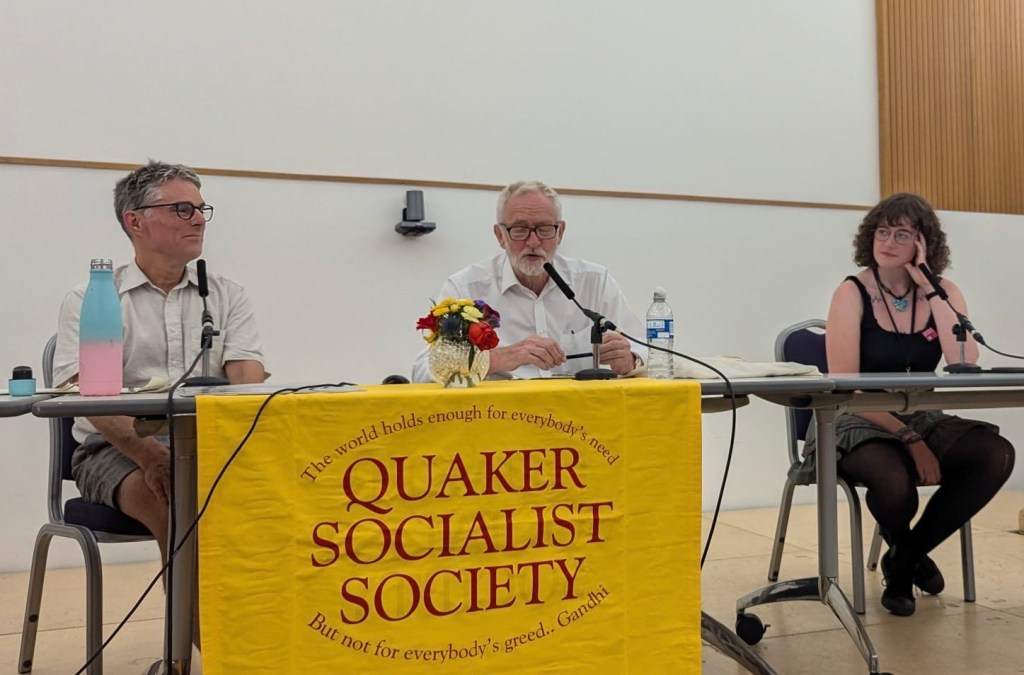
Salter Lecture 2024 – Video Recording
Salter Lecture 2024 – Transcript of Video Recording
Applause, with Sheila smiling: “Well, you know what I’m thinking, don’t you? I’ll carry on anyway and say what I was going to say about the Quaker silence and no applause!”
Sheila: “I would like to welcome everybody and thank you very much indeed for coming this evening. My name is Sheila Taylor, and I’ve been coordinating the Salter Lecture on behalf of the Quaker Socialist Society. For QSS, the annual Salter lecture is an important part of our Quaker life, and this evening will be run in the same way as other Quaker gatherings. There will be a short silence before each speaker. There will be no applause during or after any contribution, and the meeting will end when the people on the platform shake hands.
This annual lecture is named in honour of Ada and Alfred Salter, the inspiring Quaker socialist couple who settled in Bermondsey at the beginning of the last century and devoted their lives to transforming the slums of south-east London with their pioneering work on social housing, public health and environmental beautification.
The Salters would have identified wholeheartedly with tonight’s topic. As pacifists, they campaigned unflinchingly for the peaceful resolution of international conflict. For that they were denounced as unpatriotic and even physically attacked. On one occasion, their house was stoned by an angry crowd and on another, the local Labor Party headquarters was set fire to, while Ada was speaking inside.
Ada found by bitter experience how difficult it was to change government policy in this respect. ‘It is always like this,’ she said, ‘We are against the last war and against the next war, but not against the present war.’
Inspired by the Salters, QSS chose this topic for our 2024 lecture. And to speak on it tonight I’m delighted to introduce our two lecturers, Paul Ingram and Jeremy Corbyn.
Paul became a Quaker soon after his first CND march in 1983, and hosted Peckham Quaker meeting in his own home for 20 years. In the Green Party he has held many positions, including two years as co-leader of Oxford City Council. His working life has been spent within the British and global nuclear weapon policy community. Perhaps his most unusual connection being with Iran where he was not only involved with mediation over their nuclear program, but also hosted a talk show for five years on Iranian state television. Most recently, he’s been part of the interdisciplinary team at the Centre for the Study of Existential Risk at Cambridge University.
Jeremy is arguably the most prominent socialist figure in Britain. For the older generation, he has been there leading or supporting every campaign for peace, disarmament and social progress throughout our lives. And for the younger generation, his five years as leader of the Labour Party brought new hope onto the political scene with his radical vision of global peace and justice. Jeremy famously stated that if he were to become Prime Minister, he would never use nuclear weapons. And just like the Salters, this caused much anger and condemnation in certain circles.
We are immensely grateful to Paul and Jeremy for helping to promote the alternative Salter visionwith this year’s lecture. And if we may, we will now begin with a short silence and Paul will start speaking when he is ready.”
Paul:
I have lived since I was 12 with a sense that our society is on course for major catastrophe. In the early 1980s there were 70,000 deployed nuclear weapons and Reagan was talking at the time of confronting the evil empire.
My first CND march, as was just said, was in October 1983. It was sandwiched between two near misses for nuclear war – the Petrov false alarm incident just a few days earlier and the Soviet reaction to NATO’s Able Archer exercise a few weeks later.… though of course we didn’t know it at the time. We emerged from that particular Cold War seven years later, or at least it seemed that we did, just as I was starting out as a nuclear weapons policy researcher.
It turns out that shocks to the system can be positive. But the euphoria was short-lived. Even in the 1990s when the world forgot about nukes, I could see the hubris and the addiction to domination through force when America was imposing the Wolfowitz Doctrine and a neocon New World Order that would morph into Full Spectrum Dominance.… trends that led directly to the Iraq war, declining relations with Russia and confrontation with a rising China.
And now the threat of nuclear war hangs over us again, within a global polycrisis with multiple interconnected hazards, any one of which could lead to trigger general and global catastrophe. We harness powerful technologies such as artificial intelligence and biotech to exert our power over forces that obstruct our will. And the very same capabilities drive conflict and further risk.
Our economies are stagflated, with increasing debt at national, local and household levels. Debt owned by the global megarich who buy up the assets – housing and stocks – driving up those prices and people into poverty. Demand for public services is ballooning.
This of course exacerbates populist, nationalist sentiment, calls for control on migration, higher trade barriers, and economic decoupling, magnifying risk of global misunderstanding and conflict. And Trump hasn’t even been re-elected yet.
Whilst we contemplate our own oblivion, let’s not forget that numerous societies have already experienced catastrophe and annihilation, often as a result of contact with our own.
Wow. Take a deep breath. It’s depressing.
To be honest, I tire of my own negativity. When I hear others driven by blame, it’s even worse. There are many dangers in keeping our attention too long on the negative and the oppositional. We need to know when to move on.
Jeremy and I first met on the steering group of the Stop the War Coalition in 2002. I was representing the Greens and Jeremy…. well, the good people of North Islington. Our group organized the massive anti-war demonstrations before and in response to the invasion of Iraq. I remember asking how we could respond to our critics when they challenged us on what we would do about dictators like Saddam Hussein. The question had such heavy undertones of the ubiquitous challenge to pacifists of the Hitler question. The response from others on the group was quick…. This would complicate our message and divide us. We had to stick to the simple message: No war! This was right and very understandable. We were attracting millions of supporters, and Tony Blair was already politically wounded.
But we are back there again. Demonstrations and elections show the solidarity many feel with those that suffer from war today. The Lancet estimates that just under 200,000 or 8% of Gaza’s population, will have died from the war up to July. That’s a lot more than the estimates we are hearing, because of course many of those deaths are indirect. But it is in no uncertain terms genocide.
How are we to relate to Israel when recent opinion polls there suggest that around 40% think the military response has been just about right, and shockingly another 35% on top of that, that it has not gone far enough?
As Friends, we are urged to ‘Search out whatever in our own way of life may contain the seeds of war’. Here’s a question for you. Is Israel’s genocide worse than those conducted by the British in the past? How do we relate to them?
It does help to acknowledge our complicity and thereby transcend confrontation. At a conference this April in Moscow, in front of several hundred senior Russian officials and strategic thinkers, I spoke from the platform of my shame about Britain’s historical legacy in the Middle East and recent involvement in this conflict. It gave me the chance to point out that Russia too suffers similar delusions of grandeur and damaging military interventions, that we need to help each other overcome our addiction to the colonialist mindset.
But as Friends, our peace testimony is far from being a simple idealistic expression of moral judgment about wars far away. It is a highly pragmatic approach to relationship, culture and belief…. and holds clues around the political change necessary for our collective survival. It is about how we approach those we disagree with. Every time we blame THEM or set about solving our challenges in a confrontational manner is a step away from peace.
This isn’t easy. I know only too well the temptation to descend into righteous othering and confrontation. It may be driven by fear, by greed or purpose, or a need for control. The emotions involved can be intoxicating. They can also be manipulated to support powerful and dangerous ideologies, or draw us into others’ conflicts when they claim the status of victim. For example, we have an obligation to recognize and tackle racism, fear that divides and damages cohesion in our society.
But these sensitivities can be manipulated by those with their own agenda. Accusations of antisemitism have been used to isolate those who challenge settler colonialism, apartheid and genocide. The manner in which Jeremy was hounded out of the Labour Party was truly shocking, even to those of us in other parties. The manner in which this smear continues today is particularly distressing.
Complexity in our modern world, interpreted by soundbites and 15 second TikTok videos is all too often boiled down to binaries, us versus them, East versus West, Labour versus Conservative, disarmament versus deterrence. Ben Jarman talked about some of this on Saturday [In the Swarthmore Lecture] in relation to belonging and identity, the complexities of community, and our complicity living in a society that others its prisoners and excludes them.
I have created this rule of thumb for myself when approaching knotty problems…. If an action divides or isolates, it damages the prospects for peace. If it brings diverse people together and encourages communication, particularly when it’s difficult, then it’s positive (with the exception: if the purpose is to confront third parties).
It was this rule of thumb that enabled me to almost feel comfortable on TV defending the actions of an authoritarian leader earlier this month. Victor Orban had visited Zelensky, Xi, Putin and Trump in an effort to explore possible ceasefire proposals. In contrast, the European commission had decided to boycott his EU presidency in response.
But I forget sometimes. At the general election count, I caught myself seeing activists from other parties as ‘them’, those responsible for all the distortions and the disinformation that I had been attempting in my little way to counter. When I realized, I felt ashamed.
One of the arenas I work in is assisting states in the art of nuclear disarmament diplomacy. I devised the Stepping Stones Approach with the Swedish Foreign Ministry in 2018. This involves radical visioning of better futures as guide stars… but starts practically where states are at, taking them on a journey that organically unfolds. It forms the basis of the Stockholm Initiative for nuclear disarmament…16 non-nuclear weapon states driving political engagement. The first ever initiative to meet at political foreign minister level, five times and face-to-face (at least before Covid hit), to talk about nuclear disarmament.
As non-nuclear weapon states, the governments were aware that their perspective, experience and access to information was very different to those states they sought to influence, so they needed to adapt. The Initiative attempts to draw the nuclear weapon states into inclusive, collaborative, listening engagements to overcome the obstacles to disarmament. It involves visions of a world free of nuclear weapons, pragmatic steps that could take us in that direction, but crucially, a listening approach.
Proposals were developed as flexible points for open discussion. Invitations to dialogue. This radical incrementalist approach was heavily informed by Quaker writings. One such is expressed in Advices and Queries 17: Listen patiently and seek the truth which other people’s opinions may contain for you…Think it possible that you may be mistaken.
Certainty and righteousness drive conflict. Recognizing this, I have become a crusader for doubt. Doubt is, in the words of Leonard Cohen, the crack that’s how the light gets in. Have you ever really persuaded someone by the sheer force of your argument ever? If we have no humility and no curiosity, what is the point of listening to us? There’s no place for learning or growth.
I first met Rear Admiral John Gower when I was conducting the UK Trident Commission 12 years ago. He was the Assistant Chief of the Defence Staff, the uniform in the Ministry of Defence, responsible for nuclear weapons policy and the coalition government’s own Trident Alternatives Review. As you can imagine, we disagreed profoundly. But we treated each other with respect and later built a friendship across the divide that separated us – a peace activist and a nuclear war planner.
When I pitched my idea for the Stepping Stones Approach to the Swedish Foreign Minister in New York in 2018, I took John with me. Our personal stories and our cooperation were far more convincing than any verbal persuasion.
Now don’t get me wrong, I’m not advocating for naivety or even compromise…though it is important to be flexible. It does involve us expressing our own view with confidence, knowing it has validity as one amongst many. As an anti-nuclear activist, I would assume that my view was unwelcome in the halls of power. But I found that if I expressed it with sensitivity and respect, there were some that would receive it with interest. John was not interested in a squidgy middle ground. Some mistake this as weak. The Stepping Stones Approach grew up alongside the emergence of the Nuclear Ban Treaty and was strongly criticised by some who favoured clarity and confrontation on the basis of strong positioning.
But such an ideological attachment to righteous confrontation can harm our agenda. We can be better than that. I used to be a talk show host on domestic state Iranian television. I had the privilege to deliver a lecture to a number of high level officials in Tehran. I suggested they shift their scientific investment away from nuclear power, a poor bet for many reasons, and instead invest in renewables. Isuggested they could export this technology across the region and through this promote the Islamic Revolution, one of their principal goals. There was significant interest, but particular special interests and an established confrontational mindset blocked any shift.
As a lifelong anti-nuclear activist I have long come to recognize that my negative point of departure -rapid disarmament – has been at times an obstacle to the engagements I have sought with those Ineeded to influence. I needed a more positive and more radical point of departure. A big picture vision for a sustainable international society, building peace relations with itself. A vision that could unite diverse perspectives and peoples.
Now I’m not saying that an anti-nuclear protest is mistaken, far from it. But the real enemy is the manipulation of fear, the grasp for power, an obsession with self-interest and so-called national security described as ‘realist’…This is deeply embedded in our culture and assumptions about human nature and we need to shift it.
This new Labour government has just started a defence review. It promises a rapid rubber stamping of increases in defence spending. Our armed forces must be battle-ready for confrontations with Putin, Xi and other author authoritarian leaders challenging the US world order.
But it does so on the back of a questionable mandate. Just a little more than half the resident adult population voted a few weeks back. Less than 20% voted Labour. Little more than 35% of the adult population voted for all three mainstream parties, and they hold 95% of the seats. Many, many of those voted for negative reasons – to get them out. The politics of negativity and confrontation. Our politics is broken, so much so that we have come to imagine that politics is defined by confrontation.
This goes deep. We set up our parliament, our courts, even our educational approach on the idea that truth emerges from confrontation. Our deepest secular values of individualism and neo-liberalism further entrench this conflict. Is it any surprise then that this culture drives conflict internationally?
And most reasonable people despair at this conflict, but assume that it is inevitable, when it is not. Granted, self-interest is part of human nature. But it is not the full story. To stop at the assumption that we are by nature selfish could be the single most dangerous idea that humans have ever invented. As a good friend and political theorist, Sonya Ahmadi puts it, this belief lies at the heart of game theory, nuclear deterrence, and the rise of the neoliberal revolution that led to Thatcherism, Reaganism, and was then consolidated by Tony Blair. So its current incarnation is relatively recent and particularly extreme.
Self-care is essential. It protects our capacity to serve the greater good. When we fly, we are told to fix our own oxygen mask before we sort our child’s. But if we believe that self-interest and confrontation is the main driver of our relations, there is no hope of avoiding catastrophe. It’s a belief that could ensure that we as a species are self terminating.
We need a politics that involves true listening. I hope that Jeremy will tell us a bit of his amazing efforts over recent weeks to stimulate engagement in his own constituency through the mechanisms of deliberative democracy, and some of his work with the peace and justice movement. We need an alternative citizen-led open process that builds active peace within our own communities and enriches relationships across cultures, backgrounds, and experiences.
This listening also needs to happen within and between our political parties. I have a dream. I imagine an explicit, organized, cross-party movement of people listening and collaborating across political divides, united not by policy outcome, but in how we do politics… exploring ideas not as positions, but as invitations for dialogue with an expectation of movement. I imagine us rebuilding our politics based upon open thinking, not closed, dynamic adaptation and continuous improvement. And I think this is the meaning of the peace testimony. And this is a critical element of our collective salvation.
Because I believe that the dynamics of nuclear confrontation that I witnessed this last week in the Geneva halls of the United Nations are driven by this dysfunctional assumption that domestic politics and human relations are determined by confrontation.
I met Jeremy when he was party leader. I suggested that whilst we may feel ourselves on the right side of the debate over unilateral nuclear disarmament, we were not carrying the British people with us. We thereby fall into a trap and inadvertently hand control to those who believe in the benefits of nuclear weapons. I suggested we run a major public conversation on how the UK could better drive global nuclear disarmament, a question with clear public majority support that could unite with us.
And I had many ideas because I’d been thinking about them when developing the Stockholm Initiative. This could turn an issue often perceived as a political liability into an asset. Jeremy agreed wholeheartedly, but at the time the idea didn’t take off.
It may look even less likely now. Public confidence in nuclear disarmament has taken a battering with the war in Ukraine and the demonisation of Putin. But the awareness and fear of nuclear war is high, and confidence in the stability of nuclear deterrence has also taken a massive hit. So our point of departure is the widespread desire to reduce nuclear risk. From there we can go on a journey, a journey that might involve some of these steps…
…One that rejects the manipulation of catastrophic risk through nuclear threat.
…One that builds habits of cooperation across states that in the past have helped create the disarmament agreements that we actually have.
…One that acknowledges the weaknesses of nuclear deterrence and explores alternatives.
…One that might build towards a common security structure with the Russians and Chinese given respect and their approach, culture and engagement also respected.
…One that establishes collaborative and fair global governance mechanisms that genuinely escape a supremacy power-play agenda.
This journey would give us human beings just a chance of collective survival. Our conversation may involve citizens assemblies, online engagement, artistic expression, and other forms of genuine interactive discussion and education. It could expose the ways in which our previous government blocked multilateral nuclear disarmament talks, and the consequences arising from the current Prime Minister’s blind commitment to a failing Trident replacement program.
But the principle focus will be the positive open invitation into the citadel of foreign policy currently controlled by a small elite. In curating this conversation, we can hope to build confidence in the possibilities of a safer world. And it would be more difficult to dismiss us as naive purists.
This is why I’m honoured to share the platform tonight with a politician who has for decades campaigned for peace in all its aspects, who inspires constructive hope in so many. But also, contrary to the claims of his detractors, as a human being approaches engagement in a kind and generous manner, rarely condemning individuals, and willing to experiment in fresh renewal of our democratic process.
Jeremy:
Thank you Paul. And thank you very much for inviting me to come to the Salter lecture. I consider it an enormous honour. I’ve been to one previous Quaker Socialist Society meeting many, many years ago, and I’m very grateful to you for inviting me here this evening. And I’m looking forward to the questions and discussion that we’ll have.
Because the role of the Quakers historically has been protecting dissent, protecting the right of freedom to follow whatever religious course you want to, and standing up against the power of the centralized power of the church, which Tony Benn always described as the one piece of nationalisation the British state was very proud of: the construction of the Church of England as an all- powerful body. He was essentially a born dissenter, I suppose you’d say. And I absolutely admired Tony for that, and for many, many other things.
And I think to have the evening in memory of the Salters is really wonderful. Because Dr Salter was a doctor in Bermondsey and an MP for a very long time. He was one of the very few Labour MPs who managed to survive the 1931 election when Ramsay McDonald crossed over and the National Government was elected. He survived that and sadly stood down in 1945. He was quite elderly by then, but he would’ve made an amazing contribution to the construction of the National Health Service and maybe it would’ve been even better if he’d still been in Parliament at that time. And his work for peace was also alongside his work for social justice and health in his community.
And Ada Salter was an amazing woman in so many ways. An environmentalist 50 years ahead of her time, who started the campaign in 1913 to try and get clean air in London at that point, because she was pointing out the industrial effluent that was obviously killing children in the community where they both lived.
And I just think we should always remember those people that stood up under difficult circumstances. And no doubt, I can’t bother to research it, but I would imagine the Daily Mail was probably critical of them at the time. I would imagine they wouldn’t have gone along with all that sort of stuff somehow. And so it is in their memory that it’s right that we meet, and right that we understand the bravery of often random and sometimes surprising individuals throughout history who’ve tried to make the case for peace rather than war, to make the case for social and human and environmental justice rather than the general run to go to war.
And the imperial history of this country, which we’ll come onto in a moment, has been linked to a whole programme of massive education of our population, particularly in the 19th century when general education became the norm from the 1870 education reforms. There was a whole indoctrination process of every school child into the value and the benefits of empire and with it a sense of racial superiority over people in Africa, Latin America, south Asia, or anywhere in the world that wasn’t labelled Europe. And on top of that, there was a superiority over Europe. And those elements of mental superiority ended up being able to be used to support the most ghastly conflicts that the world has ever seen.
And so I think it’s important that we think deeply in terms of how children’s minds are formed, both in primary and in secondary school, through the teaching of history and through the teaching of moral lessons about how you deal with each other.
At the moment, if you look around the world, it’s hardly a world of peace. The major war that’s going on in Ukraine has cost the lives of hundreds of thousands of people. The most massive level of environmental disruption, destruction rather, and disruption of food supplies to Africa. And the deaths of very large numbers of conscripted Ukrainian soldiers and conscripted Russian soldiers.
A mother or father mourning the loss of a son or a daughter is the same whatever nationality you are. It’s still the loss of one of your dearest and loved ones, whatever the conflict or whatever side they’re fighting in that particular conflict.
And I find it beyond sad that none of our leaders in describing the war in Ukraine ever use the word peace, ever use the word, search for a way out of the conflict. It took the Pope to make some moves.It took the African Union to make some moves. It took some effort by Antonio Gutierrez to try and get towards at least a negotiation or a settlement to try and get a ceasefire and move on from there.
But instead, our government has just committed several billion pounds per year, ad nauseum, to Ukraine, much of which will be used to buy weapons from this country to fuel the war. I hate the war in Ukraine. I want to see it stopped. I don’t think what the Russians did is any way defensible or right. It doesn’t mean there hasn’t, there shouldn’t be, a search for peace to save life in Ukraine.
And I have to say, sort of en passant, that I absolutely support and welcome all Ukrainian refugees that have come to this country, have come to my community, have come to any community in this country. If we can do that for Ukrainian refugees, we can do that for refugees from Afghanistan, from Somalia or from anywhere else in the world. We don’t have to restrict it just to people coming from Ukraine.
And the other wars going on. Congo. Massive loss of life in the Congo at the present time occasioned by very powerful militia forces, which are funded essentially from the minerals industry, and the mining companies, which are used to extract coltan and cobalt from the Congo, which ends up in mobile phones and exported into the so-called respectable mineral chain via Rwanda. So it’s child labour, militias, and a horrendous death rate throughout the Congo, which is exploiting the natural resources of the Congo to go into the supply chains of industries all over the world.
And I’ve had the advantage, if it is an advantage, of visiting Congo twice and going to Goma, which is in the east of Congo, which is a city of refugees, of thousands of women who are victims of rape, because rape is a weapon of war in the Congo. And at the same time the most glossy, expensive hotels and headquarters of mining companies, alongside roads that have no surface, that have no pavements, that are just deeply rutted. And every open space is occupied by refugees in tents.
You just see all the horrors and the greed of the world in one city there in front of you. And that the Congo is absorbing not so much the heavy weaponry that’s going into the Ukraine or other conflicts, but it’s absorbing large numbers of lighter weaponry, which is just as deadly and kills tens of thousands of people.
The war in Sudan, likewise, massive. Huge loss of life going on there. And again, the arms trade is feeding into it. And Paul has already explained so much about Gaza and the conflict there. And we are now witnessing 40,000 deaths in Gaza in what’s just over nine months have happened. And on top of all the others that have been killed over the years. And at least 2,000 deaths that have happened on the West Bank by settler violence against Palestinian villages.
And we’re watching this all live on television. We’re watching live on television as children die from diarrhoea, from dehydration, from hunger, or from operations that lacked anaesthetic because there was none available there. And within five, 10 kilometres of where those children are dying and other people are dying, older people are dying, there is the supply of water, there is food, there is medicine, and there is anaesthetic, there are the conditions. We’re just watching this in real time on television.
And so all our demonstrations, all our meetings, all our marches have made a difference, have forced the pace on international law. And I went to the ICJ discussion on the genocide application that was made by South Africa. They have made a difference and they have forced governments. And indeed the British government to my pleasant surprise has now withdrawn the objections to the ICC arrest warrant on Netanyahu. It’s not very much because they should have just said automatically, we are signed up to the Rome Convention, therefore we must abide by it. But at least that statement has been made.
But the issue of arms trade, arms deals and arms supplies, and the use of RAF Akrotiri as a staging point for dropping bombs, or taking bombs rather, into Israel which are later dropped on Gaza, is still going on. And so the demand for an end to the security cooperation with Israel is a very, very important part of our demands that we have to make in all the demonstrations that we put forward.
Now, I say this because I was in parliament last week when the House came back and we had the State Opening and so on, and the government grandly announced that there wasn’t much money available for improvement of services. And Rachel Reeves spent about an hour today explaining there was no money available for anything that I could make out. And she gave a whole list of things that are going to be cancelled because there isn’t enough money available.
One of them I was actually quite pleased about, and that was the cancellation of this crazy tunnel next to Stonehenge, the A303. So the A303’s been cancelled. Wow, great! I’m very pleased about that, because I think you should leave Stonehenge alone and let us enjoy the history of it and understand the history and explore it, not destroy it.
But at the same time as the general lecture is coming out about the lack of resources that are available, there is no challenge to the grotesque levels of inequality within our society. A society of billionaires and food banks, and increasing gap between the richest and the poorest. And no challenge to the proposal to increase defence expenditure from slightly under 2% of gross domestic product now to 2.5% by 2030. And indeed, there are quite a few think-tanks hard at work, no doubt well funded by various arms interests, who think it should go up to 3%, completely arbitrary figures plucked out the air, saying we need this.
That means in financial terms that an annual expenditure of about 55 billion a year will go up in the case of the UK to over 80 billion a year, plus whatever inflation there is between now and 2030. That is a pretty big increase in expenditure, just on defence. And that is not all being spent on nuclear only by any means; only quite a small amount of that is on nuclear. It is on a whole range of weaponry, much of which will actually be bought in from the United States. And so it is, I think, an issue that we should be talking about much more. That if they’re saying there isn’t enough money to bring in a national care service and a national care programme for people in need of social care, then start looking at the defence budget and start looking at that as a source of money that you could put into the services that we need, as well as obviously changes in our taxation system.
Now, nuclear weapons are something that I suppose brought me into political activity when I was at school in Shropshire. I quite enjoyed being the only one – I was the only one in my class – that was opposed to nuclear weapons. And apart from my brother, the only ones in the school that were opposed to nuclear weapons. And running a CND branch in Newport Shropshire was a lively affair. There was all but two of us in it. But nevertheless the arguments were still made, or we still made them as best we could.
And I’ve always been inspired by the simple bravery of people that founded The Committee of 100, founded CND, and continued what was an argument very much in the face of convention saying that nuclear weapons are unacceptable in any terms. They are the ultimate weapon of mass destruction. There is no defence against them whatsoever.
And I was often confronted with all these questions about: ‘Are you a real man? Are you prepared to use the nuclear weapon?’ And I sort of tried the testosterone argument. I said, ‘Yeah, I’m a really, really real man. I wouldn’t ever use them.’ Ooh, weakness, weakness, weakness. And so, by simply saying that I would never use nuclear weapons, that unleashed years of abuse in every conceivable way from the defence establishment, the arms industry and everyone else against everything that myself and others were trying to say.
I stick with that. Nuclear weapons are unbelievably evil things. There can be never be any defence against a nuclear weapon. And anyone that wants to use a nuclear weapon basically is happy to contemplate destruction of life on the planet or at least in parts of the planet. There is no defence against it, I think that we would all know. And the cost of nuclear weapons is massive and enormous, but it also means you have to look at the pressure that is there, which leads to policymaking, which gets us into the situation of spending this huge amount of money on arms rather than ever discussing peace.
And through the Peace and Justice Project, we just produced this book called ‘Monstrous Anger of the Guns’. You’ll recognize the words ‘monstrous anger of the guns’ from the First World War poetry. And we put together this book about how the global arms trade is ruining the world, and crucially what we can do about it. And this is a lifetime book. It’s just been published.
The printers really let us down, totally confused and threw us totally. We were expecting to launch the book at the Peace and Justice Project International Conference on September the 14th. And last week they arrived at my office with a thousand copies of the book already printed. They let us down and came a month early. I mean, you can’t trust printers anyway, can you? So it’s on, it’s going on sale now. And you can either buy it online from the Peace and Justice Project or I’m sure Housemans will be able to supply it and other bookshops. But please look out for it. Sheila, this is your copy. No applause [laughter] but thank you, Sheila, and I’ll sign it later if you wish.
So what this book does is to try to outline the cost, the effect on the wider economy of this concentration of brilliant people and brilliant research methods on production of armaments and weapons of war such as planes and ships and so on, and what the alternatives could be, what the alternatives could be with those skills there. And it is not, absolutely not, an attack on anybody that works in the arms industry. It is saying their skills should be put to something more productive and more useful. We are not in the business of making enemies of people who just need a job. We don’t want to sort of go into an area and say, Well, you know, none of you should be working there. Well, maybe that place should be making something different.
And there are plenty of examples in history. Back to 1945 Boulton Paul, aircraft manufacturers in Birmingham, in three weeks stopped making aircraft in parts. And three weeks later were turning out prefabricated aluminium houses to deal with the housing crisis at the end of the Second World War. Three weeks turned the whole factory around. And then the wonderful people at Lucas Aerospace in the seventies with their Lucas Aerospace Plan – Mike Cooley and others that put together that plan.
And those that are now challenging urban systems and so many others about what they’re doing in this country. There’s a rich vein of people that have always had the imagination to think and act for something very, very different. And so I think we have to come into that scenario now and ask people to imagine a very different world, but it does mean serious campaigning work.
But it’s also understanding the dangers of the situation that we’re in. I’m sure many in this room have read a great deal of the history, particularly the run up to the First World War, the brilliant book by Adam Hochschild on the descent into the First World War and the way in which the various military alliances had come together and all the secret deals that had been done and the secret treaties which required each other to go to war. Suddenly all collapsed in three weeks from relative peace in Europe to the First World War and all the deaths that went with it.
And those people before the first World War – Keir Hardie, Jaures and many, many others, Karl Liebknecht and Rosa Luxembourg, and many others – that had tried to build that alliance of opposition to war all across Europe and actually made amazing progress in saying, British workers don’t want to kill German workers, German workers don’t want to kill French workers. And sort of working class unity across the continent just collapsed in a relatively short time at the start of the First World War, where Keir Hardie went from being the leader of the Labour Party opposing the First World War, to being shouted down by his own parliamentary colleagues as he spoke out against the war. And they sang the national anthem behind him in Parliament. And as we know, Keir Hardie died in 1915. He didn’t get to see the end of it. But there was consistent opposition to the first World War by very brave people such as Fenner Brockway and others who went to prison for it.
The outcome of the First World War. We’re living with the consequences today. The Treaty of Versailles, that so tried to humiliate Germany and the German people, gave the ground on which the Nazis grew up, and the convenient lines secretly drawn on maps all over the Middle East gives us the borders that in the Middle East at the present time. And the various elements of double dealing have given us the conflict that we’ve had for all that time, going on at the moment in Gaza. So we have to think quite carefully about what happens after wars as well as what happens in the build-up to them.
The end of the Second World War, yes, did bring about decolonisation of some places, But it also brought about the partition of India and Pakistan and the loss of several million lives as a result of it. And now a state of war between India and Pakistan that’s gone on for all of my lifetime and shows no signs of abating at the present time. So it is a question of understanding what we can achieve in educating people for peace.
So I would start with a couple of things. First of all, I think that the teaching of history in primary schools and secondary schools is the most important thing to concentrate on. I’m not so worried about teaching at university history because by that stage, students have obviously developed, one hopes, critical abilities of their own and will study and research whatever they want to do, one hopes. But the sort of rather formalized, not very analytical history of European expansion, of colonialism, of the buildup of colonial attitudes and racial superiority is a very, very serious issue. And so the easy word ‘decolonise the curriculum’ is actually quite important.
Dawn Butler and I developed an idea that we wanted to do and set up something called the Emancipation Education Trust, which would provide resources in schools which could start to look at issues such as how the slave trade was stopped, how it was abolished, and the bravery and the deaths of tens of thousands of slaves in uprisings against the slave trade. It is about understanding our history and above all where historical power comes from.
And we as socialists, what is our aim? Socialism is about producing for need rather than profit. It is about accepting the needs of everybody to eat, to have somewhere to live, to have a school to go to, to have a doctor to go to, to have somebody to care for you when you need to be cared for because you don’t have the ability to care for yourself.
It’s not a very complicated idea. Socialism is essentially one of basic humanity of how you care for and look after each other. But it’s also about how we live our lives and how we live with the environment rather than on top of the environment, sustainability. Sustainability of our lives, by living with nature rather than above it. And so to me, environmentalism and socialism are the same thing. And peace and socialism are absolutely the same thing. And so we have to mount those arguments.
Now, there are opportunities to mount those arguments. The government has just announced it’s going to have a defence review. All new governments have a defence review, and this one is no exception. They’ve announced the defence review. I’m not exactly clear who is undertaking this defence review yet, but maybe I’ve missed the announcement on it. But that’s also an opportunity for all of us.
What I’ve put in a suggestion to a number of peace organisations is that we come together and put in a collective response. A collective response to the defence review, pointing out the issues of costs, pointing out the issues of dangers around the world, and pointing out, as our book points out, the incredible lobbying power and political influence, power of the arms industry in the United States, Canada, France, Britain, Germany, and so on, all around the world. And the way that the war in Ukraine has led to a huge increase in armaments production in Europe, with Germany now opening up a particular armaments factory just for the war in Ukraine. But it’s also led to a big increase in arms production in Russia, in China, and in India. And so essentially there are two power blocks in the world that are feeding more and more weapons into the war in Ukraine. And the video images of those drones and other things are then used at the International Arms Fair to advertise the effectiveness or otherwise of particular weaponry. Is that really the way forward we want to go in this world? Or are we going to have some serious proposals for peace?
And so my argument would be: the Defence Review is also an opportunity to survey the issues of conflict, violence and wars around the world and turn that into arguments for peace. And so the Defence Review gives us that chance. Last thing I want to say is this – you mentioned it earlier, Paul – the rise of the far right in our society and the argument that is used, the argument that spending money on armaments and defence is actually an economic generator. So you decide to order a new aircraft carrier, order new fighter planes, it obviously creates a lot of jobs. It is essentially public spending on those jobs.
I have no problem with public investment to create employment and develop products, no problem with that whatsoever. But it depends what the products are and if they’re actually going to benefit people or they’re going to kill people. It’s no good complaining about the death of people from arms we export, if at the same time we export those arms which we know full well are going to kill people later on.
So it is a question of making that argument for peace, and I hope we were able to do that. But the rise of the far right. Last week you had Stephen Yaxley-Lennon and his friends trying to occupy Trafalgar Square with the most appalling language against refugees, who themselves are victims of wars in Afghanistan, Iraq, Iran, Syria, Libya, you name it, they’re there.
I’ve been to Calais several times. You meet people who are victims of wars, some of which you’ve barely heard of, and just trying to get to a place of safety. Farage and his party, the Reform Party gaining 4 million votes in the election, which was the major factor in the election in the loss by the Tories. But Labour did not gain any more votes than previous elections. In fact, it lost votes on the last two general elections.
The danger is that the far right will rise on the basis of the arguments against minorities such as refugees being the cause of the problems of underfunding, of education, of housing, of health and so on. It’s complete nonsense, the argument. The underfunding of health and housing and education is nothing whatsoever to do with refugees. It’s everything to do with the direction of public spending by (a) giving tax breaks to the very rich. And secondly, by the excessive amount of money that’s been poured into the defence budget. So we need to sort of balance these things out and use these arguments. Otherwise the country descends even worse and deeper into the horrible racist abyss that they, those people would want to lead us into.
The left are very keen on historical parallels and saying – and I’ve used a few myself saying this is like it was before the First World War. This is like it was before the Second World War. And so nothing ever repeats itself exactly, but you have to look at the sense of hope and optimism that’s there in politics in any way. And having just gone through the process of the election campaign in my own constituency, what I found most inspiring about it was the number of people that came along from all over who just said they wanted to be involved in something that was hopeful rather than fearful. Something that was positive rather than condemnatory. Something that was collaborative rather than exclusive. And it was to me a fascinating experience talking to the people that came along just to join in because they wanted to experience something very, very different.
And in the Peace and Justice Project we have produced this book. We’ve also produced a poetry book, ‘Poetry for the Many’. And we’ve done lots of poetry events around the country and other places. Well, I’m going to Ireland next week to do some more there. And this brings in a lot of people who just want to think about ideas and things, allow people’s imagination to flourish. And that is important. And we’re holding our international conference at Queen Mary College on the 14th of September. And that’ll be a hybrid conference. It’ll be both physical and online, with people speaking live from South Africa, from India, from the USA and other places. And it will concentrate on global living standards, environmental issues, and obviously issues of war and peace such as the wars in Ukraine and other places.
And locally, just to finish on Paul’s invitation. I see the way forward politically, as far as I’m concerned anyway – no longer being a member of the Labour Party, because the Labour Party has decided I’m not fit to be a member of Parliament or indeed a member of the Party, which is funny really – forming local assemblies, open assemblies in which I will report on what I do. But also we will then encourage the local community to come along with its ideas: ideas on housing, ideas on health, ideas on mental health issues, and so much else, as a sort of bubbling up of hope and encouragement of people dealing with the issues that they face.
The issues of war and peace are what the Salters faced, faced with incredible bravery, in the most difficult of circumstances and maintained their integrity and their principles to the very last and remembered forever in Bermondsey for what they did for that community there, for what they did for working class people whose lives were physically improved a great deal because of their work.
And if by coming together as thoughtful associates, we can achieve a considerably better world by opposing the whole concept of war, instead look for the magic word of peace and the justice that’s necessary to bring about peace, then we’ll have done good work.
I look forward to our discussion. Thank you very much.
Question and Answer Session (with Imi Hills, using Slido)
Jeremy:
….the opposition to the Vietnam War in the 1960s. Those of us that can remember that far back were very, well, appalled at what we could find out was happening, because it wasn’t televised anything like the extent wars are now. And then we stood up against the mainstream opinion, which I remember being nauseously explained on the television every night, was that it was all about a house of cards falling over. Unless we stood up against the threat, the communist threat in Vietnam, then the whole world would be destroyed. And so we had to support the American strategy in Vietnam, which led to the horrors of that war.
I’ve just finished reading a book about Kennedy and his involvement in the Vietnam War, which actually was quite revealing. But that war did bring a lot of people out onto the streets here and in the United States. And that generation is still around, most of them, and those, that generation, learned a lot of lessons from it.
Later conflicts in the Gulf War and then later Iraq did mobilise very large numbers of people. Almost separately the anti-nuclear movement, that grew up from the 1950s onwards, then came together with the totality of the peace movement, when we came together in 2001 when we set up the Stop the War Coalition.
The Stop the War Coalition was not set up after Iraq, it was after Afghanistan, which is a quite significant point. And we had various discussions and, as you remember them quite well, we eventually settled on the generality of opposition to the war on the basis we could mobilise the most people on that. It was simplistic and it is simplistic, yes, but I always felt, and others felt very strongly the same, we just had to get the numbers out and the massive movement out against it. And so we did get the million plus demonstration which, whilst it didn’t stop the war, those activities did deter other countries such as France and Spain from joining in the war. It did have quite a big effect.
But the numbers that are now active in solidarity with the victims of the war in Gaza are not quite at the same level, but they’re more consistent. We’ve now had 14 national demonstrations on Palestine. I’ve been at all of them. And I sort of think every time I go, oh goodness, here we go again. Another, another demonstration, another march through Central London. And then I hear in my head phone conversations I’ve had with people in Gaza, in the West Bank and so on, they say, please, please, please carry on doing it because it gives us some encouragement that somebody does care about us.
And it does create levels of embarrassment amongst politicians. And I sort of monitor the language that’s used over ceasefire in the House of Commons. It was a dirty word last October, and now they’re all falling over themselves to say how much they support a ceasefire in Gaza. So in a slow moving sort of way, it’s had an effect. And so, let’s not run away with the idea that people aren’t, don’t care and aren’t concerned about it. They are. And it’s up to us to also the link the issues. And that’s why I made the whole point about levels of arms expenditure and the effect that has on the social needs of the people amongst whom we all live.
Imi:
There is a question here that says: How do you square citizen-led conversation on foreign policy with the fact that British citizenship is a heavily guarded privilege?
Jeremy:
Well, yes, it is a good point. It is an extremely guarded privilege. And I don’t know how many of youhere have ever enjoyed a Royal United Services Institute breakfast where they tell you about theneed to go to war all around the world? Yes, you’ve probably been to one too? You’ve seen thosemaps?
Paul: Absolutely.
Jeremy: The maps. Yeah, the maps. You know, Johnny Foreigner over here, we’re going to, he’s going to cause us trouble in the future. But I do remember some deeply depressing conversations with all these people in the early nineties. The nineties was the big moment, it really was: end of the Berlin Wall, agreements on nuclear reduction, agreements on ABM, etc, etc. And there was a reduction for a short time in defence expenditure, and certainly reduction in numbers in nuclear warheads. It wasn’t disarmament, it wasn’t peace, but it was a move in a very important direction.
And I just remember endless invitations from think tanks I’d never heard of to go along and be lectured about the dangers for the future. And they would sort of give a whole list of countries that could give us problems in the future. You must have gone to some of these things?
Paul: Yes.
Jeremy: They tell us how we have to be ready to go to war at a moment’s notice. And the current period is the most dangerous they’ve ever known because there is disarmament going on. We’ve got to stand up against that kind of language and produce an alternative.
And so you’re correct that foreign policy is very much a sort of elite activity, conducted in Chatham House, etc, and all these think tanks. In reality it has to be on the basis of a popular discussion and debate about the nature of war. And the Iraq War originally was not opposed by a majority of the population of this country. There were concerns, but opinion polls right up to February, March 2003 did not show majority opposition. It grew when people realized they’d been lied to over the weapons of mass destruction issue.
And an interesting point you might pick up on is that in the midst of the 2017 election, the Manchester bomb happened, which was appalling at any level, and I obviously did like any other human being would do, condemned the bomb and the horrible loss of life that went with it and went to Manchester for the memorial events that were held in Albert Square there. And then all campaigning was suspended in the election. And then I decided that we should restart the campaign as soon as we could and had an argument with Theresa May about restarting the campaign.
And then I restarted it by giving a lecture on what I believe to be the causes of the growth of terror, which was of course the wars that we’ve been involved in. I was advised by a very large number of people, don’t say that. Don’t go there, don’t give that talk, don’t do that debate. It’ll ruin everything in the election campaign. I said, sorry, I’m doing it, because this is what I believe. We’ve got to as a nation understand that foreign wars have implications. So I duly made the speech, and it was duly condemned within minutes on all of the media. And then YouGov did a telephone poll three hours later and found 60% support for what I’d said on the basis that it was opening up the debate. The opposition collapsed immediately on that. So you can use a moment to try and invite people to learn a particular lesson.
Paul:
Yes. I think there are a number of dominant narratives in our society that are pushed by the elites that are actually quite shallow. And we can nibble away at them, and that’s one. And another one would be that we stood alone in World War Two and that Hitler was like some kind of evil. There was lots of evil there, but there was also a sense in which he was a product, as Jeremy was saying earlier, of the Versailles Treaty and history and legacy. And we are often given these very binary moments where you fight or you give in, you dominate or you’ll be dominated.
And then there’s a demonization that goes on. So Vladimir Putin is a terrible autocrat. He has all sorts of nastiness attached to him, but is he any worse than so many other leaders within our system? Is it so bad for me to go to Moscow – to the condemnation of large numbers of people – to talk about the way in which Britain has played a negative role, just like Russia has played a negative role?
I was able to speak to two deputy foreign ministers and a whole coterie of diplomats and military people from Russia about the negative actions, the negative consequences of their actions. But from a place of compassion and acknowledgement that we were part of the problem. Because if it’s always us and them, black and white, good versus evil, we will fail, and this will get worse and worse.
I think people understand that because their direct experience is one of oppression, of feeling blamed in so many different ways. And we need to overcome this sort of conflict triangle that people draw us into, where we are either victims, perpetrators or rescuers. And I think Ukraine today is a very clear case in point. The war in Ukraine is devastating, absolutely devastating. In Ukraine, the Ukrainians are being given incredibly difficult choices. We are by proxy fighting that war to the very last Ukrainian. And then people here are told that the cost of living crisis is Putin’s fault. When there are choices there about the way in which we are fighting that war by proxy. And these are difficult messages to get across, but I think people understand complexity more than we think.
Imi:
One of our top questions is: If countries stop giving funds and weapons to Ukraine, Russia might
overwhelm them. How would you suggest we stop funding war without abandoning Ukraine?
Paul:
I’m involved with somebody else here, a friend of mine, in some back-channel conversations with Ukrainians at the moment. And they’re quite clear that they need support and they need military support. But if we just kind of keep pumping weapons in, then more and more people will die. And there will not be a resolution to this conflict. It will be a frozen conflict that will continue on, on and on. More Ukrainians die.
This is what I meant in my talk when I talked about righteousness. We need to go beyond being right. We understand that sometimes in our most dear relationships where we have conflict, you know: two people living together, both feeling right, drives conflict. But there’s something more important than being right. And it is actually about reaching across and building relationship. The Russians are ready, I think. From my engagement with them, from my conversations, they’re ready to talk. And we need ceasefire. The more we keep pumping arms in, the more it continues. And the people that need ceasefire most are the Ukrainians themselves. Because we’re in a war at the moment where two sides are fighting over parts of land that neither of them really want because they, because there’s a lot of conflict there, inside those parts of Ukraine. There are choices, and there are opportunities here for some kind of dialogue, but it requires ceasefire first. And I think we’re closer to that than the media would like us to think.
There are leaders on this side of the conflict that don’t want ceasefire, that are arguing against it. And encouraging those within Ukraine to avoid it, to wait before ceasefire. Those actions, I believe, are criminal. I think what we need to be doing is talking about ceasefire, talking to the Ukrainians about where we go from now in this very difficult situation. But continuing to supply them with weapons because they ask and promising them NATO membership when we have no intention of giving them that membership. And when we privately tell them there is no hope, and in public we tell them that there’s an open door policy. There’s a lot of war-mongering going on by our leaders. And I think it is time that we took a very radically different stance.
Imi:
The top question is: During your years as Labour leader, you inspired millions with hope. Where is the political home now for young people and those who want to see real change?
Jeremy:
I find, I spend a lot of time travelling around the country doing lots of events, Palestine and many, many others. And I find large numbers of people who tell me they became politically active from 2015 onwards and have remained so, sometimes in different campaigns, housing, environment, peace campaigns and support of Palestine. A whole lot of issues like that. So that many of those people have been politicised and remained so. Is there a convenient single political home for people at the moment? Not obviously, but there are lots of avenues in which people can follow them.
And the five of us that were elected as independent MPs on July the fourth – that’s the ones from Leicester South, from Blackburn, Batley & Dewsbury, and Birmingham Perry Bar, and myself – have a common thread in that we’re all elected calling for a ceasefire in Gaza – other issues as well, but that was the common thread that ran through it. We are working very closely together. We didn’t know each other particularly at all before the election. We formed an informal grouping of the five of us. We’re working closely with our friends in the Green group, which is bigger now in Parliament, and we’re getting on fine with them. We’re also working with people in Plaid Cymru, as well as the Scottish National Party and quite a few people in the Labour Party that are also happy to work with us on a number of issues, particularly surrounding ceasefire and things like that.
I’m developing the idea of citizens assemblies and I wrote to get an article for The Guardian about this, sort of, I broke a self-denying ordinance, because I get very irritated by the Guardian, but I did write… (I’m sure everybody does. Don’t say anything!)… but I did write an article for the Guardian a week after the election in which I was setting out the ideas of mobilising popular opinion. I think this could develop very quickly. This could well develop into a sort of political voice of some sort, which brings together a whole lot of disparate groups.
What I am nervous about is forming a new political party with the top-down structure of people who ordain what the politics of it should be and the ideology of it should be. I think the mood is very much for something the other way around. And if you look at first of all, the low turnout in the election, in most constituencies – not in mine, I have to say, but generally speaking, there was a very high turnout in mine – but generally low turnout, and the way in which Paul quite rightly described it. Essentially it was an election campaign where it was a negative vote. People voted for somebody because they were against somebody else. Very few voted for somebody because they actually wanted that person to win or that party to win. It’s not total, but in general it was quite sort of negative process. That’s not how it ought to be.
And so I think the debate about public spending, the debate about social needs of people, but also the fundamental debate about the grotesque levels of greed and inequality in our society. I mean, you walk to this place from any of the three train stations near us – Euston, King’s Cross, St. Pancras. How many homeless people do you see on the way here? And how many mega-expensive cars do you see driving along the Euston Road at the same time? All occasioned by tax relief for the very rich and the poverty of people, all occasioned by the lack of expenditure on social needs of the poorest people.
I mean, it’s not sort of rocket science to say that you could actually do things a bit differently and create some social justice within our society. I think it’s unleashing that fundamental force for good in our society, which is what we can and must do. And I found the last few years a very interesting experience after having now been an independent MP for four years. It’s not the easiest place to be in Parliament, and sometimes you find it hard to find somewhere to sit in the tea room, but that’s okay. I’m not particularly worried about that. It is about what we actually do, and also the illusion that electoral politics will actually change everything. It won’t. It’s part of a process. People sort of sometimes say to me in quite a confrontational manner – you must have all been at these meetings – where really determined, very dedicated socialists say, ‘Well, it’s either the parliamentary road or the other road.’ I said, ‘OK, what would that be?’ Then they say, ‘Well, you know what I mean; it’s either the revolutionary road or the parliamentary road. Have you not read Ralph Miliband’s book?’ I say, ‘Yeah, I knew Ralph Miliband as well, and I enjoyed the book.’
But it is about a totality of actions that you take. You vote in elections for people because you either like them, or dislike them in most cases, or you believe that the program they’re offering will make some change to our lives. Does that mean you stop doing every other piece of campaigning or not? No, of course it doesn’t. Every major social change that ever happened in this country has not come about from an initiative within parliament. It’s come about from somewhere else. And so it is about how we activate ourselves at all times. We have a quite a depoliticised, demotivated, de-organised society where our media are more interested in sport and personality than they are in ideas and social justice and change. Now you know, you can achieve change in lots of ways by mobilising people through their ideas and their imagination. And it means you’ve got to do it all the time. That’s the joy of life, is it not?
Imi:
We often look for the psychological reasons why an individual wants to become a bully. Often their own trauma is the root. How can we apply this internationally?
Paul:
We have an image in this country of Iran, and some aspects of that image are accurate. They hang boys from cranes in public for same sex relationships. And just kind of open to that, to the horror of that. There are aspects of Iranian society that are deeply, deeply traumatized and brutish. It’s also one of the most progressive countries in the region on a number of different dimensions. I met huge numbers of fascinating, intelligent, progressive people in the Islamic Republic. I was able to talk to officials, members of the public, all sorts of people about their aspirations and their visions. And they were more active than most British people I know, and more knowledgeable about politics.
And I would say the same about Israelis, despite the statistic I was giving you earlier. There are some amazing, amazing Israelis and the courage they have in standing up and challenging their government at the moment.
I think there is another myth that I didn’t talk about. I talked in my lecture about the myth that we’re all self-interested. I made indirect reference to it. But the myth of the national state, of the idea that somehow we are very different from them over there, is incredibly damaging. And it’s completely wrong, because the diversity amongst our communities is extraordinary. So, there are bullies and there is brutishness, and Putin is in a long line of very brutal Russian leaders that go back many hundreds of years and predate communism. But there are also fascinating dimensions in Russian culture. Their literature is extraordinary. Their poetry is amazing. And there are always things to appeal to. And this shouldn’t be a surprise to Friends. I mean, we have the closest thing we have to a dogma is that there is that of God in everybody. And that is true within cultures, and it is true within individuals.
So when I talk to the deputy foreign minister in Russia, I’m talking with compassion. He gave a speech to this conference about how difficult it was to sit opposite Americans when it felt like there was a wall, a gulf and no listening. ‘What was the point?’ was his message. And my message back to him was: ‘You are in a relationship. You’ve got to talk, you’ve got to communicate. There is inevitable communication. If you don’t communicate, that’s communication. If you brandish your nuclear weapons, that is communication. Sitting the other side of a table and talking is much more efficient in terms of your messaging. So, carry on going. I know it’s difficult. I can only imagine. I’m not a diplomat. I haven’t sat for hours on end with my adversary the other side of the table. But we still have to do it.’
And it’s almost always wrong to judge in these binary ways that that person is a bully, and it’s my responsibility to stand up to the bully. Across life as individuals, as societies, as nations, we are sucked into the conflict triangle, where you are encouraged to think of yourself either as a victim or the rescuer that comes to the victim’s aid, and they are the perpetrator. And the reality is we cycle around that triangle.
The Israeli story is one of victim. And look at what that does today for justifying. They keep going back to October the seventh to justify the daily killing of innocent people. We have to break that triangle. And the way to break that triangle is to transcend those roles of victim, perpetrator and rescuer, and start to recognise that we all have those different dimensions in all of our experience.
And to have compassion for those that fall into the trap of that triangle.
Jeremy:
Following what Paul just said, I’ve been to Iran once as part of a delegation. It was a very strange delegation. I was in the company of Jack Straw, Ben Wallace and Lord Lamont.
Paul: I was there with George Galloway and that was even more…
Jeremy: The most, the highlight of the week actually wasn’t… There was, we were invited to meet a group that I was told was the Iranian Peace Campaign against the Iraq War or something like that. I’m not quite sure what the title was. It was never explained to us. They sat one side of the room and we sat the other, in this beautiful room with all these sort of mirror glass images all around us, and they spoke at great length about the bravery of the British people in founding the Stop the War Coalition, the fantastic work that’d been done for peace and how they were great solidarity. They wanted to compliment all of us on our work in promoting peace in Britain against the Iraq War.
And Lamont, Wallace and Straw sitting like this, and weren’t quite sure what to say or what to do. And Straw was the leader of the delegation. So when the peons of praise had been finally ended – it was about 20 minutes it took, it wasn’t brief, full-on stuff – Straw just grunted and said, ‘I think this question’s for Mr. Corbyn’. And I then gave a suitable reply, but pointed out ours was a politically very diverse delegation and I was not of the mainstream of the other three, which they found a bit difficult to understand actually.
And then, like Paul, my other experience that week was apart from raising human rights issues with a lot of ministers, particularly death penalty, public executions, killing of people for gay relationships and so on, all the things you talked about. What I also found was incredibly knowledgeable groups of people who knew incredible amounts about European politics and the American politics and everything else. And a very open way of debating the ideas and future of their own country and what was going on there. It wasn’t anything like the sort of monolithic political establishment I’d been led to believe that I would be having to deal with while I was there. I found it an absolutely fascinating experience being there.
And what you said about Israel, likewise. I just remember campaigning for many years for Mordecai Vananu’s release and going to Israel several times on the misled hope that we were going to be… Susanna York and I were told in terms that we would be allowed to visit him in prison. We got there, there was no such thing at all. You know, there was no way they were going to let us in prison to see Mordecai. So we mounted demonstrations and things. And then when Mordecai finally came out, there was a quite substantial reception party for him outside the Ashkelon prison when he came out. And he made an incredible speech about wanting to live in a nation of peace that didn’t oppress the Palestinians. And he made that. Was it reported on Israeli media? I doubt, I don’t know, but I doubt. Certainly we saw it, and it was interestingly reported by the BBC who were there, because I did an interview with them straightaway describing it.
And so, I just think we should just remember that there are people often in incredibly difficult circumstances, like the Salters and others, who despite everything do speak up for peace. I remember the founder of the peace movement in Israel. Wonderful guy who was a former fighter in the Irgun in 1948. And I went to see him in his flat. He’d become a pacifist and was a very wonderful guy. And I said, ‘What’s it like living in this neighbourhood as a pacifist in a country that is very keen on having a war with Palestine?’ He said, ‘Well, it’s simple. I go out in the morning and I measure opinion.’ I said, ‘How do you do that?’ He said, ‘Well, for the first 10 neighbours I meet when I go out, if only six are abusive to me, I know it’s going to be a good day.’
Imi:
I have a question at the moment, and one no doubt you both struggle with throughout your careers. It’s: How do we square how killing other humans is wrong with the fact that liberation for enslaved and colonised peoples has often needed violence in order to be achieved?
Paul:
Wow! For a start, I wouldn’t dream of judging other people’s choices when it comes to their reaction to oppression. And it is true that violence has been an important part of liberation for many people. And I don’t judge that negatively. But I do think that we need to be thinking beyond the violence, thinking beyond the war, recognising, particularly from our perspective as largely white, British, middle-aged, privileged – I know not everybody – privileged people, we cannot, we have no right, we cannot be thinking that violence is appropriate for our choices. And it is a very last resort. And the trouble is when we use that as an excuse to make it a first resort, when our governments do, when people that support those choices do. And it is our responsibility as people with privilege here in this room to be thinking beyond that question towards how do we overcome the colonialism in our own heads, in our own communities, in our own society, in our own attitudes, to do so with humility and with understanding that that is a question that is sitting alongside a massive opportunity to transform the way we do politics. One that isn’t driven by me being right and you being wrong, one that is actually driven by recognising that I’ve got stuff to learn, even from the Reform activist, to understand with compassion why they might have joined that party, why they might be saying that it’s the downtrodden and the oppressed that are the problem. To have an engagement with them and to understand that actually sometimes that comes from their sense of losing privilege or losing their status or whatever. And that we need to understand why that happens and then work with them in an open way to explore how we might move beyond the prejudice that emerges from that experience.
But that takes humility and it takes listening, and it takes me with a lifetime of political righteousness and a sense of clarity that I’m right, to let go of that or to hold it less tightly. I have my perspective, it’s important, it’s valid, but it’s only one amongst several that have validity too.
Jeremy:
I think it’s a very interesting and very good question because it’s easy to condemn violence by the oppressed against the oppressor without thinking about the circumstances of it. You think of, give a random example: Peterloo massacre in Manchester 1819. Did the crowd that assembled in Manchester look for a war, look for a fight, look for violence? They were mostly people that had been soldiers at the Battle of Waterloo, come home impoverished and been chased out of town after town. And also were motivated by people like orator Hunt and others who wanted to bring about degrees of social justice and social change. They met in peaceful assembly in Manchester. The response of the state was to shoot them, or some of them, as Shelley’s great poem The Masque of Anarchy explains.
Were those that demanded independence in various British colonies around the world trying to do it by violent means or were they saying, we don’t like being occupied, we want to be independent, we want to be able to run our own affairs? Were they then treated with respect and listened to and brought about change? Or were they instead imprisoned and in many cases violently attacked for doing so? Hence the actually terrible role that the post-war Labour government played in Malaya and in Indonesia and in Vietnam and in Kenya later on, particularly in Kenya in the mid-1950s. And so in most cases, the violence is actually in reaction to the refusal of the occupying colonial power to give any degree of independence.
I mean, just think for a moment about Vietnam 1945. The Vietminh forces had cooperated with opposition to the Japanese occupation of Vietnam, and quite reasonably assumed at the end of the war the colonists would leave Vietnam and it would become a self-governing independent country.
It was quite a logical thing to think through. Not a bit of it. The British who had not been in Vietnam rapidly went to Vietnam. They took troops out of India and Burma to Vietnam and there used Japanese prisoners of war to shoot Vietnamese people who were demanding independence, until the French actually arrived to continue with the job. And the war went on till 1954 when the French were finally driven out. Were the Vietminh looking for a war with Europe? No, not a bit of it. What they wanted was the expression of their right to their own self- determination. And you can look at conflict after conflict and see that.
Now, I hate violence. I hate the wars that go with it and I hate all, all that. But it means you’ve got to try and understand the historical process that has brought this about. Most people, when they want some huge element of political change, do not start from the premise they’re going to do it by violent means. They start with the premise of making the reasonable demand. And if the reasonable demand is not met, then that’s when you descend into something that’s quite horrific as a result of that.
And the horrors of war don’t end when the war stops. I mean, think if there was a ceasefire tonight in Gaza, if the Israeli forces withdrew tomorrow from Gaza and aid went in to reconstruct Gaza next week, and we were suddenly on a process of something completely different, and we were all having big concerts and fundraising to rebuild Gaza, that would be an incredible change. But there are at least 12,000 children in Gaza who’ve lost the entirety of their families. Every single member of their family, aunties, uncles, mum, dad, cousins, brothers, sisters, everything gone. And they will live for the next 70, 80 years with a survivor’s guilt, as will many others in Gaza and the West Bank. I don’t know what their mental state is going to be like. I don’t know what their attitudes are going to be like.
Violence doesn’t stop when violence ends. That can indeed generate the next level of violence, maybe a long way down the line. And so you’ve got to think of what the consequences of war actually are. More Americans committed suicide from being in Vietnam than were actually killed in Vietnam, because of the horrors of what they went through. And the mental health stress that was on soldiers, American soldiers was huge, and probably even greater for Vietnamese soldiers who were there in much larger numbers. And much larger numbers were killed in it. So yes, of course we hate and detest violence, but think of how it comes about and the processes that bring it back.
Imi: Well, to bring us back to why many of us are here: Conflict has enormous economic costs and a cost of living crisis. Should a modern peace movement highlight how peace brings us economic prosperity?
Jeremy: I think that that’s what I was talking about in my contribution earlier. That the peace movement has to be relevant to people, relevant to their needs and relevant to their fears and concerns and the levels of insecurity, particularly that young people face in our society, where if they’ve been to university, they’re in debt. If they’re living in any of the big cities, London, Birmingham, Manchester, Newcastle, or wherever else, they’re paying through the nose for private rented flats without any security of where they’re going to live next year or the year after. And their wage levels have basically been falling for the past 15 years or so. The real levels of wage have been falling.
So the peace movement shouldn’t separate itself from everybody else’s issue. Hence the points I was making about this proposal to spend – well, it was more than a proposal – this plan to increase defence expenditure by the huge figures that we’re talking about, over 20 billion pounds more per year going on defence. So I think you have to put that against the social and economic and environmental needs of the rest of society. And so we shouldn’t ever say, ‘We are the peace movement, we’re therefore not very interested in anything else.’ You’re not going to get much of a hearing if you say, ‘Well actually, you might be worried about your rent, but sorry, we’re talking about war and peace here.’ You actually ought to sort of link the issues together to be relevant to people’s ideas and lives.
Paul:
Yes, absolutely. And actually public opinion polls I think suggest that that is quite an effective strategy anyway. People realize. They see the billions of pounds being spent on the preparation or the actual prosecution of conflict and war. We are told that the cost of living crisis is inevitable. But these are choices as I was saying earlier. And I think that if we bring these issues much more closely together and demonstrate that this is bad for us, it’s bad for them, it’s bad for everybody.
We are sliding into World War Three. And part of that slide is because we are too quick to confront and to blame and to separate our economies, our societies from those that we will be in conflict with in the not-too-distant future unless we change course. And that is very real to people’s everyday lives. It reminds me of a time when I visited Egypt with an American friend of mine and….. (hm, just been told we need to wrap up, so I’m just going to be very quick with that story.) He was trying to understand why the Egyptians were so concerned about Israel’s nuclear weapons and not about Iran’s nuclear program. And what he didn’t realize was that for Egyptians, they’re struggling every day with a sense of injustice and grind and poverty. They know what it’s like to feel injustice, and they were far more concerned about injustice than they were about security in the international system. They weren’t worried about Israel’s nuclear weapons being targeted against them. They felt it was just not right, just like all the other injustices they felt every day. So it is about linking that sense of injustice and insecurity that people experience on a day-to-day level with that international equivalent.
Sheila:
I would like to thank our two speakers very much and to thank the audience very much. If this were a normal Quaker meeting, we would have a few moments of silence to think about what we’d been told and to leave in serious thought mode. However, I am told that although the hall was booked until nine o’clock, they expect us to be out of the hall at nine o’clock. So thank you very much again, and thank you to our speakers, and to Imi for the questions.
 Quaker Socialist Society