Quaker Socialist Election Special

by Jonathan Dale and Manchester-Warrington Area Meeting.

The Quaker Socialist Society does not have an election programme or a view on party policies. Our ethical socialism is a question of values and principles, which may be applied by some in one way and by others in another. In our view the fundamental values, derived from George Fox and John Bellers, are Equality, Peace, Simplicity and Truth. We don’t include Sustainability, as some do, because that is often the policy of a political party. This does not mean that Quaker Socialists have no opinion about parties and policies. For example, our commitment to equality and peace rules out supporting Conservatives and some on the right of the Labour Party. The corollary of that is that we are more likely to support the Greens, and those on the left of the Labour Party and the Liberal Democrats. Much depends on the individual candidate. Nonetheless, we give no advice on which parties to support in a General Election.

The document below was prepared for the General Election by Manchester and Warrington Quaker Area Meeting, some of whom are Quaker Socialists. It does not recommend voting for a political party but offers some reflections on the sort of policies Quakers might approve. It is not presented here as any sort of definitive Quaker Socialist statement. If other Quaker groups with a social commitment send us their reflections we would equally be open to publicising them just as we have published this one. The policy judgements presented below are not endorsed by the QSS but offered for debate.

What Can We Say To Politicians Seeking Our Votes?

(Manchester and Warrington Quaker Area Meeting)

CONTENTS

MANCHESTER AND WARRINGTON AREA QUAKERS WANT TRANSFORMATION

Overview

QUAKER UNDERSTANDINGS OF ISRAEL/ PALESTINE AND THE GAZA CONFLICT AND

CALL FOR ACTION

Questions

TOWARDS PEACEFUL SCHOOLS

Recommendations from Peace at the Heart document

QUAKERS STAND FOR CLIMATE JUSTICE: GLOBALLY AND IN THE UK

What is our British responsibility?

What we’re calling for: Loss and Damage finance

What we’re calling for: A Fair Transition in the UK

Phasing out fossil fuels

Questions

TOWARDS A SECURE PLANETARY FUTURE

What policies do we want to see?

Questions

TOWARDS A RENEWED UNDERSTANDING OF DEMOCRACY

Questions

TOWARDS A MORE EQUAL WORLD

Policies and questions

WHAT MANCHESTER AND WARRINGTON AREA QUAKERS WANT

TRANSFORMATION

Overview

Quakers prize Peace, Truth, Simplicity, Sustainability and Equality.

Our institutions, our laws, our economic and social choices as a nation as well

as our democratic processes have markedly deteriorated over recent years. We

are further away from Peace, Truth Simplicity, Sustainability and Equality than

we were a decade ago.

The deep changes that are needed are essentially interlocking. The heart of our

economic life needs to be directed, on the one hand, to the determination to stay

within the planetary boundaries that will enable human life to be sustained; and

within a natural world that is valued and enriched. On the other it needs to be

directed towards a good quality of life for all. This will require both

fundamental change in the ways in which our economy works and very

significant taxation of the wealthiest. This needs to continue until gross

inequality is eliminated.

In turn this will significantly reduce the UK’s role in creating climate change, as

the wealthiest pollute far more than the average. It is also a precondition of the

renewal of democracy and a more truthful approach in our political life. One

aspect of this is that at present the wealthiest are able to acquire far too much

political power through political preferment and media ownership in particular.

Furthermore, a democratic nation that is capable of facing up truthfully to the

scale and impact of the changes in our national and personal lives which will be

required will have to discover ways of deepening and strengthening democratic

participation, perhaps by community or citizens’ assemblies involving far more

people in real engagement with the difficult choices we face. Examples of such

difficult choices might be: ways of limiting meat consumption, by price or

otherwise; whether to ban private jets and mega yachts; how and where to

rewild the countryside. Such decisions could be greatly helped by a well-

informed process of involving citizens.

Then again, if we are to stay within the essential planetary boundaries, we will

have to prioritize the things which we really need, and which are least harmful

to the environment. This means that war and the preparation for war should be

seen as an appalling waste of increasingly scarce resources. It is imperative that4

we develop institutions which seek to defuse conflict and to build a

collaborative approach to the global crises that we face. Peace education in

schools would be one essential approach.

Globally, we should be doing all we can to build justice into the net zero carbon

transition. This is our obligation both because we have far exceeded our fair

share of carbon emissions, having led the industrial revolution; and because a

very significant role in the creation of UK wealth, has been played by profits

from the slave economy and from the resources from our empire which was

created by military force.

We all have a voice. We have a vision of a very different world. We need to

challenge politicians to face up to the fundamental challenges of reducing our

demands on natural resources to get back within the planetary boundaries,

rebuild our public services again, drastically reduce inequalities both locally and

globally, promote a climate of peace and of trust and renew our democratic

practice in ways that actively involve people. The political parties are mostly

intent on narrowing down discussion. It needs to be opened up. Let us Quakers

in this area contribute to that.

QUAKER UNDERSTANDINGS OF ISRAEL/ PALESTINE AND THE GAZA

CONFLICT AND CALL FOR ACTION

The history of the Middle East for a long time has faced British Quakers with multiple

challenges to speak and act in terms of love and truth, which, together, form the bedrock of

our faith.

We recognise a significant British responsibility for the founding of Israel without the

agreement of the Palestinian people and without even affording them protection. We also

recognise the Holocaust left many, many Jews understandably intent on securing a safe

haven.

Quakers have a history of supporting both Palestinian and Israeli communities in the

contested territory. Years of inequality, injustice, violence, poor political choices and limited

peace attempts have failed both peoples and led to savagery. The daughter of Kibbutz Nir Oz

co-founder, 83-year-old Oded Lifshitz, told the Independent newspaper ‘He wrote a column in

2019 in which he said that when the Palestinians have nothing to lose, we lose big time.’

Oded remains a hostage.

And now respected Israeli, Palestinian and International human rights organisations recognise

Israel’s treatment of the Palestinians as meeting the legal definition of apartheid. These

include: Amnesty International, B’Tselem and Human Rights Watch amongst others.

That savagery has come to the surface since the Hamas-led incursion into Israel on 7 October

2023. It was self-evidently horrific and cannot be morally condoned. However, it has to be

understood as a consequence of the decades of oppression, violence and humiliation that

Israel has inflicted on the Palestinian people. Israel’s response which has focused uniquely on

force, with few bounds to its destruction, is profoundly mistaken. It will not bring peace in

the area any closer; except fortuitously by engaging the world in a new way with the need for

a permanent solution.

In January, the International Court of Justice warned Israel that its conduct in the war was

likely to be in contravention of International Humanitarian Law. In May the same Court

ordered Israel to refrain from a major assault on Rafah. Also, in May 2024, the International

Criminal Court’s Chief Prosecutor announced he was seeking warrants for the arrest of

several leaders of Israel and of Hamas.

Sadly, the UK, and the US have been amongst the states refusing to halt arms sales to Israel

and those disrespecting the decisions of the top International Courts.

Quakers worldwide have issued a statement with the following amongst calls to act, which

are here rephrased as questions to candidates/canvassers, etc. The whole Call to Action is

available on the Quakers in Britain website.

Questions:

Do you advocate an immediate and permanent ceasefire in Gaza now?

Do you accept and uphold judgements of the international courts, and will you

try to ensure that the International Court of Justice’s provisions imposed on

Israel are carried out?

Do you support an immediate end to the UK’s arms sales to Israel, and to the

importation of Israeli goods from the occupied territories?

Do you support an end to Israel’s occupation and the creation of equal protectio

and rights for all?

Do you support an inclusive political process for peace that incorporates all

voices, perspectives, and political factions?

TOWARDS PEACEFUL SCHOOLS

Relationships are key to peace. At their best, schools create environments in which students

can learn, feel safe and develop skills and attitudes that will benefit themselves, their

communities, and society for the rest of their lives. Sadly, though outside pressures and

pressures within school can have detrimental psychological effects. Relationship breakdowns,

disaffection and demoralisation may follow.

Data from 3,000 education staff found 78% of school teachers report feeling stressed, 36%

reported experiencing burnout and 51% experiencing insomnia or poor sleep.

https://www.educationsupport.org.uk/resources/for-organisations/research/teacher-wellbeing-index/

Quakers believe peace education can aid young people as they navigate the difficult route

into adulthood. Peace education asks what better relationships mean and how they can be

cultivated by students and staff, on personal, interpersonal and wider world levels. As

students and staff develop the knowledge, skills and attitudes needed to relate well and

respond to conflict creatively, a beneficial community ethos is formed. Cultivating these

skills assists young people in their own development and enhances their educational

experience. During their adult years, knowing how to look for the root causes of conflict and

having the confidence to work towards the best outcomes possible, is a huge benefit

considering the problems their adult lives will bring.

https://www.quaker.org.uk/documents/peace-at-the-heart-executive-summary

Recommendations from Peace at the Heart document follow:

1. Mandate. The governments of England, Scotland and Wales explicitly recognise a

duty to educate for peace, requiring schools to develop whole-school strategies for the

cultivation of healthy, engaged, fair relationships across the learning community and

beyond. Include handling conflict and encourage peer mediation.

2. Teacher training. Training institutions are supported to embed peace education as a

dedicated study stream for the initial training and continuous professional

development of school and college teachers.

3. Funding. A fund is established for work to enhance school communities and peer and

student-staff relationships, and to facilitate the strategic development of existing

training providers while seeding new ones.

4. Research. Governments commit resources for independent research and evaluation of

work in schools to enhance peaceful relationships, particularly restorative practices.

Question: Do you support the introduction of Peace Education into all schools?

QUAKERS STAND FOR CLIMATE JUSTICE: Globally and in the UK

What is our British responsibility?

Quakers are committed to equality and sustainability. We want to see a world in which all

living beings can thrive. Quakers have long noted the need to put equality and justice at the

heart of action on climate change. This means we have a special responsibility to those

countries that have used far less of the greenhouse gases than we have. This is because we

started the industrial revolution and used up our fair share of the carbon emissions long ago.

Already in 2019 Quakers in Britain recognised this:

“The climate crisis is a grave situation affecting us all, but it does not affect us all equally.

Most wealthy people and countries have so far escaped the worst impacts of climate

breakdown, while the poorest, who have done the least to cause the crisis,

are hardest hit.”

What we’re calling for: Loss and Damage finance

The impact that climate change is having on people right now is called ‘loss and damage’. It

includes fast events like people’s homes being destroyed by wildfires, and slow events such

as rising seas covering ancestral lands. At the UN climate talks in 2022 and 2023, countries

including the UK agreed to set up a Loss and Damage Fund to help people rebuild. They

pledged money to fill the fund. We now need whichever Party leads the Government after the

4 July to set out how it will raise additional money for this, rather than taking it out of

existing aid budgets. The government must make UK-based fossil fuel giants contribute to

the fund, because they have done the most to cause the loss and damage in the first place. In

this way, our Quaker approach to Climate Justice is that we need to make up for having used

more than our fair share; we need in short to make reparations.

We will not solve the climate crisis globally unless we do; for, if we don’t act justly rather

than selfishly in relation to poorer countries, there will be no lasting agreement on dealing

with human-induced climate change.

What we’re calling for: A Fair Transition in the UK

But we will not solve it either without acting in the UK to ensure that the transition is made

easier for those with the fewest resources.

Justice must be at the heart of our transition away from fossil fuels. We need to redirect

government funding to fair and sustainable solutions to the climate and cost-of-living crises.

This includes home insulation and support for workers and communities dependent on high-

carbon industries. Scotland has established a Just Transition Commission and a Just

Transition Fund, and the UK government could consider something similar.

By taking action on the climate crisis, we can address the cost-of-living crisis in the UK.

Renewable energy is increasingly cheaper; combined with a large, subsidised programme of

home insulation energy bills could be very much lower, which would be some relief over one

of the most oppressive aspects of the cost-of-living crisis.8

Phasing out fossil fuels

The UK is still far too wedded to fossil fuels, which harms our security and cost of living.

The UK government gives billions of pounds of taxpayers’ money to fossil fuel companies in

subsidies and continues to support existing oil and gas extraction and even, against the

warnings of almost all climate scientists, the development of new fields.

Questions:

1. Do you agree that we have a special responsibility for poorer countries in

terms of climate justice?

2. How should the UK contribution to the Loss and Damage Fund be

financed?

3. Should all new fossil fuel developments be prevented?

4. Should all subsidies to the fossil fuel industries be discontinued

5. Should government create a major programme of home insulation,

making it affordable for all?9

TOWARDS A SECURE PLANETARY FUTURE

We live at a time of great danger and uncertainty. Global power struggles and climate and

environmental breakdown threaten a liveable future. Despite vast amounts of money being

spent on weapons in the interests of ‘national security’ it is clear many people live insecure

lives, lacking even basic needs – food, water, a home. Without a change to the current security

model the future looks bleak.

Last year global military spending surged, reaching $2.44 trillion.

Russia spent 24% more than it did in 2022, Ukraine 51% more, and the UK 9% more.

It has been estimated the global arms trade is responsible for 40% of all corruption in global

transactions.

Right now, the climate crisis is ‘amplifying displacement and making life harder for those

already forced to flee’. Indeed the world’s militaries may contribute over 5.5% of global

carbon emissions. An urgent change of direction is needed.

What policies do we want to see?

The end points of https://demilitarize.org.uk/gdams-2024-statement/

We call on governments to reduce military spending and instead address pressing global

challenges that require all available resources. We must denounce the hidden interests and

pressures of the military-industrial complex.

•We call for real efforts aimed at global disarmament, stopping the arms trade and ceasing

arms shipments to countries in conflict. It is time for the UN General Assembly to commit to

a final date and structure for a Fourth Special Session on Disarmament, noting that the last

session was 36 years ago and that states have neglected their responsibility and duty to pursue

disarmament through the United Nations framework.

•We call on governments to prioritise justice over profits derived from arms trading;

specifically, we call on them to cease supplying arms to and buying arms from Israel and use

all existing means to push for a ceasefire and an end to the genocide in Gaza.

We call for a sincere and active discussion on new and responsive international and

regional security architectures based on the ideas of common security and the United Nations

Secretary General António Guterres’ New Agenda for Peace. From Gaza to Sudan to

Myanmar, conflicts will not be solved by military means. We call for a global ceasefire; the

logic of peace must prevail over the logic of war.

•We call on civil society across local, national, regional, and international levels, to join

together in the campaign to combat the rising trend of military spending, to strengthen the

global movement for peace and justice, and to challenge decision-makers who seek to justify

a never-ending militarism in the name of our security.10

Questions:

Do you think UK military expenditure should be increased, decreased or

maintained at the current level?

What steps would you like to see taken to foster peaceful relations in the world?

Are you in favour of the UK purchasing a new generation of Trident Missiles in

nuclear submarines?

TOWARDS A RENEWED UNDERSTANDING OF DEMOCRACY

Parliamentary democracy as practised in the UK is failing to creatively tackle the immense

crises of our time. These include:

1. first and foremost, the urgent need for major changes to our economy, our social

institutions and lifestyles to meet the challenges of global heating and biodiversity loss.

2. increasing migration.

3. the increasing capture of wealth by the super-rich which results in damaging levels of

inequality

4. air, water and land pollution.

5. a renewal of most public services.

6. the wholly inadequate care for elderly people and much more.

Although lip service is paid to our current form of representative democracy, the reality is

that politics and politicians are increasingly distrusted; those involved are widely seen as self-

serving and out of touch. Political debate is both sterile in its polarisation and also by the way

in which an establishment view too often simply stifles debate.

In this situation, what we need is a well-informed and active citizenry. Instead, we have had

repeated attacks on those citizens who have understood the huge gap between public policy

and the scale of the crises that we face. The Government has made it more difficult for many

folk – predominately those who are poorest – to vote; they have made it much more difficult

for people to engage in protest by introducing new penalties for a whole range of actions

previously open to non-violent direct action.

Most of these new laws need to be repealed. Government should foster the contribution of an

informed and participative public. To this end, it needs to encourage the education system to

see as one of its fundamental goals, the development of active citizens.

A livelier space for political exchange would be encouraged by some form of proportional

voting.

Beyond that we should experiment with involving the public much more actively: Citizens

Assemblies might help to create the conditions for a more effective and widely accepted

response to issues such as Social Care, Air and Water Pollution, Flying and Climate Change

as a whole.

Abolition or drastic reform of the House of Lords would also tend to reduce the sense of

distance between those in power and those who most acutely experience its effects.

While much of the above shows the links between our ailing democracy and the great issues

of our time, there is also the very important issue of money and influence; this raises acute

issues of inequality of power which should be tackled urgently by the incoming Government.

To start with, the funding of political parties should not be distorted by huge donations; such

funding seems certain to buy both political influence and honours.

Beyond that we should support an inquiry into the financing of the media. There is no reason

why wealthy people should face so little control over their exercise of unaccountable power

through undue wealth. We must also limit the power of wealth and influence in Parliament. A

low cap on individual donations to political parties should be brought in,

We should aim to widen the political dialogue by introducing a form of proportional

representation. We need to use Citizen’s assemblies, not least to help Parliament to take

account of what folk, after informed debate, really want.

Immediately we see that this whole issue of the nature of our democracy is linked to our

Environmental concerns: it may well be that a more participative democracy would assist in

making better long-term and far-reaching decisions, such as halting climate change, than can

be made by a parliamentary system with limited means of really involving people.

It is implicitly related to racial justice through the issue of migration and to peace through the

potential for conflict over land, water, and human migration linked to climate change and

increased poverty in the global south. And inequality lies at the root of the problem.

The parliamentary system as it operates in this country is confrontational and is confined for

the most part to short-term political advantage. But this is the very opposite of what is needed

as we face ultimate decisions about the future of life on earth.

Instead, we need to foster a spirit of open exploration and a steady focus on the critical issues

which confront us all.

Questions:

Would you favour repealing most of the recent laws that discourage protest?

Are you in favour of a low cap on the size of donations to political parties?

Are you in favour of experimenting with a more participative approach to policy

formulation, perhaps through the use of Citizens Assemblies?

Have you any ideas for improving the standard of political discussion in

Parliament, in the press or in society more broadly?

TOWARDS A MORE EQUAL WORLD

Extreme inequality has grown monstrously over the last half century. As of now, globally, the

wealthiest 1% own as much as the rest of us, the 99%. Such gross inequality has been shown

to correlate with a marked increase in a society’s social problems – whether the crime rate,

mental health problems, alcohol and drug addiction and much else. That is true of the UK.

While some have much more wealth, income and opportunity than anyone needs, many have

virtually no wealth, far too little income and few opportunities to develop. More than a

decade of austerity under successive Conservative governments has substantially

disintegrated Beveridge’s vision of the Welfare State. The NHS and social care have been so

underfunded that many, unwilling to wait many months or even years, are resorting to private

medical care; growing numbers of children are being brought up in poverty; foodbanks are

expanding but struggling to meet need; teachers are increasingly having to find food for

hungry children or items of clothing; even those with decent wages face extortionate housing

costs and are exposed to almost instant loss of their homes; once one is homeless, the

prospect is often a room in a grotty hotel with no proper cooking facilities and nowhere for

children to play, or to do homework. The wealth of those who own the land, and the capital

needs to be shared much more fairly.

Moreover, we simply can’t afford to have a few wealthy people using their wealth for a

lifestyle which is tens or hundreds of times more damaging than the average, in terms of its

contribution to global warming: private jets and mega yachts simply must go.

Democracy is also unbalanced by the excessive power and influence of the wealthy. The

political system is too open to persuasion both by wealthy individuals and by powerful

corporations. And the same tiny segment of society has a stranglehold on much of the media.

Policies and questions

So, what are the policies which need to be offered to the public?

1. First and foremost, as a nation, we need to agree on the minimum income that is

needed for different households to be able to live lives which are not governed by

debilitating anxieties. Ultimately a universal basic income, whereby all the people are

paid the same income as of right should be seriously considered.

Question:

Are you in favour of establishing authoritative minimum income levels

and linking them to an inflation index

2. Secondly, we need to renew our public services which have been woefully run down.

We shall need major new funding as well as thoughtful reforms for Health, Social

Care, Education, Housing Local Government and the Legal System.

Question:

“How will you bring all public services back to good working order?

Where will you find the money?

3. Thirdly, we need to build justice into all the crucial measures to cut our carbon

emissions. Globally we need to provide capital and technical know-how to enable

countries to rapidly build up their generation of renewable energy. Locally we must

adequately subsidise home insulation and make the transition to electric vehicles

financially attractive for those on low incomes. Progress towards a zero-carbon world

must be based on justice if we are to stand a chance of persuading those on low

incomes to accept the measures that are needed. For example: we need to drastically

reduce the amount of flying; but this could be done by keeping costs relatively low for

a first flight and loading cost onto the frequent flyers who are generally well off

financially.

Questions:

Give examples of how you would build social justice into climate policy.

How would you raise the enormous sums which the UK needs to

contribute to the Loss and Damage Fund, for example, to compensate

poorer countries for the damage they suffer from climate change that they

have scarcely had any responsibility for?

4. Fourthly, we must reform the taxation system. Wealth should be taxed both to fund the

population’s needs and to progressively reduce the inequality which damages us in so

many ways. This will mean a wealth tax, an end to capital taxes being lower than

taxes on incomes, a major reform to Council Tax so that very valuable properties play

their due part. More generally, taxes need to be reduced on labour and increased on

goods and activities that are damaging to the health and well-being of both people and

of the natural world: plastic, fossil fuels, super yachts, private planes, also flying in

general – as by far the most flights are taken by those who are wealthy-, ultra-

processed foods and so on.

Question:

“Do we need a better approach to taxation of wealth? If so, what?

5. Fifthly, we need to reduce both the income gap and the gap in access to services that

affects many groups, including women and many ethnic communities. But also, gross

regional disparities.

The Salter Lecture 2024 (1)

by Sheila Taylor.

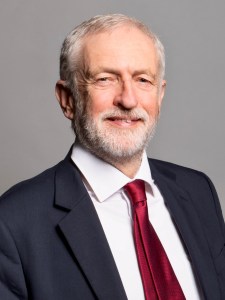
This year’s Salter Lecture is definitely taking place! Controversy arose because QSS invited Jeremy Corbyn to be one of our two speakers, and those responsible for Yearly Meeting felt this would cause ‘reputational damage’ to Quakers. After much debate, we were given two options: either to go ahead in Friends House without Jeremy Corbyn, or to organise the lecture elsewhere. We chose the latter option and have made arrangements as follows:

The 2024 Salter Lecture

‘War and Peace: the peaceful resolution of conflict’

Speakers: Paul Ingram and Jeremy Corbyn

Monday, 29 July at 7pm

Hamilton House, Mabledon Place, London WC1H 9BD 

Hamilton House is just a few minutes walk from Friends House, within easy reach of Yearly Meeting. However, the hall only has space for 200 people, and we want to give QSS members priority to attend in person. So we are sending the booking link to members first. We will then advertise it here and elsewhere, so others can book to attend in online.

www.eventbrite.co.uk/e/online-salter-lecture-2024-war-and-peace-tickets-936561038277?aff=oddtdtcreator

Sheila Taylor (Salter Lecture Organiser)

Paul Ingram & Jeremy Corbyn

The Ban on Jeremy Corbyn 

by Ruth Kettle-Frisby.

In a landmark event, Quaker management at Friends House in London has acted decisively in banning prominent socialist Jeremy Corbyn from delivering the Salter Lecture on ‘War and Peace’ at this year’s Britain Yearly Meeting in July. Although not a Quaker himself, Jeremy would have jointly presented the lecture with the Quaker mediator, Paul Ingram. 

Many of us in the Quaker Socialist Society (QSS), and outside, are perplexed by the decision; feelings of confusion, and sadness, continue to radiate outwards as more people catch wind of it. It sets a disturbing precedent that has troubled friends so deeply that it has set our very consciences off-kilter and put our integrity as a Society of Friends into serious question. 

Growing up in the 90s, my sharply felt social conscience was entirely divorced from any political motivation whatsoever. In the wake of Thatcher’s ruthless and divisive neoliberal policies, Blair found the rhetoric to unite Right and Left by redefining the Left at a Centre-Right position, calling this ‘New Labour’.

Several popular TV appearances later, Blair dashed hopes for systemic changes in education (“education, education”), and assisted US forces to invade Iraq based on weak intelligence of non-existent weapons of mass destruction in what is deemed to be an unjust war in Iraq, with ongoing devastating consequences for 4.4 million displaced people. The Tories didn’t take long to take the reins, via an embarrassingly ineffective coalition with the Liberal Democrats, and British people like me who were living in privately rented shared houses – and finding it impossible to mobilise ourselves – deserved better. 

Sometimes, when you have no capital, you have the closest contact with those at the sharpest ends of injustice; those who are most in need of equitable socialist policies. I worked in a run-down mental health ward, and then with learning disabled young people, all of whom had little in terms of rights and power. Politicians – so distant from us with their privileged backgrounds, education and connections – didn’t speak for us, so we switched off and muddled on.

Enter Jeremy Corbyn in 2015. His resurgence gained rapid momentum on social networking sites like Facebook: swathes of us awoke from apathetic slumbers and got behind this older white man who nevertheless spoke up for us – ‘for the many, not the few!’ What was being denigrated as ‘radical’, Jeremy Corbyn – after the Diggers, or ‘True Levellers’ before him – just called ‘fair’.  

Jeremy Corbyn ignited political hope, but his credibility was systematically crushed by the British Establishment, which repeatedly called this democratically elected leader of the Parliamentary Labour Party ‘unelectable’, and subjected him to a sustained smear campaign led by unregulated billionaire-owned British tabloids. After the ‘unelectable’ Corbyn did so well in the 2017 General Election he began to be smeared as an ‘anti-semite’ because he was critical of Israel.

Jeremy Corbyn is not an antisemite; on the contrary, he continuously stands for nuclear disarmament, antifascism, and antiracism, and is at the forefront of our shared campaign for an immediate permanent ceasefire in Gaza. He founded the Peace and Justice Project, and spoke at Friends House itself at the War on Want conference.  

QSS invited Jeremy Corbyn as our Salter Lecturer in good faith, for the sake of what we might learn in our shared commitment to peace. It is in this spirit that I write: not to persuade friends to deviate from the calling of your own consciences, but to invite you to be part of this important conversation. 

What does this decision mean for the Society of Friends, with its radical roots based in a fearless upholding of truth?

What is to become of a Society of Friends that kowtows to the self-perpetuating capitalist priorities of the New/Blue Labour-cum-Conservative Establishment that sustains social – including climate, economic and migrant – injustice?

Whether or not Friends agree with Jeremy Corbyn, should we not welcome him in acknowledgement of the Light within him?

—————————————————————————————————————————–

1 https://www.standard.co.uk/hp/front/failure-failure-failure-blairs-10-wasted-years-on-education-6592344.html

2 https://www.ucl.ac.uk/nahrein/news/2023/apr/we-are-still-displaced-20-years-after-iraq-war

Starmer’s challenge: a courageous government in a courageous state

“MY CHANGED LABOUR PARTY”. Keir Starmer has used that phrase many times in recent months. All parties must evolve – failure to do so means sclerosis and death. But the more boldly inclusive and consensual that process is, the better the health of the party and of our democracy will be.

It is the possessive pronoun which gives rise to concern. That a politician should wish to make a mark on the party which has chosen them as its leader is right and natural. But it is also right that this course should be pursued with some humility and a sense of the manner in which a party’s historic mission should inform its future in a time of rapid, and arguably unprecedented change.

The next general election is at most eight months away. It is very likely that Keir Starmer will be our next prime minister. As the effects of the past few days of electoral excitement bed down, it is beyond doubt that this Conservative administration is in terminal decay and that the country is desperate for change. But Starmer is not the owner of the Labour Party. Like any democratic leader, he is his party’s custodian and to forget that would be to betray his trust.

Over the decades, the Labour party has been often described as ‘a broad church’ and where it has stumbled to electoral defeat, it is because its various factions have turned upon each other in a way which made ecumenism impossible to sustain. It has always been at its best when socialists and social democrats have managed, in pursuit of common goals, to make creative compromises and see clearly who it is that would divide them into impotence.

Occasions of ugliness are driving away many who desperately need a just, compassionate and redistributive government. Shadow Health Secretary Wes Streeting, sneers at those who do not share his views on private sector involvement in the NHS as “middle-class lefties” – a puerile insult which indicates a damaging ignorance of the nuanced relationships between origins and beliefs. Rachel Reeves, who will be the chancellor in Starmer’s administration, has declared her belief that “Labour is not the party of people on benefits”.

Labour needs to widen its ethical horizons far beyond this. If it is to be the party of equality and justice, it must recognise the many-layered inequalities and injustices which play so large a part in making life wretched for millions. If it is not to be that party, choosing instead to deny just and empathic action for those outside its exclusive demographic of ‘working people’, it can only be a slightly less cruel version of the neo-liberal Tories who have created despair among the very people who have, historically, and in the present, looked to Labour for hope.

My hope is that Labour in government will put equality and justice at the heart of its policy making. This must be the yardstick against which all is measured. It should not fear to take and promote the ‘preferential option for the poor’: for the powerless, sick and disabled, for the old and the young, the in-work, the unemployed and those unable to work.

It must build council houses and spend into public services and benefits. It must develop a foreign policy which prioritises conflict resolution and move to a mindset alert to the seeds of future conflict, realising that foresight and prudence may gradually reduce our dependence on military solutions. It must embrace the internationalism which grew out of the the two global wars of the 20th century and the institutions of the rule-based order which which underpin democracy.

Above all, it must strive for that justice which is the foundation of peace: fear and favour have brought us to some very dark places indeed. This will need the strength to exercise a spirit of courage which is not yet apparent in the tendency to anxious authoritarianism which characterises the present leadership.

If the government is to play its part in sustaining a liveable planet for all people, it will also need to find the courage for an unwavering commitment to green technologies and resistance to the global corporations and fossil fuel giants who have the power to hold vacillating nation states captive.

To do all these things, Labour will need to fight its fear of, and subservience to, much of the media. This will demand a steadfastness in the truth which will not fear to own mistakes, and an end to the equivocation and outright deception which has disfigured politics for too long.

There is a sense that the time may be right for all this to begin. The electorate is becoming both more aware and more cynical. Trust has been badly damaged and repair may initially prove a very rough ride indeed. However, compassion and hope have the power to do far more than does self-serving caution. Build it, and they will come.

Counsels of perfection, you may say. Simplistic, some will sneer. No. Simplicity is never simplistic nor is it easy. And the devil may well be in the detail. But if Keir Starmer can cast off his possessive desire to control the Parliamentary Labour Party in every aspect of its thinking, and permit the growth of a courageous and sometimes disputatious government in a courageous state, then a clear-eyed view of those things which make for equality, peace, truth and simplicity will give the Fiend much less room for manoeuvre.

————

© Jill Segger (England) is a freelance writer who contributes to the Church Times, The Catholic Herald, Tribune, The Friend and Reform, among other publications. Her acclaimed book Words Out of Silence was published by Ekklesia in 2019. She is an active member of the Religious Society of Friends (Quakers) and a Fellow of the Royal Society of Arts. Jill became an honorary associate director in 2010 and is now Ekklesia’s Contributing Editor. She is also a musician and has been a composer. Her recent columns are available here and her pre-2021 articles can be found here. You can follow Jill on Twitter: @quakerpen

2 responses to “Starmer’s challenge: a courageous government in a courageous state”

  1. paulagalvin1 avatar

    A really interesting article, measured and thoughtful. Trust needs to replace the cynicism and flagrant ignorance of the truth which pours forth daily from some very loud and very provocative voices. Courage, integrity and radical hope is necessary to truly transform our fractured societies

    Like

    1. quakersocialists avatar

Leave a comment

2 responses to “Starmer’s challenge: a courageous government in a courageous state”

  1. paulagalvin1 avatar

    A really interesting article, measured and thoughtful. Trust needs to replace the cynicism and flagrant ignorance of the truth which pours forth daily from some very loud and very provocative voices. Courage, integrity and radical hope is necessary to truly transform our fractured societies

    Like

    1. quakersocialists avatar

Leave a comment

Different Meanings of Truth and Integrity

by Priscilla Alderson.

Integrity

The Quaker Truth & Integrity Group (QTIG) is concerned about standards in politics, public life and the media. They adopted a statement in 2022. These are a few of the points they made.

‘We seek kinder ground…of tolerance, respect, mutual cooperation and shared ethical and spiritual values’, led by individuals of impartial integrity. To address oppression and seek reconciliation, advocates work ‘between those of opposing views’ towards the shared truth of ‘truly inclusive, participative democracy, where people feel their wishes and needs are truly respected and taken into account’. ‘Where truth and integrity flourish, so too can personal relationships… our democracy and our precious traditions’, besides international relations that ‘completely address the crises that threaten our very existence’.

‘Crises’ hint at another meaning of truth and integrity. When ‘lies, injustice, inequality, deception and entitlement are prevalent it is only the truth – in all its uncomfortable [my emphasis] forms – that will heal us.’1 People who identify their integrity with ‘upright ethics and unbending principles’ may bitterly disagree on what is ‘the truth’, as decades of disputes about anti-slavery showed. Defending the truth can be disruptive and painful not peaceful. Many early Quakers suffered imprisonment and torture when they dared to speak truth to power. 

  Organisations such as churches, universities and political parties honour their own integrity by encouraging critical debates that search for truth. Yet truth may become too divisive, as in current disputes about anti-Semitism. The priority then may be to defend, not the truth, but each organisation’s integrity in its reputation, unity, closely integrated membership, and unquestioning loyalty to the leaders’ policies. Even neutral bystanders can help the strongest side to win, fairly or not, by their unquestioning loyalty. 

  For example, since 2019, the Labour Party’s unity has been preserved by over 150,000 dissenting members resigning or being excluded. In another example, the Quaker Trustees aim to safeguard the integrity of Britain Yearly Meeting in July by excluding the annual Quaker Socialist Society Salter Lecture because Jeremy Corbyn will be a speaker. (This was explained by Sheila Taylor on this website on 3/4/24.) Are their fears justified?  

Truth

Led by the great and the good, by the BBC and the Guardian, the campaign against Jeremy Corbyn alleged that he ‘presided over “unlawful” anti-Semitic harassment within the party. When he claimed this finding was “dramatically overstated”, he was suspended.’ This accusation, which can seem moral, religious and nonpolitical, was repeated again in Quaker weekly, The Friend (11/4/24 and 25/4/24). 

  Several books and a film explain these misunderstandings. Public opinion surveys run by universities found that, on average, respondents believed that one third or ‘34 percent of Labour Party members had complaints for anti-Semitism made against them’. There were a horrifying 453 complaints. However, complaints were made against less than 0.1 percent of Labour Party members when there were well over 500,000 of them in the largest political party in Western Europe. The public believed there were 340 times more complaints than were actually made. Jeremy Corbyn commented, ‘One case of anti-Semitism is one too many’ but the public’s estimation is ‘grossly exaggerated’. When Labour leader, he tried to speed up anti-Semitism hearings but was told he should not interfere in Party procedures.   

  It is often said the 2019 election was ‘catastrophic’ for Labour. Yes, many seats were lost, often by a narrow margin. Yet the table shows that more votes were won by Labour under Jeremy Corbyn in 2017 and 2019 than under Gordon Brown in 2010.

UK Election Results

Date Political Parties


ConservativeLabour Lib Dem
201913,966,45110,295,9073,969,423
201713,636,68412,877,9182,371,861
201010,703,754 8,609,5276,836,825

One problem in 2019 was documented in the report by Martin Forde KC commissioned by Keir Starmer. Some senior right-wing members of Labour Party staff worked hard to ensure that some left-wing Labour candidates were defeated.

Searching for truth and integrity

Quaker truth and integrity would involve examining Jeremy Corbyn’s lifelong work for antiracism, peace and justice, asking who his powerful opponents are, and what they gain by discrediting him. The books I’ve noted earlier analyse how the most powerful and wealthy groups in the world aim to ensure that no political leaders can stand for peace and justice (and Quaker values). Instead, they must stand for inequality, austerity, war and nuclear arms.

  These international powers work through networks and thinktanks, the social and mass media funded by billionaires and the arms, oil, technology and other giant industries, to mislead voters. They persuade voters to fear socialist policies and to support right wing and even fascist governments that will enrich the rich and punish the poor. Their successes are shown in elections around the world. Yet socialist policies are widely supported. Keir Starmer could only become the elected Labour leader in 2019 by saying that he supported ten carefully costed socialist policies. Then he soon reneged on them.   

  Real anti-Semitism is among the greatest cruelties and tragedies in all history. Yet the word has been redefined to mean anti-Zionism. Criticism of the Zionist Israeli government is seen as criticism of all Jews. But that is like saying to criticise the British government criticises all British people. Many Jews are punished for being anti-Semitic.

  Should not Quakers concerned with truth and integrity be protesting more clearly against real anti-Semitism and Islamophobia, against the false accusations and, as Quakers in Britain say, against all wars?  

Priscilla Alderson, Member of Dorchester Meeting, 26/4/24

Leave a comment

 1 Quaker Truth and Integrity Group, https://quakertruth.org/ 

2  On Jeremy Corbyn: The Big Lie  https://www.youtube.com/watch?v=9TACIA7oSIk; Winstanley, A. 2023. Weaponising Anti-Semitism: How the Israel Lobby Brought Down Jeremy Corbyn. OR Books. 

 3 Philo G, et al., Bad News for Labour. Pluto Press, 2019.

4 https://commonslibrary.parliament.uk/general-2019-election-turning-votes-into-seats/

5 https://labour.org.uk/resources/the-forde-report/; https://www.aljazeera.com/news/2022/9/25/what-really-happened-during-labours-anti-semitism-crisis

 6 https://www.trilateral.org/; https://www.theguardian.com/commentisfree/2024/jan/06/rishi-sunak-javier-milei-donald-trump-atlas-network 

7 https://en.wikipedia.org/wiki/Jewish_Voice_for_Labour

8 https://www.quaker.org.uk/news-and-events/news/statement-on-israel-palestine

Grace the Convenor

by Graham Taylor.

Last January the Quaker Socialist Society (QSS) suffered a historic loss with the death of Grace Crookall-Greening. Grace had been a founder member of QSS in 1975, Convenor of QSS from 1976, and was still on the Committee in 2018. It was largely through her hard work, dedication, and quirky stubbornness that QSS flourished over five decades, and it was largely through her that the achievements of QSS – the Social Testimony, the Salter Lectures, the working co-operatives – were brought about. The QSS had been founded by the charismatic Ben Vincent – Classicist, Bible scholar, and a veteran of the old Socialist Quaker Society founded in 1898 – but by 1975 Ben was elderly, and it was Grace who did most of the work.

Grace Greening came from a working-class background. Her father was a cabinetmaker who worked for Co-operative Wholesale and he was also a Baptist lay preacher. At Baptist Sunday School she won certificates for memorising chapters in the Bible, and all seemed well. Unfortunately, a generous member of the congregation, impressed by her talent, paid for her to attend a private school, and she hated it. She played truant and cycled off into the Cheshire countryside to read ‘pagan’ (secular) books disapproved of by her father, the church and the school. From this act of juvenile rebellion she gained her life-long love of nature, as well as an encyclopaedic knowledge of trees, flowers and birds.        

In 1943 she escaped the dreaded private school and entered a commercial college. She then further shocked her parents by becoming a junior reporter on the Manchester City News, instead of getting a ‘proper job’. She was a rebel by nature; she trusted implicitly in her own instincts; and she was stubborn as a mule.   

Her future development seems to have been prefigured by these events of her youth. Her revulsion against private school prefigured her socialism; her father’s work prefigured her love of co-operatives; and trust in her own instincts prefigured her Quaker trust in following the Inner Light, regardless of whom it might offend.

In 1957 she married John Crookall, a scientist, at St Giles in the Fields, Holborn, an Anglican Church. After the disaster at the nuclear power plant now called Sellafield, John began studying radioactive fallout. His horror at the threat from nuclear radiation drew them  to the Campaign for Nuclear Disarmament (CND). Their participation in the Aldermaston marches organised by CND then led them to become pacifists and Quakers, and this led them to other peace campaigns, in particular for Vietnam. By 1972 Grace was supporting a daily vigil for Peace in Vietnam outside the American Embassy.

There remained the outstanding question of her self-disrupted education but, while living in Crawley, Surrey, now with two children, Olwen and Chris, Grace studied at Labour’s newly founded Open University. She was awarded a Social Science degree, followed by a Post-Graduate Certificate in Education (PGCE). According to Olwen, Grace’s daughter, she did teach for a while at a Catholic school and enjoyed it but then perhaps inevitable tensions emerged after she had a discussion with her class about birth control. Grace and schools did not seem to mix.

Everything was easier after she used her journalistic experience with the Manchester City News to get a Quaker job at Friends House, as Publications Officer. She became editor of Labour Action for Peace, and formed friendships with trade union leaders such as Quaker Ron Huzzard, with Labour MPs such as Tony Benn, and with Methodist preacher, Donald Soper – sitting for political reasons in the House of Lords, an institution he deplored.

It was from the Christian Socialist Movement (CSM) led by Soper that in 1975 the Quaker Socialist Society emerged. In the summer Ben Vincent had raised the idea of a Socialist Society and by November Grace was reporting in the Friend that the CSM had convened a meeting of Quakers “to form a new Quaker socialist group”. The Quaker Socialist Society formed that December was backed not only by Soper but by two Labour MPs, Guy Barnett and Fred Willey; by the trade unionist, Ron Huzzard; and also by the Quaker Nobel Prize-winner, Philip Noel-Baker. Grace was made ‘Convenor’ of the QSS, although Ben Vincent was clearly the leading light.

In 1977 Grace caused a minor storm in Quakers when a letter by her was published in The Times and signed “Grace CG, Convenor of the Quaker Socialist Society”. Posh Quakers, it seems from the response, were appalled that readers of The Times would think Quakers were connected in any way with ‘socialists’. Ben Vincent thought it was hilarious – Are the readers of The Times really imagining a lot of Red Quakers donning “red ties as they go off at six in the morning to their chocolate factories?”, he asked. Grace did fail to consult the QSS Committee, yes, but that was no great sin – “well, all right then, we’ll tick dear Grace off.” 

Grace was characteristically unrepentant. She had acted from the best of intentions: “I’m sure my letter will have done the readers of The Times, and the Quaker Conservatives, a power of good.” Her son, Chris, said at her memorial service earlier this year that her “magnificent stubbornness” was “always unrepentant”. She would never take instruction from anybody –  not even from recipes in a cookery book. Some of her meals were “shocking”.

Grace pursued a different agenda from Ben and maybe a different agenda from the rest of QSS. In 1973 she had been inspired by reading a new book, Small Is Beautiful: A Study of Economics As If People Mattered by E.F. Schumacher, which objected to mega-companies and mega-capitalism destroying nature and destroying working-class communities. This environmentalism fitted in with her love of nature and with the QSS idea that the ‘socialism’ they stood for was not one dominated by the state but one such as Keir Hardie wanted: a countrywide network of co-operatives. Impressed by the Bader family in Northamptonshire, who had handed over their chemical factory to their employees to be run as a co-op, she joined the Scott Bader Industrial Common Ownership Movement (ICOM) and was even made a director. It was quite a success, and led to the formation of hundreds of small or medium-sized co-operative businesses across the country.

Inside Quakers Grace’s major achievement was to bring about, with Jonathan Dale, the formal recognition of a Quaker ‘Social Testimony’. George Fox, who founded Quakerism in the 17th century, had pursued equality from the start of the Quaker movement, and peace was added only later. Grace believed it was necessary to restore that original emphasis and make equality as important as peace. She thought it was from the inequality between regions and countries that war derived.

In 1982, at Yearly Meeting in Warwick, Grace delivered the QSS lecture that is now known as the Salter Lecture. Her title was Capitalism – A Cause of Social Unrest, Injustice and Fear. In this she argued that Christianity and capitalism were incompatible and the ‘ethical socialism’ of QSS was the modern political expression of early Quaker beliefs. Capitalism was so destructive it would destroy itself, or the world, and the socialism that would replace capitalism had to be a network of co-operatives, run by workers and managers along the lines of Scott Bader. A minute was sent to the Clerk of YM asking British Quakers to adopt a Social Testimony based on the Quaker ethical value of equality.

Jonathan Dale wrote after hearing of Grace’s death: “Grace had a burning conviction that we needed to create a new Social Testimony, to build on the 1918 Eight Foundations of a True Social Order.  Her steadfast commitment to this vision certainly fed into my work as Clerk of Quaker Social Responsibility and Education… Between 1990 and 2005 I think we can say that Grace’s vision of a transformed British Quaker movement was achieved.”

To Grace’s astonishment her lecture created not only discussion within British Quakers but evoked an international response, in particular from New York and Moscow. In New York Quaker Socialists had long wanted to found a QSS but it was not possible in America to use the word ‘Socialist’ without provoking immediate hostility. Now, seizing on Grace’s idea of an ethical socialism based on Bader’s worker co-operatives, they invited Grace to New York to deliver her famous lecture over there. Grace flew to New York in June 1983. After hearing Grace, New York Quakers founded the Quaker Society for Economic Democracy (QSED), the first branch of QSS in America. The QSS paid her expenses for the trip: £810 (7 nights in New York plus the flight).

In Russia the problem was the exact opposite to that in America: the word ‘socialism’ was accepted but anything religious was regarded with suspicion. Russian Quakers had long been struggling to find common ground with Soviet socialism but lacked the right words. For them Grace’s lecture, published as a pamphlet, was a life-line. Her lecture was also greeted enthusiastically in the GDR (East Germany) but that was easier. In the GDR the Quakers, highly regarded for their relief work in 1919 and for the Kindertransport, had always been treated with respect.  

Grace’s lecture may not have made any impact on Russia except that in 1985 Gorbachev came to power and started to liberalise Russian politics. Grace was working in the Peace Department of Friends House, as Assistant Peace Secretary to Ron Huzzard, and she discussed with Eleanor Barden, who was on the Peace Committee, the idea of sending Quaker tourist groups to Russia. In July 1986 Grace and Eleanor flew to Moscow with Quaker diplomat William Barton (fluent in Russian and with contacts in Moscow at the highest level). She explained worker co-operatives to the Russian Communists, and they listened politely. This cleared the ground for Quaker tourism across the ‘Iron Curtain’ and in 1986 she and Eleanor launched a company, advertised as ‘Meet the Russians: Goodwill Holidays in the Soviet Union’. As usual with Grace, there were no half-measures. By the end of 1986 she had set up a dozen ‘Meet the Russians’ tours for 1987.

On one trip Grace met Tatiana Pavlova, a Russian historian who had written about John Bellers, a 17th century Quaker identified by Grace (and by Marx) as a pioneer of Quaker Socialism. Tatiana was enthused by Grace’s Quaker Socialist initiative, and later set up a Moscow Quaker Centre, which is still active to this day.

In 1997, though a Labour government led by Tony Blair was elected, it was not as radical as Grace wanted and in 1998 she resigned as ‘Convenor’ of the QSS. To be clear: only she called the role ‘Convenor’, and not ‘Clerk’. QSS had been founded in 1975 to take the Quaker message out to trade unionists and peace campaigners. They understood what a ‘Convenor’ was, but not a ‘Clerk’. It therefore made no sense to say ‘Clerk’ if that would defeat the objective of QSS, so Grace would not say it. Following her resignation she was replaced almost overnight by Barbara Forbes not only to general surprise but to Barbara’s surprise. Barbara later explained: “What actually happened was that Grace sent round a notice to everybody saying that I had agreed to take over from her as ‘Convenor’ – except that she hadn’t actually asked me!” Everyone smiled – this was ‘typical Grace’.

Grace used her extra time to combat the Conservative Quakers who opposed the Social Testimony. She unleashed a strong attack on the 2001 Swarthmore Lecture, delivered by the leading light of the Conservative faction, Tony Stoller. She was also refining her own position. At her final AGM the speaker had been Labour MP, Clare Short, and in her AGM report Grace quoted Clare’s words: “When people talk about the death of socialism they mean either the end of communism or the end of Keynesian economics. But socialism is an ethic which recognises the full value of every human being.” This was Grace’s Quaker Socialism. This was what Grace herself believed.  

After her husband, John, died in 2009, Grace produced a late flurry of Quaker Socialist writings, promulgating her ethical socialism. In 2011 she co-authored Labouring for Peace with Rosalie Huzzard – a history of Labour Action for Peace, and its long struggle for peace policies inside the Labour Party. She wrote a dozen essays and booklets in a few years: on Bader and worker co-operatives; on the 17th century Quaker, John Bellers, praised by Marx and Owen; and on radical Quaker economics, derived from Schumacher but updated by John’s scientific concern for climate change.

In January Grace’s funeral was held in Corsham, Wiltshire. A passage by Isaac Penington was read, taken from Quaker Faith and Practice, and Bach’s Concerto for Two Violins in D minor was played. Grace had always loved music. When she was a 19-year-old reporter, she had interviewed a young concert pianist from Manchester, Joan Burns. They remained friends – as lovers of Bach, Chopin, Vaughan Williams – and in 2014 it was Grace who had written Joan’s obituary in the Guardian.    

In February there was a memorial event for Grace at her Bedford Quaker Meeting-House. It was mainly her non-stop campaigning for peace that was recalled: handling out leaflets in the centre of Bedford every week against the Iraq War, just as she had done against the Vietnam War – bringing peace closer, shortening the war, saving lives, being vindicated by history. In this connection her son, Chris, read out a tribute to Grace from the former leader of the Labour Party, Jeremy Corbyn. He had worked with Grace in CND, when she was editor of Labour Action for Peace, and about her tireless work he had kind words to say.

Many at the event recalled with a smile her stubborn and uncompromising character but also what fun she could be in her eccentric pertinacity, full of laughter. She was authentic, everyone said; she acted from the heart and at the bidding of her Quaker conscience; she was “hands-on” even at work, walking out of Friends House to collect money for the Kent miners on the picket lines outside Euston Station, and attending to homeless people on the pavement, doing whatever could practically be done…

In Memoriam: Grace Crookall-Greening (1928 Nov 13 – 2024 Jan 11).

2 responses to “Grace the Convenor”

  1.  avatar
    Anonymous

    What an inspiration!

    Liked by 1 person

  2. beautifulbarbadosblog avatar
    beautifulbarbadosblog

    It only takes a spark…
    RIP Grace.

    Like

Leave a reply to Anonymous Cancel reply

Keir Hardie and the Sacred Cause

by Chris Wilson.

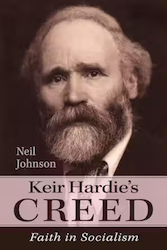
An organisation allied to the Quaker Socialists is Independent Labour Publications (ILP). This is not the same as the old Independent Labour Party of Keir Hardie, George Lansbury, Ramsay MacDonald, Isabella Ford and the Salters but a successor organisation established in 1975 called Independent Labour Publications. They publish books and articles about ethical socialism on their website at independentlabour.org.uk, and it is well worth a read. You can also find them on Twitter (X) at @IndLP. This article of theirs by Chris Wilson reviews ‘Keir Hardie’s Creed’ by Rev Neil Johnson.

A new book on the ILP’s founder and first leader explores the religious underpinnings of his socialist faith. It contains important lessons for the left today, says CHRIS WILSON.

Methodist minister Reverend Neil Johnson offers a valuable contribution to the historiography of Keir Hardie in this fascinating booklet. While many have written about Hardie’s life and politics, here focus is trained on the Christian underpinning of his developing activism.

Keir Hardie’s Creed deserves consideration by all those interested in the formative years of the British Labour movement or in the development of Hardie’s political thinking. Johnson draws an interesting distinction between Christian socialist and socialist Christian thought, placing early pioneers such as FD Maurice in the former camp, as one whose ecclesiastical position and theological reflection led to socialist advocacy; and Hardie in the latter, drawing inspiration more from the person of Jesus than from some doctrinal system.

He has a point. Christ’s life certainly resonated with Hardie’s own. Johnson points to Caroline Benn’s observation that Christ and Hardie were both born to unmarried parents, had fathers who were carpenters and mothers called Mary. No wonder then that Hardie saw in Christ’s life some expression of his own.

Hardie’s Christianity was certainly of the dissenting variety, with strong congregational influences, and shaped by the emerging Labour Churches. For Hardie, Jesus became the working man of his time, excluded and marginalised yet expressing in and through his life the struggle for brotherhood and peace, where the ends never justified the means (Christ rejected the Zealots of his day), and with his disciples holding all things in common.

Here then is an embryonic, deeply ethical and democratic socialism.

Johnson also offers a valuable summary of those other influences on Hardie’s life, from John Ruskin to Robert Burns to Thomas Carlyle to John Stuart Mill. This I found convincing, although I am less sure about the impact of Walt Whitman or Ralph Waldo Emerson as that risks recasting Hardie as a Unitarian Christian, deeply devoted to the person of Christ but not accepting his privileged position as saviour of humanity. This might have been true of Ramsay McDonald but Hardie’s later wish to have preached the gospel suggests otherwise in his case.

On the other hand, Johnson is surely right to see Hardie’s embrace of socialism in religious terms. The argument that his socialism was no more than the religion of Jesus (as opposed to religion about Jesus) recast as political activism in his own time is compelling. Hardie’s creed was neither scientific socialism nor utopian socialism but something else, something more like a religious revival based on a political outworking of Hardie’s personal commitment to Christ.

Gospel of Labour

I also liked the author’s attempt to summarise Hardie’s creed: “Socialism is the Christianity of today … the gospel of the whole labour movement … based on love, fraternity and service.”

There is much here that needs to be rediscovered today – the idea that we should be changing capitalism not accommodating it, and that change must not just be a revolution of structures but also of the heart. Hardie’s socialism was never of the Leninist insurrectionist variety, notwithstanding his nod to Marx in his book From Serfdom to Socialism.

Johnson also explores Hardie’s commitment to temperance, and this deserves further unpacking – that his politics was also shaped by the wider fraternities to which he belonged. There was the miners’ union, of course, but also the temperance of the Independent Order of Good Templars (still going today, and still pointing out the damage of alcohol to people and societies).

Hardie remains a deeply compelling figure. Johnson has reminded us that he cannot be simplistically located even within the (or should that be ‘a’?) Christian tradition, but rather is someone who stands apart, a dissenter amongst dissenters, a prophet standing alone. There is indeed, something of the Old Testament prophet in Hardie – speaking truth to power, seeking the common good, praised then vilified in his own lifetime.

What then can we learn from this book and from Hardie?

That socialism has to be visionary, certainly; ethical too, with deeps roots in the culture of the day; and fed in Hardie’s case from the ecosystem of radical dissent, trade unionism, friendly societies, temperance causes and a growing working class confidence. We learn that hearts as well as minds, behaviours as well as structures need to change if the New Jerusalem, or the Kingdom of God, or the socialist utopia is ever to arrive.

But there’s also a strong warning against naivety. Hardie’s pacifism was swept away by the blood of the trenches and its relevance today is questionable when confronted with our current world and its authoritarian leaders.

Still, when facing a world of injustice, inspiration can still be drawn from Keir Hardie’s creed, just as, in turn, the great man drew inspiration from that radical Galilean peasant, Jesus Christ. As Johnson notes, in the words of James Keir Hardie himself, “Socialism is a sacred cause.” And Christ’s ‘Sermon on the Mount’ from Matthew 5 is a pretty good place to start.

——————————————————————————

The Reverend Chris Wilson serves on the national executive committees of the Community Union and the Co-operative Party. He is a church minister and member of Christians on the Left. He writes in a personal capacity.

Keir Hardie’s Creed: Faith in Socialism by Neil Johnson is published by Wipf and Stock, and available here for £27 (hardback) or £16 (paperback). See also: ‘Hardie’s Creed & the Religion of Socialism’ by Neil Johnson. And: ‘Christian Socialism: Out There & Active’ by Chris Wilson.

Leave a comment

Absent Voices (and Palestine)

by Nicola Grove.

In this article Nicola Grove reflects on how rarely these days do we hear from the people actually involved in the issues of the day. In between stand commentators, presenters, pundits, opponents and supporters. Quakers too sometimes do this, excluding the voices of those marginalised by mainstream media.  

I was in an online meeting about how to enable the stories of marginalised people to be told; in this case focusing on disability. Family members were prominent, sharing moving and often uplifting accounts of personal connections. But because my work focuses on participation, I was struck by the absence of the individuals themselves. We were hearing the stories of their allies, but were these the stories that they themselves would want to tell?

Cut to a wonderful exhibition about displacement. As well as contemporary images and installations, there were powerful art works dating back to the Spanish civil war and World War II. The curator had added her comments – that one disturbing charcoal sketch of refugees risked dehumanising them by presenting a faceless mass. (For the record, I didn’t agree, I could easily discern individuals amongst the trudging crowd). But what would displaced people themselves think? We don’t know, because nobody had thought to ask them. 

How do people want to be represented? How do they feel about being seen as vulnerable victims? What do they think about the programmes we run, that we are certain are vital to their survival? What do they want us to do? Have we asked them?

Quakers are not immune to this trend. I have been reading through Quaker responses to the unfolding genocide in Palestine. Strong statements and letters are written in our name by the various bodies in British Yearly Meeting. The letter pages of the Quakers’ Friend magazine have provided contrasting views over many years about whether criticism of Israel is de facto  antisemitism. In the body of the magazine we have read recently that perhaps war crimes are not something we should focus on, since all war is a violation. The inferences are clear – we need to question our “progressive” stance on, say, settler colonialism, on self determination, on any ideas that Hamas might be an evolving, complex, multifaceted organisation. Similarly, a book is reviewed that exhorts us to adopt the concept of Israelophobia, whilst distorting (to put it mildly) the history of Palestine and Palestinians. We are now told that to invite Jeremy Corbyn, a leading campaigner and politician who has spent his life working for peace and justice to give a public lecture at the same time as the Quaker Yearly Meeting would be to risk accusations of antisemitism and “damage the reputation” of Quakers.  

Do you notice any absent voices here? Where are the Palestinian voices? Where is the voice of the  banned speaker, Jeremy Corbyn? 

Absent Voices: Jeremy Corbyn MP and Stella
Assange at Conway Hall with David Davies MP

I will leave the final words to Pastor Isaac Munther from Bethlehem, another absent voice. Astonishingly, no Quaker outlets publicised his metanoiac Christmas sermon “Christ under the Rubble”, nor covered his visit to London in February, apart from a link in a recent newsletter to one minute of a candlelit vigil. Perhaps his words are too dangerous for Friends to hear, because they challenge our comfortable thinking that as Quakers we are principled, impartial, peace-loving. And that this stance is enough, quite enough, to prove how much we are suffering on behalf of others.

Absent Voice: Pastor Munther Isaac from Bethlehem welcomed at the Bloomsbury Baptist Church this year at the same time as Archbishop Welby refused to meet him.

What did Pastor Munther actually say about us? He said: “This is not about “praying for peace” “raising concern” or “sending support”. Piety, religiosity, true spirituality means the active participation in loosing the bonds of injustice, undoing the straps of the yoke, letting the oppressed go free, and breaking every yoke. This is active solidarity, this is action.”

Nicola Grove, 23 March 2024.

[Another version of this article later appeared in the Friend magazine on 05 April 2024.]

Leave a comment

Quaker Socialists at Three Demonstrations

by Graham Taylor.

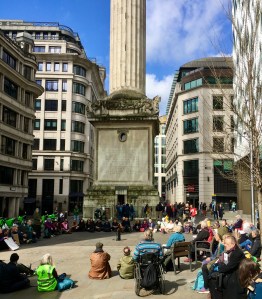
[Phil Laurie at the Monument before the Quaker silence]

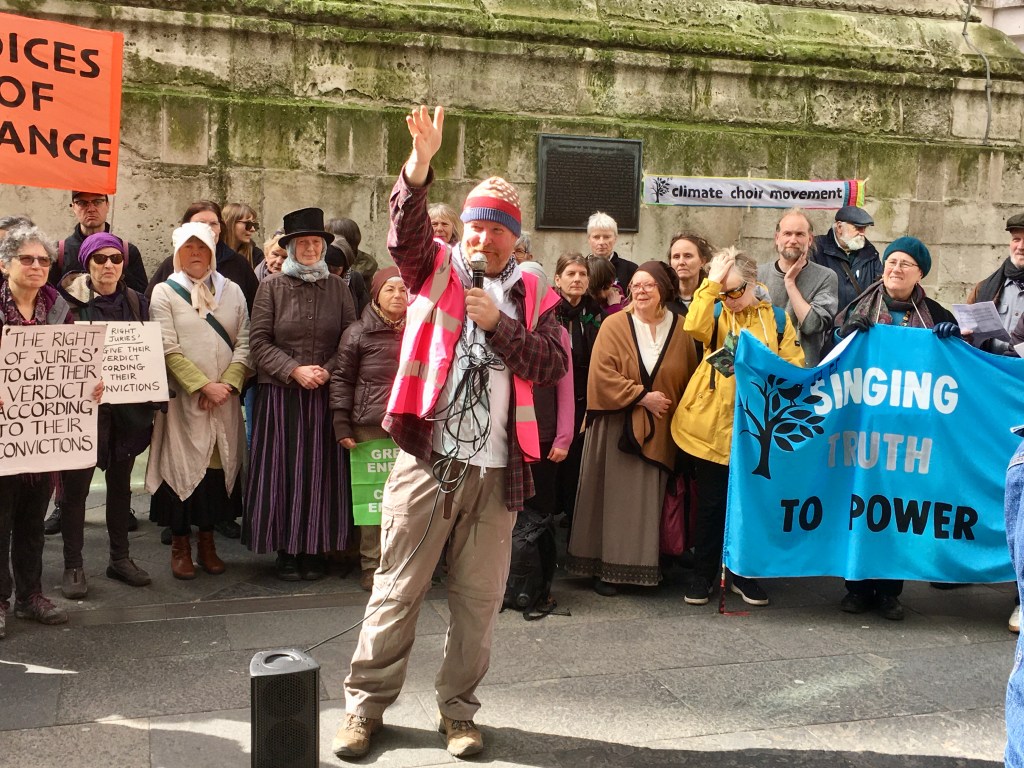
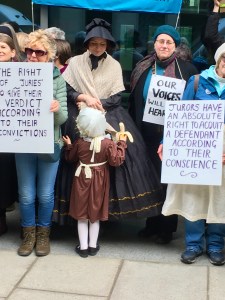
In 1670 persecution of Quakers by the Puritan government was in full flood. Meeting Houses were being closed, or totally destroyed, and Quakers imprisoned. Yet Quakers did not falter but insisted on freedom of speech and freedom of assembly . Unlike most at the time, they not only insisted on free speech for Protestant sects but asked that Catholics , Jews and Muslims be allowed freedom of speech as well. Their reward after the Revolution of 1688 was the Toleration Act which, although it granted freedoms only to Protestants, nonetheless is still one of the foundation-stones for the civil liberties we enjoy today.

The persecution was severe. In August of that year soldiers closed down their Meeting House in Gracechurch St, in the City of London, but Quakers pursued their customary tactic of meeting and speaking as close as possible to the building where they are forbidden to speak. This tactic is still practised even today. The organisers in 1670 were William Penn and William Mead, both leading Quakers, and after they refused to end the meeting they called in the street outside, they were arrested and charged with unlawful assembly. Presiding at their trial in September was Samuel Starling, the Lord Mayor of London, acting in his role of Sheriff. The trial showed that Starling was no fan of free speech and no fan of Quakers.

There was conflict at the trial from the beginning but at first it was rather comic . Starling knew that one well-known aspect of Quaker egalitarianism was that they refused to remove their hats to their ‘social superiors’. When they did that, he had planned to fine them for contempt of court, but to his evident annoyance Penn and Mead appeared before him without their hats. He had to order court officers to put their hats back onto their heads, so they would then refuse to remove them in his presence when he asked them to, so he could then fine them for contempt.

That was the last light moment in the trial. Starling then, very unwisely, took on William Penn in a battle of wits. Penn had enquired under which law they were charged and Starling declined to make any answer but merely said it was “common law”. Penn then asked which specific part of common law he meant because if he was using an interpretation of common law that ruled out freedom of speech and assembly, this was a threat to “the rights and privileges of every Englishman”. When Starling tried to brush him off, perhaps unsure himself of the answer, Penn then revealed to the court his line of defence in the now famous sentence: “The question is not whether I am guilty of this indictment, but whether this indictment be legal.”

On hearing this, Starling ordered Penn removed from the dock and returned to the ‘bail-dock’, a cage where prisoners sat waiting to be called. But William Mead was up next, and he found Mead pursued the same line as Penn, this time citing learnedly the Institutes of Edward Coke, regarded in the 17th century as England’s leading legal authority. Mead too was sent to the cage.

Starling then proceeded to the conviction and imprisonment of Penn and Mead by instructing the jury on the obvious guilt of the defendants. However, to his astonishment it appears, he found the jury no more compliant than Penn. They refused repeatedly to obey the instructions given. The jurors found a spokesperson for their principled stand in one of their number, Edward Bushel. Eventually, in exasperation, Starling had the jury locked up without food and water until they produced the verdict he wanted. The Court Recorder, John Howel, told the jury: “you shall not be dismist, till we have a verdict that the court will accept; and you shall be lock’d up, without meat, drink, fire, and tobacco: You shall not think thus to abuse the court; we will have a verdict by the help of God, or you shall starve for it.”

Penn appealed to the jury to remain strong, and they did, and history was made when they endured the punishment for two days and still remained defiant. Starling fined them, as well as sending Penn and Mead back to jail for contempt of court, but he had gone too far. Later, in the face of extreme disquiet amongst members of the establishment who themselves might need the help of a jury one day, the Chief Justice of the Court of Common Pleas, John Vaughan, made the historic ruling that in future a jury could not be punished for any judgements they chose to make.

The modern reader should not be too contemptuous of Sheriff Starling, as if they would have acted differently if they had been alive at that time. For a start, there are cases similar to the Penn-Mead case taking place today and usually only a few individuals protest. Secondly, there were historical circumstances constraining Starling, Howel and the Puritan government. The courts at that time had no presumption of innocence, no exclusion of hearsay evidence, and no burden of proof on the prosecution. From Starling’s point of view he was trying to keep order in the City of London (there were no police in those days) and here was a bunch of trouble-makers (Quakers) clearly guilty of what today would be called a breach of the peace. The jury surely must have heard of the Quakers’ appalling reputation, Starling would have thought: Quakers were extreme egalitarians, refusing to address their superiors by ‘you’; refusing to take off their hats to clergy, judges and other eminent people; refusing to pay taxes for the upkeep of the state Church; and refusing to swear oaths just because their social superiors did not have to swear oaths. Starling must have felt it very unlikely, in the City of London, that the solid citizens who sat on juries, reliant for their livelihoods on law and order, would countenance in their own City such unruly behaviour.

The recent cases today with a similarity to the Penn-Mead case were those of climate activists not allowed by judges to communicate to a jury the motives for their protests. This meant the actions of which they were accused looked to the jury like random criminal damage. In addition, there has also been a general trend in recent years towards an erosion of the right to a fair trial by jury. That was the reason for the ‘re-enactment’ demos by Quakers and others in London last weekend and why there is a National Week of Action called by the campaign, ‘Defend Our Juries’, for April 13-21. The aim is that every court in the country will be picketed. These tactics try to draw public attention to the undermining of juries but it is doubtful whether any other protest will be as colourful as the ‘fancy-dress’ re-enactment last Sunday. About 70 protesters, some in traditional Quaker dress, sat around the Monument at London Bridge in an impressive Quaker silence before they marched to the site in Gracechurch St close to where the trial of 1670 took place, and then moved on to a third demo outside the Ministry of Justice in Petty France.

An article by Rebecca Hardy in the Friend, the weekly Quaker magazine, written before the event, described the dramatic ‘re-enactment demo’ in this way: “The London event at Gracechurch Street is in support of the Defend our Juries campaign, which was sparked by a wave of restrictions in climate activist court cases. These prevented defendants from mentioning climate change in front of a jury, sometimes resulting in imprisonment. The re-enactment will depict the trial of William Penn and William Mead, which became a legal precedent for the rights of juries. Quaker Phil Laurie, one of the organisers of the event, told the Friend: It’s basically to alert Quakers to the fact that one of the great gifts of Quaker activism in the early days was the jury system – and it’s under threat. Quakers need to wake up to this and defend it. A jury was threatened with prison last month if they acquitted someone according to their conscience. We’re reminding people that this was hard won by the sacrifice of Quakers in the 1670s…”

There were several Quaker Socialists among the demonstrators last Sunday who went to all three protests. Starting from the impressive Quaker silence at the Monument, they proceeded to the re-enactment in Gracechurch St, then to the demonstration outside the Ministry of Justice, before finally arriving, weary but happy, at the Westminster Quaker Meeting House in St Martin’s Lane, where they were greeted by warm hospitality and hot soup. Trudi Warner, a climate activist, then gave a filmed account of why she was at the Penn-Mead demo. She herself was one of those soon to be on trial, and she told the camera that the case, and the subsequent ruling, “had established the really important legal principle about jurors being able to give a verdict according to their conscience”. That victory she pointed out – now commemorated on a plaque in the Old Bailey – was all due to some persecuted Quakers who 354 years ago “held a protest meeting in the street”.

Graham Taylor 2024.04.13

[The Quaker silence at the Monument]
[The demo in Gracechurch Street]
[The demo at the Department of Justice]
[At the Department ofJustice]

Leave a comment

Quakers, Socialists and the NHS

by Priscilla Alderson.

Recent remarks by Wes Streeting MP give a distorted view of the effect that his proposed reforms would have on the NHS . He says Labour healthcare policy is to support the private sector ‘to help to reduce NHS waiting lists’ but this involves taking doctors and all other healthcare staff out of NHS services, where they have been trained.   The plan includes the NHS paying for private services for some patients. But these waste money by costing more than they would do if they were provided directly by the NHS. Meanwhile, some leading Labour MPs accept funds from private healthcare companies and can expect to work for them in future decades and earn very high incomes. This is explained in:

 https://www.healthcampaignstogether.com/pdf/HCTno22.pdf

Professor Allyson Pollock has researched the privatising of the NHS for over 20 years and has made this moving webinar. Anyone who care about the NHS would greatly benefit from watching it. https://gftu.org.uk/general-election-protect-the-nhs/

Professor Allyson Pollock, expert on privatisation of the NHS

Leave a comment