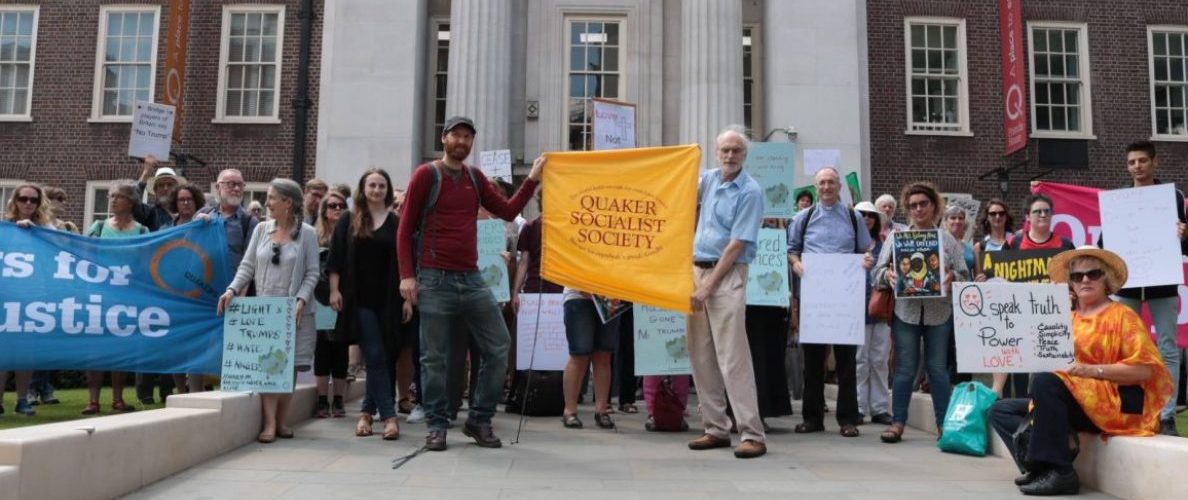
By Sheila Taylor (Salter Lecture Co-ordinator)
On Sunday some 400 Friends listened in person at Quaker Yearly Meeting to the 2026 Salter Lecture, while 385 watched the lecture on the livestream. The lecture received overwhelming praise for its extraordinary breadth of knowledge and depth of humanity. A member of staff at Friends House commented today: “It was a really fantastic lecture. It’s not easy to be left with a feeling of hope on this topic, and many people have shared with us how insightful and thought-provoking the lecture was.” We are deeply grateful to Rachel for her outstanding Salter Lecture. The full video, with captions, can be seen here It is also available on the Quaker Yearly Meeting 2026 playlist and the Quaker playlist of Salter Lectures. And below is the full text of the lecture.
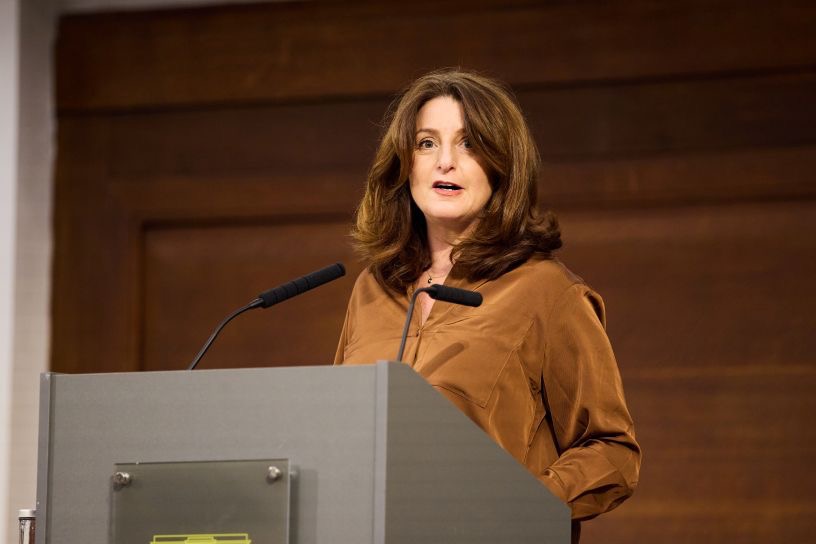
[Rachel Shabi speaking at Friends House]
Rachel Shabi: 2026 Salter Lecture: The Middle East, A Moral Catastrophe?
When Sheila told me about Alfred and Ada Salter, I looked into these Quakers and social reformers. And I found a quietly powerful example of what universal principles look like when they’re lived consistently. Their lives were anchored in what continue to be inspiring ideals today: those of non-violence and moral consistency, the idea that you cannot build a just society through unjust means, and that dignity belongs to everyone.
Theirs was a slow, patient sort of success. They lost elections. They faced resistance and ridicule. They carried on. Their achievements are testimony to the idea that transformation doesn’t rely on extraordinary moments, but rather on many ordinary ones, repeated steadily, and often.
When I look at the work of the Salters, I see a direct line that runs through to many social justice and antiracist campaigners and thinkers of today. I hear the political activist Angela Davis: “You have to act as if it were possible to radically transform the world.” Or Ruha Benjamin, the author of Viral Justice, who argues that we can “infect” society with small acts of justice and care and joy. She writes: “What I am calling ‘viral justice’ orients us differently towards small-scale, often localized actions. It invites us to witness how an idea or action that sprouts in one place may be adopted, adapted or diffused elsewhere.”
And we can follow that line, carved out in an insistence on universal values, etched in the insistence that dignity belongs to everyone, to my starting point today.
Which is January 2024, when the Irish lawyer, Blinne Ní Ghrálaigh, addressing the International Court of Justice, said something that has stayed with me ever since. She was a member of the legal team representing South Africa’s case at the Hague, that Israel was violating the genocide convention in its assault on Gaza. That assault began immediately after the Hamas atrocities of October 7th 2023, in which 1,200 people, the majority Israeli civilians, were killed and over 200 more taken hostage, including women and children.
While setting out the case, which the court ruled in favour of, Blinne Ní Ghrálaigh spoke of: “The horror of the genocide against the Palestinian people being live-streamed from Gaza, to our mobile phones, computers and television screens. The first genocide in history where its victims are broadcasting their own destruction in real time in the desperate, so far vain, hope that the world might do something.”
It haunts me, that sentence. It haunts me because of all that has happened since, the horrors that we have seen inflicted upon Palestinians in Gaza, with at least 71,000 killed, 170,000 injured according to the United Nations, and many still missing under the millions of tonnes of rubble that will take years to clear.
It haunts me because it speaks to journalism’s responsibility to expose harm and injustice—a responsibility that across so many western media organisations was not fulfilled, a profound moral failure.
In June that same year at the international journalism festival in Perugia, Italy, I heard Youmna el Sayed, Gaza correspondent for Al Jazeera English, describe how she and others braved impossibly violent conditions to document Israel’s war, thinking that international news networks outside Gaza would amplify footage, boost it, follow up.
“One thing that I took away when I survived this war,” she said, “was the abandonment of the international community towards the Palestinian people in Gaza.” She spoke of the failure to, as she put it: “Fight for the freedom of speech that you have been for many years lecturing third world countries about, that you failed to practice when it came to covering this genocide in the Gaza stip.”
But mostly, I keep returning to Blinne Ní Ghrálaigh’s words at the Hague because, despite the livestreaming of terrible news and horrific images, the killing did not stop. It went on and on, death and trauma, famine and suffering. A hell on earth so bad, that by mid-August last year, children in Gaza were wishing for death, according to Save the Children, which noted: “They’re wishing for food, water and to be in heaven. They’re wishing for things no child should EVER wish for.”
When we talk about a moral catastrophe in the Middle East, this is it. This is how so many of us feel. A total collapse of shared universal values. An enormous violation that shook us to the core. A shattering so seismic that it ripped through all our institutions as they supported or funded, obfuscated or misreported the intolerable violence that rained down upon the people of Gaza, without mercy and without end.
In truth, the moral collapse goes deeper. The seeds were sown earlier. We need to wind back the clock to reveal this larger implosion. We need to pan back, to bring a complete picture into view, not to fudge, or to excuse, but to help us cohere around a shared vision and purpose, premised on our shared humanity.
Because the total moral collapse in Gaza was prefaced by a slow unravelling, one that we have been inside for years. If we zoom out far enough, we can see a pattern that has been taking shape for some time, in which western governments tear up moral codes and international laws.
But we will get to that. Because the collapse we are looking at right now is in Gaza. From where we heard of surgery without sedation or pain relief as Israel blocked medical supplies; of toddlers with sniper wounds to the head and chest, of maggot-infested wounds, of tens and thousands of child amputees – more in Gaza now than anywhere else on earth.
We saw these fragments of a living nightmare for Gaza’s entire population, running from horror to horror, scrabbling to survive while grieving for loved ones, bombed and shot and blown to pieces by the Israeli army, day after day, night after night.
Everyone has their own list of the horrors we witnessed, live-streamed from Gaza. For me, these include the six-year-old Hind Rajab, who in January 2024 died pleading for rescue workers to come and save her from the car where she sat, surrounded by her dead uncle, aunt and three cousins. They had been trying to escape Gaza city, but were killed by the Israeli army, which also killed the two paramedics that came to her help.
Or the video of 19-year-old Shaban al-Dalou, burned alive while attached to an IVF drip, his leg trapped, in a tent, in a humanitarian zone next to Al Aqsa hospital. Injured in an Israeli bombing a week earlier, he and his family had been displaced six times. His mother was also burned alive in that tent and weeks later, his 11-year-old brother Abdul Ruhman died from injuries sustained that same day.
Or Mohammed Bahr, a 24-year-old with autism and Down’s syndrome, who in July 2024 was left by Israeli soldiers to die from his wounds after he was mauled by a military dog.
We could go on, but its already too much. The relentless scale of it made us all lose our minds. In what world was any of this justifiable? Why did Western nations, including the US, Britain and Germany, provide Israel with military aid and the necessary diplomatic cover? We will get to the reasons why. Because among many factors, an often overlooked component is the one that so often causes violence and suffering: capitalism.
But before we go there, I want to tell you about the author, doctor and holocaust survivor Gabor Mate who, speaking at the Palestina Forum in Vienna last year, articulated what so many of us feel. “There’s something called moral injury,” he said. “And moral injury happens when you are watching something terrible happen and you can’t stop it and you are helpless in the face of it.”
He added: “It is impossible to have your eyes open and not be heartbroken.”
And so here we all are. Heartbroken. And our eyes are also open to moral catastrophes, devastating countries across the Middle East. It’s a severe, multi-front humanitarian catastrophe marked by intense conflict, widespread displacement, and collapsing infrastructure.
In Lebanon, amid thousands dead, one million people have been displaced, with the health sector near collapse. Iran is being bombarded by a US-Israel war, with thousands dead, over three million displaced, toxic air pollution due to the bombing of oil facilities causing long-term damage to the health of people and the planet.
In Sudan, described as the world’s largest humanitarian catastrophe, 30 million people, TWO THIRDS of the population, are in need of aid. 14 million have been forced from their homes. Three years of brutal civil war has caused an impossible 150,000 deaths, with famine raging in parts of the country and countless atrocities and war crimes on both sides.
When we talk of the human toll in countries of the Middle East, I worry about growing numb, desensitised by the incomprehensible numbers. But grief is grief, pain is pain. It looks the same, everywhere, every life is a universe; every death mourned.
Earlier this year the International Rescue Committee (IRC) described the situation in Sudan as “the New World disorder” – a stark, but fitting label. Several countries, including the UAE and Russia are indirectly involved in this war, prolonging it. Western countries – with few direct security interests, with relatively small impact to the global economy and unwilling to antagonise regional allies – mostly watch on and issue periodic condemnations.
And so universal rights have become conditional on a sort of, what’s in it for us, cost-benefit selectivity. And with little international consequence, the actors in the Sudan war continue to expand it. In a recent report, IRC has highlighted how state collapse through fighting in Sudan has created a thriving war economy, stating: “Large quantities of gold flow out of the country, while increasingly advanced weapons move in the opposite direction.”
Taken together, these crises point to a deep erosion of shared ethical norms and it is devastating lives across the Middle East.
Earlier, I spoke about winding back the clock, panning back to trace the gradual unravelling of universal values. So where do we begin? Well, as I have been alluding to, so much of this begins with racial capitalism. That’s the global system where wealth was extracted by exploiting people who had been racialised and placed into racial hierarchies precisely to make that exploitation possible. Today’s western imperialism looks different – in the Middle East it runs through global finance, energy politics, arms deals and strategic alliances. But it still revolves around securing resources and power in ways that keep long-standing, historically rooted inequalities in place.
But I also want to explore how a moral collapse as complete and as devastating as the one we witnessed in Gaza is the culmination of a series of collapses. And I want to turn to a few key junctures when universal norms were torn up and thrown aside.
There’s the war in Yemen, which lasted over a decade from 2014, with the UN estimating over 370,00 deaths linked to the war. At least 85,000 children under five in Yemen died from extreme hunger or disease. A coalition led by Saudi Arabia intervened militarily, prolonging and escalating the war. This Saudi-led coalition bombed Yemeni fishermen, in a country heavily reliant on fish as a food source. As an ally, Saudi’s bombing campaign in Yemen was deeply dependent on British support, in weapons sales, intelligence, military advice and training.
In over ten years of civil war in Syria, amid a brutal regime crackdown, up to 650,000 were killed, tens of thousands of them children. Again, the impossible numbers, containing unbearable loss. Amid a population of some 22 million, 13 million Syrians were displaced. Three out of every five people were forced to leave their homes. For a series of reasons, western governments failed to meaningfully defend international law in Syria. And so it broke, again.
Wind back another decade to the illegal wars in Afghanistan and Iraq. Back then, too, we marched in vain as Britain joined the catastrophic invasion of Iraq, one that even then was clear would make things worse. It produced a long chain of suffering, unfolding over many years. Hundreds and thousands of innocent Iraqis were killed, millions were displaced, state services collapsed and the destabilisation caused by the war helped fuel the rise of Islamic State.
I still vividly remember my Iraqi parents, lamenting over radio reports after that US-led invasion, about British and American forces occupying Iraqi cities like Mosul, or Basra where my father lived. They would bemoan the mispronunciations of those familiar places, observing that, if you were going to occupy a city, you should at least be able to pronounce it. But it wasn’t about mangling of words, so much as the mangling of a country, a people, a culture so often maligned, condescended and diminished, something my parents were by then all too familiar with.
And far away from those countries being bombed, those War on Terror years had a terrible domestic impact, too. In the UK alone, counter-terror strategies placed the entire Muslim community under suspicion, facing discrimination and surveillance and false imprisonments. That, too, was a pronounced departure from universal values, the idea of equal citizenship and equal treatment in practice. It dehumanised an entire community.
All of these wars, and many more besides, were norm-breaking, a series of giant tears in international law. Every single one scaffolded a kind of permission architecture for others to flout more laws, ignore more conventions They gave license to authoritarians. They all, in some way, paved the way to the decimation in Gaza.
A friend I spoke with recently, told me: “How many times have I seen a women in a headscarf weeping over a dead child and how many times has the weapon that killed that child been supplied by western governments, whether the deaths are happening in Afghanistan, Iraq, Iran, Gaza, Lebanon, or Yemen.” At some point, he says, he understood that people who look or pray like him are not viewed as equal, or equally worthy of life.
But going back to Israel and Palestine, how many times has Israel flouted international laws? How many UN resolutions has Israel ignored, over building settlements and occupying and annexing land, all illegal under international law. Or over violations of the laws of war, or the illegal separation wall’s route through the Palestinian West Bank, or the rights of Palestinian refugees, or the status of Jerusalem, or humanitarian access?
You don’t get to the world-changing catastrophe perpetuated in Gaza without first passing through a series of human rights violations, a trail of violence claimed as ‘self-defence’, a continuous breaching of red lines, all within a decades-old fortress of immunity from western allies. It happens over years and in a thousand cuts.
And that constant permission given by its western allies to avoid international law, all adds up to a culture of impunity in Israel, because any country will just keep doing what it is allowed to get away with. That is, after all, why we have international law and conventions over war. That is why we are supposed to uphold those laws, apply them everywhere.
But let’s take another step back and examine this western support for Israel. Why is it happening? One key way to think about it is this: Western nations see their own interests and the interests of the Israel state as being one and the same. The German chancellor, Fredrich Merz, said this quiet part out loud in June 2025, describing Israel’s illegal airstrikes on Iran back then. “This is the dirty work Israel is doing for all of us,” he said.
In the US, the Republican Ted Cruz, a politician I find appalling on so many levels, recently spoke about the national security benefits of the Israel alliance in terms of the intelligence that country shares with America: “The people who hate Israel, they all hate us, it’s almost a perfect overlap. And so if we tried to recreate the national security benefits of our alliance with Israel, it would cost I don’t know, $30bn $300bn,” In words that echo the German chancellor, Merz, he says : “A tiny nation the size of New Jersey is fighting our enemy for us.”
Recently explaining the dynamics of the current US-Israel war with Iran, the Dutch-Palestinian Middle East analyst, Mouin Rabbani, said that yes, Israel has wanted this war with Iran for decades. But it is still the client state of America and not the other way around.
“We know all it takes is a phone call from Washington to bring Israel to heel because, just as in the real world, tails do not wag dogs, it is dogs that wag their tails. And here we are dealing with the most powerful state in human history, the United States, in control of the regional proxy, Israel.”
He continued: “Does Israel have influence in the United States? Of course it does. Is it at times able to exert extraordinary, defining influence in the United States? Yes. But when push comes to shove it is always the Americans that are capable of taking decisions and imposing them on the Israelis.”
Now we can and should argue that any perceived benefits far outweigh the moral damage. We definitely should point out that such strategic calculations are only possible if undergirded by the assumption that Palestinian, or indeed Arab, or Muslim lives are worth less, that these lives do not embody the same dignity and sanctity as every human life.
But for the sake of building an ever wider coalition of people to oppose the terrible, and destructive violence across the Middle East, we must be able to comprehensively analyse and deconstruct these geopolitical drivers.
Last year, the UN special rapporteur Francesca Albanese issued a report documenting how global companies were deeply involved in supporting Israel in its Gaza onslaught. The report claims to “show why Israel’s genocide continues: because it is lucrative for many.” Albanese’s report, presented to the UN Human Rights council in June 2025, noted that the profiteering went beyond the companies supplying weaponry, extending to tech, investment firms, car companies, banks.
Shortly after the report came out, the US government imposed sanctions on Albanese. Speaking about this, she has said: “What the United States couldn’t process was me pointing a finger to the profits. It’s OK to accuse Israel of committing crimes, no one cares… But the moment that I pointed to the fact that there are businesses profiting from it? Yes, I got sanctioned.”
Now go back even further, to look at the multiple tragedies that created this nightmare of violence and destruction in Israel-Palestine, catastrophe upon catastrophe. Because here, too, we can see the outlines of western involvement, colonial calculations and different forms of racism, all colliding in a painful and bloody conflict that has been raging for decades.
The Jewish national project that produced Israel was, from the perspective of Palestinians, unequivocally and unambiguously colonial – in the violence, death and displacement of Israel’s treatment of Palestinians, from the start into the present day. In today’s censorious climate, the right of Palestinians to speak about and define their own experiences of Israel must be protected.
At the same time, this Jewish national project would not exist and could not have succeeded in its stated intent to establish a Jewish homeland, were it not for the rampant and deadly antisemitism across Europe at the time of its conception and in the centuries before. It was envisaged as one way out of the cycles of violence in Europe which, by the late nineteenth century, had forced European – or Ashkenazi – Jews to form an escape plan. This movement, born in Europe, imbued with European colonial ideas – was also born of antiracism and desperation.
The Palestinian philosopher Raef Zreik has elaborated on this duality, writing: “The Europeans see the back of the Jewish refugee fleeing for his life. The Palestinians see the face of the settler colonialist, taking over his land.”
During the early 20th century, many European Jews had no interest in starting from scratch in a distant land. One Jewish movement, the Bundists, advocated a stay-and-fight approach to antisemitism: they saw safety through a shared struggle with the working classes and in establishing Jewish cultural autonomy. They did not, in short, believe Jewish people required a separate nation state.
Among Jewish people living across Arab and Muslim countries, like my Iraqi parents, there was little interest in Zionism, since there was little of the virulent antisemitism that had propelled the ideology into being. Jewish people had been an integral part of the Middle East for centuries and, for the most part, had no cause to worry about their status in those lands. Indeed, Iraqi Jews were more drawn to Iraqi nationalism, communism and socialism than to the Zionist movement that struggled to gain traction among Jewish communities of the Middle East.
The thing that eventually made the Israel project appealing to European Jews wasn’t that they woke up one day and fancied doing a bit of settler colonialism. It was that European antisemitism kept on escalating, while other escape routes were closing.
The same Arthur Balfour who promised the Jews a national home in 1917, with the Balfour Declaration, had been an enthusiastic campaigner for the 1905 Aliens Act, designed to keep Jewish immigrants out of Britain.
By the 1930s, European Jews were escaping the Third Reich. Palestine was hardly the destination of choice for most Jews in dire straits. They looked to America or to Britain, but both countries had by then closed their doors to Jewish arrivals.
On the eve of the Second World War against Fascist Germany, in July 1938 in the French resort town of Evian, delegates from thirty-two countries met to talk about helping Jewish refugees who were trying to flee the Third Reich. Everyone expressed sympathy, but Britain and America, alongside every other country aside from the Dominican Republic, rolled out the reasons it was impossible for them to take in more refugees.
And so, as a consequence both of Zionist mobilising and of borders closing around the world, the Jewish population in Palestine swelled.
Even after two-thirds of Europe’s Jewish population was killed in the Holocaust, few countries were willing to welcome survivors in the numbers needed. As late as 1947, 250,000 Jews in Western Europe languished in Displaced Persons camps, with no home to return to. With almost every other alternative closed during that immediate postwar period, Palestine became the last safe haven.
We should be able to recognise this and still condemn the injustices perpetrated by the state of Israel, from the start. But all too often, as the British-Jewish philosopher Brian Klug writes, progressives put forward: “a discourse that folds Zionism completely – without remainder – into the history of European imperialism and colonialism, as if Zionism does not have its roots in the Jewish experience of centuries of exclusion and persecution in Europe”.
The deadly violence perpetrated in Europe against Jews does not exonerate Israel for its violent treatment of Palestinians. It is no justification. It does not in any way erase the colonial experience of Israel for Palestinians. But it does bring us into a wider understanding of the forces of racism and imperialism impacting this particular part of the world. It allows us to see the Western considerations and influences at play.
Writing about the hostilities in this region, professor of Middle East studies, Gil Hochberg, argues we should direct our attention to what she describes as “the third party” By that, she means “the always absent-present Christian West, which intrudes, navigates, manipulates and manoeuvres the interactions between Jews and Muslims, but itself remains a largely invisible force.” All too often, we are not panning wide enough to take in the impact of this third party which, as Hochberg writes, is often too big to be seen.
Britain’s most fateful intrusion, the Balfour Declaration, was just the beginning in helping to create a ‘side’ of Jewish people with claims to a particular land. The Declaration was premised on the idea that Jews, regardless of where they lived, really belonged ‘over there’.
British political figures at the time viewed Jewish communities as oriental, but superior to the indigenous oriental population in Palestine; European in outlook, if not actually European. This was Britain putting Jewish people through its racial sorting and categorising system, which directly informed its approach to the region (and variations of which were applied in other parts of its empire). By panning out to take in that third party too big to be seen, the Christian West, we can see that the ‘sides’ in this conflict did not always exist. They were manufactured by the broader dynamics of racism and colonialism.
And such dynamics were not limited to appraisals of European Jews and their claims to Palestine. During the 1940s, parts of the Middle East and North Africa were trying to shake off the yoke of British and French colonialism, including the puppet regimes thoroughly managed by European states. In countries like Iraq, Egypt, Algeria, Tunisia and Morocco, all boasting thriving historical Jewish communities, Jewish people ended up caught in the middle. Colonial powers, struggling to keep hold of their influence, tried to extend patronage to Jews, as they were seen as European allies. Jewish communities in these countries became a useful foil, elevated by the European colonisers and placed in a different category, precisely because they were seen as in-between – because this is how divide-and-rule is done. But at a time of nascent nationalisms, this put Jewish communities in a tricky spot.
We can see how this unfolded in Iraq, where right-wing forces tried to foment tensions by suggesting Jews were loyal to colonial powers. A fragile Iraqi government, threatened by the constant calls for democracy, drew up a law that allowed Jewish people to leave for Israel. A subsequent law meant those Jews left as refugees, stripped of possessions and their Iraqi citizenship. This last revocation pained my Basra-born father for as long as he lived.
What happens when we put all these different strands of history together? We start to see a tangle of communities in Israel–Palestine, all caught in some way by European colonialism and its attendant prejudices. The historian Hakem Al-Rustom has written about the displacements of different peoples – Palestinians, European Jews and Arab-Jews – as products of: “European interests in the region and race politics in the colonies during the nineteenth century.” He urges us to consider: “the Holocaust, the Nakba and the question of the Arab-Jew as part of a single catastrophic European history” and that we “narrate against identity-based insular histories that promote hierarchical segregations of populations”.
This is exactly the sort of approach that gets us to the joined-up, morally coherent antiracism that I want to believe in. Narrating these oppressions and displacements in tandem means we can see these histories as strands of the same rope, tightly braided together.
If we see the settlers of Israel as victims of the European racial hierarchies that subjugated and killed millions across Africa, Asia and the Middle East, we can see that the modern conflict between ‘Jews and Arabs’ is in no small part constructed by the same forces that perpetuated those catastrophes. In other words, we start to see not just the ‘sides’, but the overarching system that produced the sides.
I think this is what Columbia professor Gil Hochberg was getting at in urging us to pan back and see the invisible third party in the Israel–Palestine conflict. In authoring this “tragic drama” she wrote, western intervention has helped create the impression of a historic enmity between two peoples, Muslims and Jews, rather than see the conflict as a product of “the long European legacy of colonialism, racism, Islamophobia and antisemitism.”
Now, none of that is to remove the agency or motivations of the actual parties involved, historically or in the present day. I am certainly not here to suggest there is a “context” for Israeli violations and war crimes. There is no justification for flouting international law and committing war crimes, ever – anywhere, not for Hamas, not for Israel, not for the UK, Russia or the US.
But as Hochberg puts it, the conflict was: “Europe’s way to cleanse itself from its two modern historical crimes – antisemitism on the one hand and colonialism on the other – by transferring their weight onto its primary historical victims.”
She continues: “With this onus duly transferred onto Jewish people, a new role is activated for Europe, which gets simultaneously to turn Muslims into the new antisemites and to offer Jews protection from it.”
It is a deeply Islamophobic projection. We see it in the conveniently ahistorical assumption that today allows Western nations – even Germany, irony of ironies – to suggest that antisemitism in their societies has been “imported” by mostly Muslim migrants. And we see this same dynamic across the European far right, which uses a proclaimed defence of Jews as a means to stoke Islamophobia.
Now to get back to our sub-question: do these multiple moral catastrophes in the Middle East reflect a lack of universal values? And I want to say: no! Our political leaders have absolutely failed to uphold universal values, failed to protect them and failed to ensure that they are applied consistently.
But those universal values exist. We know what they are. Millions around the world have been marching for them. Genocide scholars and human rights organisations in Israel itself have been urging that we uphold them. University students set up encampments demanding we protect those rights and apply them universally. So many risked jobs, lost platforms or faced threats and harassments, in some cases were even detained and threatened with deportation, because they spoke out, begged our political leaders to remember that universal values apply to everyone, including Palestinians. Countries in the global south, often carrying their own histories of the violence of colonialism and recognising the parallels in Gaza, have been trying to lead us back to the values that western nations keep ignoring. It is no wonder that South Africa, with its bitter history of apartheid, was the country that took Israel to the International Court of Justice in December 2023.
And Palestinians themselves have compelled us not to turn a blind eye to Gaza, not just for the sake of Palestinians, but for the preservation of our shared values, our own humanity.
Many of us cannot forget what we saw in Gaza. Something changed in us and there is no going back. We will not stop drawing attention to it. At the same time, we should keep making these essential connections, panning back wider, keeping sight of the interconnected histories of European racism and colonial thinking that has shaped current catastrophes. And like the Salters, like Angela Davis, like Ruha Benjamin, like so many others, we must hold onto the power of the individual, the small daily work, the changes that push towards a just and equal and safe future, where every life is precious and dignity belongs to everyone.
Let me leave you with the author, Gabor Mate, who at the Palestina Forum in Vienna urged against despondence. He said:
“Even if you feel broken-hearted and helpless and hopeless and in despair, don’t let that get to you because you have a larger goal here, which is to contribute to the light and the truth in the world… and that is a long-term struggle, it’s a long-term calling and all of us can contribute to it.” ENDS
Rachel Shabi, O3 May 2026.
[Please note that articles on this website represent only the views of their named authors, and not necessarily the views of Quaker Socialists in general, or of the Quaker Socialist Society in particular.]


I agree. The Jewish state was established as the state of Israel in 1948 by the United Nations, something that the Palestinians have unwisely never accepted, to their lasting detriment.
LikeLike
Since the 1890s what has changed is the Zionist project. It moved from settlement in Palestine to establishing a Jewish state in Palestine.
LikeLike
The Palestinians have been resisting the Zionist project since the 1890s. This has never changed and it never will.
LikeLike