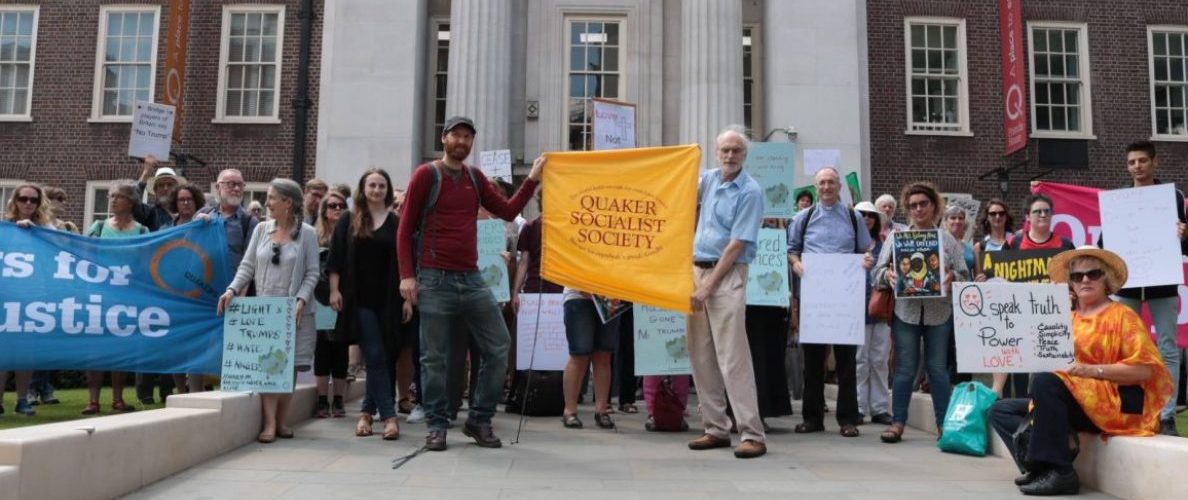
By Sheila Taylor (in collaboration with Lyndsey Jenkins).
Dr Lyndsey Jenkins came to talk with QSS on her research into the Labour MP Joyce Butler (1910-1992) on 30 March. Dr Jenkins has been conducting a project based at Bruce Castle Museum and Archive in Tottenham and has curated an exhibition on Butler’s life and work which is currently open at the Museum.
Butler was raised as a Quaker in Birmingham, attending meeting at Moseley Road, and described her family as ‘birthright members of the Society of Friends.’ After moving to London with her husband Vic, she was elected as a councillor for Wood Green, and then as MP for the constituency in 1955. Butler was only the 67th woman ever elected to Parliament, and at that time, was one of only 24 women in the House of Commons.
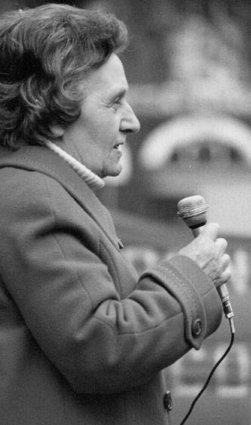
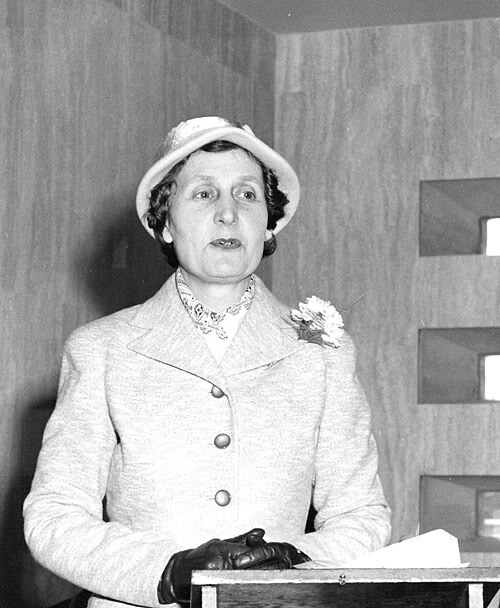
[Photograph on the left reproduced by permission of Bruce Castle Museum and Archive.]
Joyce Butler only made one reference to her Quaker upbringing in the Commons, suggesting that in part because of this background, she had never experienced discrimination as a woman. Nevertheless, Dr Jenkins argued that the values that she inherited from the Quaker tradition were central, even if not explicit, in her politics throughout the rest of her life.
This was particularly visible in her lifelong commitment to peace. She was part of the generation which came of age in the aftermath of the Great War and spent the interwar years working as part of the Young Friends and the Friends Anti-War Group, arguing that capitalism and imperialism were the root causes of war. During the Second World War she was the secretary of the industrial and social order council of the Society of Friends. Though this explicit connection is less visible after the World War II, Butler maintained a lifelong commitment to peace, serving as a Vice President of the Women’s International League for Peace and Freedom, secretary of the Parliamentary Group for Nuclear Disarmament, and was a key figure in leading Labour Party opposition to the Vietnam War.
Her commitment to simplicity was also evident in her advocacy of consumer rights, during a time in which scientific and technological progress seemed to tip the balance in favour of producers and manufacturers. There was little information and limited regulation governing what could and could not go into different products. Butler took up the cause of labelling—on food, cosmetics, and the chemicals used in farming and gardening’. This might also be seen as a manifestation of stewardships, which can also be discerned more broadly in her care for the environment, which extended to worries about waste and pollution.
But perhaps the most obvious manifestation of the lasting influence of Quaker principles is on Butler’s lifelong commitment to equality. From her earliest days in parliament she was particularly interested in women’s rights, including equal pay, equal treatment in the taxation and pension systems, and improved healthcare for women. Most significantly, she instigated what eventually became the Sex Discrimination Act in 1975.
Dr Jenkins argued that Joyce Butler exemplifies a certain ideal of public service based in compassion and expertise, informed by evidence and statistics but never forgetting the human stories. One of the hallmarks of her politics was her ability to work collaboratively, and she was at the forefront of coalitions which crossed party lines and extended beyond party politics. She was also a dedicated local politician who was widely recognised for her expertise in housing and planning.
The National Women’s MP is on display at Bruce Castle Museum and Archive until August. The exhibition is open to the public and free to visit during museum opening hours (Wednesday to Sunday, 1pm to 5pm). Dr Jenkins would be delighted to hear from anyone who remembers Joyce Butler or who has views on this subject.
April 2026.
[Please note that articles on this website represent only the views of their named authors, and not necessarily the views of Quaker Socialists in general, or of the Quaker Socialist Society in particular.]
 Quaker Socialist Society