On 11 February the BYM Trustees recommended that our Salter Lecture on ‘War & Peace’ should not go ahead at the same time as Yearly Meeting if Jeremy Corbyn were one of the speakers. On 23 February QSS produced a Summary of the situation, expressing our concern and our feeling that this decision was giving way to the establishment and the media.
We sent our Summary to the Trustees to explain our view, and a meeting was arranged for Sheila to have a discussion with Marisa Johnson and Paul Parker. We also sent it to the two other BYM decision-making bodies: Meeting for Sufferings and Yearly Meeting Agenda Committee, asking for it to be circulated to their members, but we were told that was inappropriate.
On 29 February an item was therefore posted on the QSS website headed: ‘Will Quakers ban Jeremy Corbyn?’. This was the first public mention of the Salter Lecture issue, and for some people in inner-Quaker circles it caused what they described as a ‘media storm’.
Communication with QSS members:
Discussions with BYM about the Salter Lecture had actually been going on since September. All that time we were hoping for a resolution that would be acceptable to both sides. However, the Trustees’ decision seemed to make this impossible. So on 1 March we sent QSS members our Summary of the situation, and within two days we received 31 responses from members expressing dismay, disappointment and a considerable degree of anger.
QSS talk to Management (1 March):
When Sheila met with Marisa and Paul on 1 March, she pointed out that Jeremy Corbyn’s office had still not been able to confirm his availability for July. However, she also stated that QSS could not possibly disinvite a speaker whom they considered perfectly appropriate. If Jeremy were unacceptable in Friends House, QSS would be obliged to hold the Salter Lecture elsewhere.
Marisa declared that she would happily speak to Jeremy Corbyn in person, explain the situation and ask him to withdraw. Sheila therefore arranged a meeting for this extraordinary conversation to take place.
Meeting for Sufferings (2 March):
The Trustees had sent their report on the Salter Lecture to Meeting for Sufferings as a ‘Confidential Minute’, which was not revealed until the actual meeting. So when Marisa spoke to the minute, members were unclear about the background and the implications. The report was accepted, with just a few queries from members who had seen the website or read the QSS Summary.
The meeting with Jeremy Corbyn (14 March):
Sheila and Marisa met Jeremy over a cup of tea in Portcullis House. He was very gracious, but said he was sad and disappointed with the Quaker position. He had spent five years combatting the lies told about him by the Labour Party and the media. Quakers had also experienced persecution, and he felt it would be a shame if they allowed others to set their agenda.
The meeting was warm and friendly. In response to Marisa’s request, Jeremy said he would do whatever QSS wants – speak or not speak. He wanted to maintain his close connection with QSS, so if July were not possible, he would do another event for us some other time.
Yearly Meeting Agenda Committee (16 March):
Last weekend YMAC met to decide the final agenda for Yearly Meeting. Mary Aiston introduced the item on the Salter Lecture, accompanied by Marisa. Nearly two hours were spent discussing it and producing a Minute, which was sent to us. (Attached.) It is disappointing, though hardly surprising. Essentially everyone involved in this procedure has accepted the recommendation of the Trustees. On the positive side, I gather that YMAC expressed a great deal of respect for QSS and much enthusiasm for the Salter Lecture and for this year’s topic. Members stated how keen they were that the lecture should go ahead.
Ironically, if Jeremy is not available in July anyway, this whole debate will have been unnecessary. Paul Ingram is eminently qualified to speak on War and Peace, and is happy to do the lecture on his own or with another co-presenter.
What concerns are there now? (22 March):
In the autumn we were told the concerns about Jeremy Corbyn speaking at the time of Yearly Meeting. These were based on the public perception that he is anti-semitic, and on the assumption that his presence would attract a great deal of negative media attention. They were:
The anticipated media attention, including on social media, could be overwhelming for staff. It would distract from the themes of Yearly Meeting. The distraction would mean that QSS fails to achieve the aim of our lecture topic. Quakers could be seen as condoning anti-semitism. It could damage BYM’s relationship with the Jewish community. It could endanger the Ecumenical Accompaniment programme in the Middle East.
I feel the discussion has been changing over recent months. The YMAC minute does not mention most of these points (media, YM themes, lecture topic, antisemitism, Jewish community). As for the EAPPI programme, the only danger stated is that participants might get their entry visas refused – by the Israeli government.
Interestingly however there is a new concern mentioned for the first time by YMAC. They say: “We are aware of the risk to relationships within our Yearly Meeting community, posed by one group exercising authority over the decisions of another, when we are all trying to move forward in prayerful discernment.” And they ask QSS to “consider the risks identified…….to relationships within Britain Yearly Meeting”.
This is very vague, but QSS has picked up much resentment from members and other Friends about the power of Trustees, interfering in the Salter Lecture and unfairly influencing others’ opinions. Personally I regretted that QSS were not allowed to express our views directly to the decision-making bodies. There seems to be a problem about who is allowed to query what, not just in public but also internally. And it was worrying to have it implied that any other speaker we might choose should first be ‘run past’ the management team. I thought that Jeremy Corbyn was a one-off case, but perhaps some people would like a veto on all future Salter lecturers!
Sheila Taylor (Salter Lecture Coordinator)
The YMAC Minute
YMAC 2024-3-11 Salter lecture
We receive paper YMAC 2024 03 12, Salter Lecture, which has been introduced by Mary Aiston. We have been joined by Marisa Johnson, the Clerk to Britain Yearly Meeting Trustees, for this agenda item.
We are asked to decide whether to agree to the Quaker Socialist Society’s request to hold a Salter Lecture, on the subject of war and peace, delivered by Paul Ingram and Jeremy Corbyn, at Friends House during Yearly Meeting. If the lecture does take place during the time of Yearly Meeting (at Friends House or elsewhere), we are asked to decide whether it should be included in the Yearly Meeting programme.
We are grateful to Britain Yearly Meeting Trustees for identifying risks associated with the proposed lecture and for explaining them to us. We are grateful to the Quaker Socialist Society for communicating with our clerks during the period of exploration of these questions. We are glad to hear that the clerk to Trustees and the Salter Lecture Coordinator have met with Jeremy Corbyn to explore the issues with him.
We have met together, acutely aware of the risks associated with each way forward from here. We do not wish to be swayed by fear of controversy, and we are aware of the fast movement of information and speculation on social media and elsewhere.
We note that Britain Yearly Meeting’s work in Israel and Palestine is particularly vulnerable at this time, and that this work may be put at critical risk by the conversations that we would expect to arise around a lecture held in the proposed way and including Jeremy Corbyn as a speaker.
We are aware of the risk to relationships within our Yearly Meeting community, posed by one group exercising authority over the decisions of another, when we are all trying to move forward in prayerful discernment.
We ask that the Friends in the Quaker Socialist Society tasked with arranging the Salter Lecture consider the risks identified both to peacebuilding work in Israel and Palestine and to relationships within Britain Yearly Meeting, and either:
• arrange for the Salter Lecture to go ahead in Friends House at the time of Yearly Meeting, delivered by Paul Ingram, or:
• make alternative arrangements for a venue for the Salter Lecture that may include Jeremy Corbyn as a speaker. This could be at the time of Yearly Meeting or at another time.
We agree not to publish details of the Salter Lecture as part of the Yearly Meeting programme if the latter choice is taken.
We recognise the difficult decision ahead for our Friends in QSS, and we offer them our prayerful support as they move forward with this. We send this minute to the Quaker Socialist Society and to BYM Trustees.
Here is the recent report received by the Quaker Socialist Society Committee from the Salter Lecture Co-Ordinator, Sheila Taylor, explaining the course of events since arrangements were first made for this year’s Salter Lecture back in July 2023.
Quaker Socialist Society Report (01/03/2024)
QSS proposal for Yearly Meeting:
Ever since 1899 there has been a Quaker Socialist lecture at Yearly Meeting, given by a lecturer sympathetic to the Quaker ethos, on a topic of current importance. For 2024 we felt the most crucial issue worldwide was war and how to prevent it. Our vision was that this Salter Lecture would contribute to the Quaker tradition of mediation and peaceful conflict resolution.
We invited two speakers to do a joint presentation:
Jeremy Corbyn, socialist and lifelong campaigner for peace and disarmament. In 1998 he gave the Salter Lecture: Socialism, Injustice and Poverty, with Barry Coates, World Development Movement.
Paul Ingram, Quaker, expert onglobal nuclear disarmament. Led BASIC (British American Security Information Council). Now at the Centre for the Study of Existential Risk, University of Cambridge.
Both are pacifists who believe that genuine security can only come through relationships and trust. Both support the traditional Quaker approach of not taking sides in a conflict. We felt this would be of interest to all Quakers, including those who do not identify with socialist politics.
As 2024 Yearly Meeting is Friday – Tuesday with the Swarthmore Lecture on Saturday evening, we asked the Recording Clerk if it would be possible to hold the Salter Lecture on Monday evening.
Reaction by Britain Yearly Meeting:
Our proposal (made in September) was met with horror. The idea of Jeremy Corbyn appearing during Yearly Meeting caused panic that Quakers might be accused of antisemitism by association. The topic of the lecture was sadly sidelined and completely replaced by a discussion of public perception, antisemitism and the power of the media.
Jeremy Corbyn has never been antisemitic towards Jewish people. He was merely branded ‘antisemitic’ long ago due to his regular criticism of the Israeli state and its treatment of the Palestinian people. This criticism was then weaponised in a campaign to remove him as leader of the Labour Party, although an EHRC report later admitted that Corbyn himself was never personally guilty of antisemitism.
The Present Situation:
Now, nearly five months into the appalling war in Gaza, Israel stands accused at the International Court of Justice of war crimes, collective punishment and genocide towards the Palestinians. And the majority of the global community finds itself in the same situation as Corbyn, labelled ‘antisemitic’ by the Israeli state and its few remaining allies.
Dropping Corbyn would be seen by many communities in the peace and labour movements as giving in to those powerful voices which seek to remove all who challenge oppression or suggest radical departure from the status quo. Quakers have not done this in the past. Our judgements have been based on what is right, not on fear of upsetting the establishment.
Yet some still assume that Corbyn’s presence would inevitably mean ‘antisemitism’ dominating the media narrative of Yearly Meeting. Their thinking seems determined first and foremost by fear of upsetting those who will not accept any criticism of the Israeli state.
A Risk Assessment which was produced focused solely on possible negative reactions to Corbyn, and as a result, Trustees have recommended that the lecture should not be held at Yearly Meeting.
QSS View:
Friends have always stood up against witch-hunts and been guided by our commitment to Truth. Jeremy Corbyn is a leading figure in the British peace movement and has an outstanding record of solidarity with Jewish people. We believe in free speech, and do not want him ‘no-platformed’ by Quakers.
Question for the Quaker community to consider:
Could the Trustees’ recommendation be wrong? Does this recommendation basically succumb to the reactionary establishment, to those not prepared to accept criticism of Israel, and those with an agenda to silence radical voices in Britain?
Sheila Taylor
(Salter Centenary Co-ordinator)
24 responses to “The Arrangements for the Salter Lecture”
Anonymous
I would be in favour of holding the lecture at a different venue / outside but definitely during yearly meeting so those travelling to the meeting can easily attend
I have never attended a salter lecture but god willing will be at this one
In reply to anonymous who on 26/04 said they were disturbed that Jeremy Corbyn had been invited by QSS in the first place. I would like to note the following:
The EHRC report was a flawed report. Please watch the three part Al Jazeera documentary The Labour Files. Also the meticulously researched book Weaponising Antisemitism by the investigative journalist Asa Winstanley.
Jeremy Corbyn is a well known pacifist. In 2013 he was awarded the Gandhi Foundation International Peace Award. What evidence therefore do you have that he has not got a genuine interest in peace making or that his views are not aligned with Quaker values, other than the mainly right wing mainstream media which has always been biased against him?
Jeremy Corbyn has clearly stated himself on a number of occasions that in order to achieve peace we need to discuss/negotiate with groups with whom we profoundly disagree.
As an attender at my local M for W I do have a real issue with the not taking sides stance with regard to this current conflict. In conflict resolution taking a neutral stance is the only way forward to achieve harmony and get all sides talking with each other. However the conflict in Gaza is very different and is not a normal conflict resolution situation: we are talking about a state sanctioned plausible genocide, to date nearly 35,000 killed including 15,000 children, genocidal statements made by senior figures in the Israeli government etc etc.
The Reverend Munther Isaac, Pastor of the Lutheran Evangelical Church in Bethlehem has clearly stated that it is his view that we have to take sides in this conflict. He regards taking a neutral stance as naive peace making. We all need to be active in bringing to an end this awful conflict. I am on the side of justice and it is justice that the Palestinian people need urgently: therefore I am on their side, despite the view of BYM.
Once we have a full ceasefire and a full and proper process leading to self determination for the Palestinian people and the right of all people to live in peace on that contested land then and only then-in my opinion-do we then start to take a more neutral stance.
I think there is an issue in all this about whether we as Quakers have always had our own house in order in respect of racism. If the answer is “no” then perhaps we are judging Jeremy Corbyn by standards we have not always observed ourselves. Would it not have been better to have allowed the Salter Lecture to go ahead as originally planned and to for Britain Yearly Meeting to issue a public statement beforehand stating that Jeremy Corbyn’s views are not necessarily representative of Quakers as a whole?
As a Friend, I find it disturbing that the Quaker Socialist Society should invite Jeremy Corbyn in the first place. In 2020 the Equality & Human Rights Commission investigation into antisemitism in the Labour Party, found the party, under Mr Corbyns leadership, had committed unlawful acts of discrimination & harassment. The ECHR also stated “The equality body’s analysis points to a culture within the Party which, at best, did not do enough to prevent antisemitism and, at worst, could be seen to accept it”. As Friends would we really invite any other leader or former party leader to speak if the EHRC made similar findings of racism against any other group. Of course not!
Clearly, another speaker with a genuine interest in peace and more aligned with Quaker values could have been found. The Quaker Socialist Society are of course, free to invite anyone they like, but the Society of Friends should not be in anyway associated with anyone whose values & actions are so remote from our testimony.
As Friends, we are for non violence and peacemaking. Our faith calls us to speak out against injustice and aggression wherever it happens, and to work together, sometimes with governments and groups we very much dislike, to achieve peace. Unlike, Mr Corbin we do not as a corporate body take sides. To be associated directly or indirectly with Mr Corbyn does not help us achieve our aims and actually assist the people of Israel/Palestine live peacefully together.
I am following Jeremy Corbyn on Twitter and I have not seen him make any antisemitic remarks. He does criticise Israeli policies, but then so do many of the peace movements within Israel. Rabbis for human rights are concerned that the IHRA definition is silencing any criticism of Israel, including the Israeli peace and human rights groups. Catherine Margham
I am shocked that whoever-it-is within the decision-making structure at Friends’ House is kowtowing to the right-wing UK media and the right-wing Israeli government in this way. They appear to be saying that the Society of Friends should collude with the unjust treatnment of a man of peace, for fear of being slandered themselves, by association. Really??
I think that Trustees etc may be out of touch with ordinary Quakers. I suggest that others ask people after M for W what they think, and see if that is the case.
I hope that Quakers decide to go ahead with the original plan to include Jeremy Corbyn as a speaker for the Salter lecture 2024 on the subject of the war and the prevention of war. He has clearly demonstrated that he speaks strongly to our Quaker vision of working to finding a peaceful solution to situations of conflict. The recently released expressions of concern about inviting Jeremy Corbyn to speak at this important lecture need to be properly considered, however we need to stand strong with clarity and courage when speaking truth to power wherever that ‘power’ may lie. I hope that we will shine a light in the places that seek to silence us.
Last year YM was split over two weekends because there had still not been a full return to normality after Covid. So the Salter Lecture, on the first weekend, was still at the same time as Yearly Meeting.
I feel that there is an issue about antisemitism on the Left in British Politics. I do not feel that the Labour Party is immune to this. I think that there is a tendency for those on the Left (including Quakers) to see the Jewish community as part of the establishment and therefore there is sometimes a blind spot in relationship to antisemitism, due to unconscious bias.
Having said that I am troubled by the suggestion that the invitation to Jeremy Corbyn to speak at the Salter Lecture at the start of Yearly Meeting should be withdrawn. I feel that we as Quakers would be allowing ourselves to be intimidated if the invitation is not allowed to stand. Surely there the risk posed by aggressors increases if they are placated.
What is the evidence for the assertion that the Middle East Accompanied Programme would be vulnerable if it goes ahead?
I feel that our trustee’s suggestion that allowing the Salter Lecture to take place at Friends House at the start of YM “could move attention away from other issues we should be discussing” shows a lack of confidence in the capacity of Yearly Meeting to engage with the disciplines associated with the Quaker business method.
It llooks like last years Salter Lecture was held on 21st April 2023 in Westminster meeting house, with Yearly Meeting on 28th – 30th April at Friends House.
At present thousands of Palestinians are being killed. We don’t need Accompaniers to give us “first hand testimony of the treatment of Palestinian people”. We see it now, every day. And what is being asserted? That if Jeremy spoke in July at YM the Israeli government would block the visas of the next two Accompaniers? They have already done that to the Norwegians, but Norway has taken it as a badge of honour. Are we really to have the agenda of our YM dictated by the Israeli government?
Trustees did make a decision on this matter – to recommend to YMAC that Jeremy Corbyn not be allowed to speak at YM. They made this decision after receiving a detailed recommendation from the management team. Unfortunately this contained several inaccuracies and did not include the opposing arguments from QSS, so no legitimate discernment was possible.
Secondly, they could not legally have banned him from a QSS event or from a War on Want event at Friends House. What has caused outrage is that Quakers want to ban him from a Quaker event. Yet Quakers used to be the champions of free speech.
Thirdly, it could not be another date. Paul Ingram and Jeremy Corbyn had already been invited to deliver the Quaker Socialist Lecture, which since 1899 has been delivered at the time of Yearly Meeting. They had already been invited.
This is me again, OK for the sake of transparency, Nicola Grove. Sorry all you people who think Trustees were not involved – but if you look at the papers for MFS this weekend https://www.quaker.org.uk/documents/mfs-2024-03-calling-letter-agenda-papers you will find the following MinuteConfidential.BYMT/24/02/10 which is the one relating to this discussion. I am not clear what would have happened had the Quaker Socialists not brought the issue into the open. Would members of MfS been asked not to divulge this information in their reports to their Area Meetings? why are members not permitted to know what is being discussed? I don’t necessarily disagree that asking Jeremy Corbyn to give the lecture is a brave/controversial decision. If there is a threat to the EAPPI programme we need to know about it so that we can campaign on their behalf, make arguments to our representatives and so on, so please provide us with the necessary information.
Speaking personally I am holding Members of MfS and Trustees in the Light this weekend because this is a vital discussion relating to freedom of speech, the ways in which antisemitism is conceptualised (I gather Oliver Robertson is about to report on the issue) and the whole question of how we put into practice the process of discernment which is absolutely fundamental to our Quaker identity. See here for a discussion that I was totally unaware of until I started looking in more depth into this question. https://www.quaker.org.uk/documents/mfs-2022-12-agenda–papers-package MFS22 12 11
In other words, Friends, the question is not actually about Mr. Corbyn. The question is how should these decisions be made. How transparent can we afford to be? Are trustees (yes, trustees) and management correct in preserving a silence over the decision making process because of their fear of reputational damage, and to a valued programme? what are members allowed to know and when are they allowed to know it? What are MfS representatives allowed to know and openly discuss?
There are reports regarding her associations which should have been taken into account when considering her for an award (see https://thegrayzone.com/2022/11/21/journalist-intelligence-british-pandemic-policy/). She was also found by the Court of Appeal to have defamed Aaron Banks with unsubstantiated allegations, and ordered to pay him over £1 million in damages and costs.
Cadwalladr is actually a highly contentious recipient from several perspectives. however, the QTIG (correctly IMHO) were left free to make their own choices.
If they are concerned about repetitional damage to RSoF, management, trustees and MfS need to make sure that their decisions are made with full cognisance of what this means from all points of the political spectrum.
There needs to be a discussion with members about the extent to which Trustees and Management should be censoring the decisions of Quaker related groups, and the principles guiding these bans should be discerned by all of us.
Having read/seen the Trustees’ statements on this, it seems clear that, firstly trustees don’t make decisions on these matters so there is no benefit at all in side-tracking this important conversation about Peace with the ongoing debate on charity governance.
Secondly, and much more relevantly, it seems clear that no one has suggested that Jeremy Corbyn should not speak at a Quaker Socialist Society event, or not speak at Friends House. He did in fact speak in a successful Friends House event just last week.
The only request seems to be for his talk not to be part of, and hence potentially distracting from, Yearly Meeting itself on that date, particularly due to EAPPI concerns. It seems it would be fine on any other date, so why not just hold it on another date? That a distraction was likely has been demonstrated by the conversation above, without even having to go outside the Quaker community!
This is what I would post. As a Trustee I do not recognise the description of our motivation in discerning the way forward. In our discernment we were particularly concerned about the EAPPI (Ecumenical Accompaniment Programme Palestine Israel) programme, currently in a delicate state, which we manage on behalf of a number of churches. Through the outreach done by returning EAPPIs thousands of Friends have heard first hand testimony of the treatment of the Palestinian people and many will have been moved to action. We ask Friends to consider whether protecting this programme is not more important than the lecture taking place on this particular day and place.
Many years ago, there was concern that charitable status would lead to conflict with Quaker testimony, in exactly the way described so clearly here (thank you). Charitable law was not yet as rigorous, most Friends knew little of it, and trustees behaved in a Quakerly way. Most people said we would never allow this to happen. Well, now it is happening, in one area after another. And Friends are being silenced, so it is difficult to unite to deal with it. At least Quaker Socialists have a website, and cannot be silenced there. What are we going to do?
Robin, I think Management Committee refers to running Friends House, as opposed to Quakers in Britain. I may be wrong. The phrase used in the article was ‘management team’, which I assumed to be the ad hoc support group that Paul Parker uses to discuss anything he’s doubtful about – the recording clerks’ staff, heads of the Quaker departments in Friends House, and then bringing in trustees and clerks of Sufferings and Central Committees if necessary. Again, I may be wrong. It has taken me much questionning to get that far.
I would expect Sufferings to be concerned that Friends House has attempted to veto a speaker chosen by QSS.
But the concern is reported to have come from Management Committee. This is a group of Friends House staff, with no relation to Trustees. There is no indication that Trustees have had any involvement in this. And Meeting for Sufferings will not be discussing the YM agenda tomorrow other than for an item about structural options. In any case, it has no responsibility for the Salter Lecture. I do question the decision by QSS to put out such a misleading statement.
I have been concerned for some time about the unaccountability of Trustees of British Yearly Meeting. Certainly one influential trustee regarded Quakers as identical to any other charity, with Trustees and a CEO, and major decisions taken on administrative and financial matters by trustees with no consultation. Whereas the organisation has historically been bottom up, with individual quakers taking their concerns forward to their local meetings, then to area meetings and then to Meetings for Sufferings – the most democratic structure imaginable. I am glad that QSS have brought the issue out into the open because without transparency there can be no honest discernment, and we members are left in the dark.
[This is the transcript of the sermon given by Munther Isaac at Bloomsbury Central Baptist Church, London, on 18th Feb 2024. Munther Isaac is pastor of the Lutheran Christmas Church in Bethlehem. As Gaza was being bombed and the West Bank raided, he addressed a packed church as follows:]
“I don’t take lightly your support and your solidarity with us. I truly wish I was here in different circumstances, yet I’m glad for this opportunity we have to come together in one heart and in unity.
“Is not this the fast that I choose:
to loose the bonds of injustice,
to undo the straps of the yoke,
to let the oppressed go free,
and to break every yoke?” (Isaiah 58:6)
It has been more than 130 days since the war on Gaza began. It is beyond my comprehension to believe that this war, this genocide is still going on. 28,000 thousand killed, including 12,500 children. Thousands more still under the rubble. 70,000 or so injured, 1.7 million displaced, trapped and starved. This is beyond inhumane!
What happened to the conscience of the world leaders? I say, “world leaders” and “lord of wars”, because the voices in the street are sending a different message. They are speaking loud and clear: stop this genocide. But sadly, the war lords are not listening.
The International Court of Justice was clear in its description of what is happening and its rebuke to Israel and those complicit in it, yet even the ruling of the ICJ was not enough to stop this genocide. And now we fear that Israel will assault Rafah! Could it get even worse?
The people of Gaza broadcast to us scenes of their genocide, the war leaders declared to us and to the world their intention to wipe out Gaza and recolonise it, and the world is still debating and deliberating whether what is happening is a war of genocide or not. It’s hard to believe.
Israeli soldiers are posting mocking videos of the destruction of an entire civilization… while the world still debates and deliberates! They’re even debating just getting humanitarian aid to Gaza. We’re not even able to get humanitarian aid, let alone end this genocide.
That’s why I say the truth is evident for all to see. There is nothing to debate. Apartheid is clear. Genocide is clear. We don’t need to explain it anymore. Truth is evident for all to see and, believe me, world leaders know the truth. They are denying it. In fact, they have been denying it for 76 years now.
I think of my own work. How many delegations did we receive? How many lectures did we give? How many times did we explain things?
And what makes it harder for us is that when Israel alleges that some members from UNRWA were involved in the attacks on October 7th, support to UNRWA stops directly from countries around the world, including the UK. The amount of hypocrisy is incomprehensible. The level of racism involved for such hypocrisy is appalling. I cannot get beyond this!
And now, 130 days later, we have some world leaders and church leaders who are beginning to change their stance. It took 130 days and I say it is too late! You showed up to Tel Aviv to show support; you provided the theological and political cover, you described it as “self-defence”, Israel’s legitimate right to exercise self-defence. And now you want to convince us that you care? After you have given the green light for this genocide, even offering to pay the bill. Now you are showing concern? I am sorry, you cannot undo what happened. You cannot change history. You cannot wash the blood from your hand.
Indeed, the conscience of the world is dead. They have grown numb. World leaders are obsessed about their thrones. They are intoxicated with power. We have world leaders literally signing, autographing, the missiles! They are obsessed with war. They don’t care for the victims. In fact, they already labelled them as terrorists, animals, and evil ones. Think of the level of dehumanisation behind such attitudes.
Don’t tell me it is not racism! Those complicit in this genocide do not see us as equals, as humans. How else do you explain this lack of empathy for human lives? For children dying, pulled from under the rubble, for babies found decomposed in hospitals in Gaza?
130 days later, we are tired of sharing these stories – but we will not stop! We are tired of sharing about the killing of our children. We have been pleading “Lord Have Mercy!” for more than 130 days; indeed, for 76 years!
As Palestinians, we find comfort in our faith. We find hope in the Word of God. This Sunday is the first season of Lent. As we journey towards the cross, may we reflect on the profound meaning of this season. I think of three things:
– It is time of Repentance.
– It is a time of fasting, and such a time to reflect on the meaning of true piety.
– It is a time to reflect on the mystery of suffering and how the road to glory has to go
through the Cross.
So, let me talk about these three things, and link them to what is happening in Gaza today.
Repentance – how our world needs to repent today! From apathy; from numbness to suffering; and from normalising and justifying a genocide.
Morality and ethics are missing from politics today. Let’s think about the idea that in our political sphere we have normalised a genocide. That’s why we need to repent.
For, when world leaders watch a genocide and ethnic cleansing unfold live on TV and social media, yet continue to explain it, while only raising concern over the death of innocent civilians, our collective humanity is at stake. This is why I say we need to repent.
When churches justify a genocide or are silent watching from distance, making carefully crafted balanced statements, the credibility of the Gospel is at stake.
We need to repent from our racism, from our superiority, from our bigotry. This war confirmed to me that the world does not look at us as equals. They describe a genocide as a “misstep”. Biden said it’s “over the top”. War crimes and the killing of 30,000 are a “misstep”! We need to repent from the sin of apartheid – the idea that certain people are more entitled than others. To think that churches are promoting this is beyond my understanding.
In this Lent season, we are also called to reflect on our religious practices. I think of the meaning of fasting as we read in the prophecy of Isaiah, and the message is clear: piety that does not produce compassion and mercy is false piety! Piety that does not lead to hunger for justice is false piety.
“Is not this the fast that I choose:
to loose the bonds of injustice,
to undo the straps of the yoke,
to let the oppressed go free,
and to break every yoke?” ( Isaiah 58:6 )
How much of our world and our churches is full of false piety; a piety that lacks mercy, justice, and truth. Today’s reading from Isaiah is as if it he were talking about our world today. Isaiah challenges us to go beyond “charity”. And many Christians love to hide behind charity, to look like good ones, while being silent when the genocide is happening. This is about taking a stance and active participation to bring justice and liberation. This is not about making a statement when you see a genocide! Jesus did not say,
“I was hungry, and you prayed for me and made a statement!” Jesus said, “I was a prisoner and you came to me!”
This is not about “praying for peace”, “raising concern”, or “sending support”. Piety, religiosity, true spirituality means the active participation in loosing the bonds of injustice, undoing the straps of the yoke, letting the oppressed go free, and breaking every yoke. This is active solidarity; this is about action.
I ask: Is this what the church is doing today? Let us be honest with ourselves! I hope you understand why we, as Palestinian Christians, have been crying out, “where is the church?” The question when we face injustice and suffering should not always be “where is God in the midst of suffering?” Many times the question is “where was the church?”
We are occupied by religious practices, theological discussions. Moreover, I feel the thing we lack the most today is courage. And I hesitate to use this word because the courage needed to speak the truth is nothing to the courage the people of Gaza are showing us every day. We need courage to speak the truth. But we are not speaking many times. We fear the consequences. We fear the backlash!
We live in a time when the church wants to avoid controversy at any cost. Can you imagine if Jesus walked on earth avoiding controversy! Can you imagine if he was asked a question, he would craft a balanced statement that aimed at appealing to the Pharisees and the Sadducees and the disciples and the Romans (and, if possible, his heavenly father!). Isn’t this what the church is doing today?
The way church statements dance around the issue of “ceasefire” or (god forbid) condemning Israel is indeed amazing. They write two-pages long statements that basically say nothing other than unequivocally condemning Hamas!
Honestly, we should not be surprised; how many times did we, as Palestinian Christians, experience rejection from the Western church? How many times were invitations sent to us to speak in global venues and then these invitations were cancelled. Why? For fear of controversy.
There are church leaders who are willing to sacrifice us for the sake of avoiding the hassle of having to explain to outsiders why they are meeting with us Palestinian Christians! They’d rather not do that, so they don’t invite us. They don’t meet with us. They sacrifice us for comfort. It happened for me even on this trip.
Sometimes I joke, Jesus sat with sinners, so consider us sinners and listen to us and sit with us! It is amazing, the idea that church leaders fear having to explain to others why they met with Palestinian Christians because it’s “controversial” and then end up not meeting with us. It’s beyond my comprehension.
This is why when I say “courage”, I actually shouldn’t use the word “courage”. They sacrifice us for comfort, the same way they offered us as an atonement sacrifice for their own racism and antisemitism – repenting on our land over a sin they committed in their land!
All of this while we claim to follow a crucified saviour, who sacrificed everything, endured pain and rejection for the sake of those he loved! We claim we follow him but are not willing to sacrifice even our comfort. We just want to avoid controversy.
When the church does not want to lose its comfort, something is seriously wrong with our
Christian witness. When the church sacrifices truth for the sake of conformity and avoiding controversy – something is seriously wrong with our Christian witness.
So thirdly, this is a season in which we reflect on the mystery of Christ’s own suffering and consider our identity in the cross and as followers of a crucified yet risen saviour. We need to think of the meaning of suffering and the meaning of costly solidarity.
Jesus said: “If any wish to follow me, let them deny themselves and take up their cross and follow me. For those who want to save their life will lose it, and those who lose their life for my sake, and for the sake of the gospel, will save it. For what will it profit them to gain the whole world and forfeit their life? Indeed, what can they give in return for their life?”
Jesus here tells us what it means to be a Christian – a follower of a crucified saviour. Jesus says that a Christian is one who denies himself or herself, who carries the cross, and who loses themselves for the sake of Christ and the Gospel! He is the one who understands that if he wins the whole world, it has no value without saving himself.
Christianity without sacrifice is not Christianity. The first and most important thing we sacrifice is our “self” – the “I”. This is the logic of Jesus himself, and this is how he lived. He was the one who denied himself for us, and he was the one who was crucified for us humans, because he loved us. He wants the same from his followers.
Jesus never sought what was for himself, but always what was for others. This is the kind of love that says the other is before me and I am here for the sake of others. Have we forgotten what it means to be a Christian?
And Jesus says, “For what does it profit a man if he gains the whole world and loses his own soul?” When I think about the amount of wisdom hidden in this phrase! How many people have lost themselves and their souls, their values in pursuit of glory and power – or even comfort. I am not just talking about political leaders.
How many peoples lost their soul and values when they took the approach of power, the logic of might. Today we see it expressed in colonialism, genocide and exploitation. The approach of tyranny. How many leaders and peoples chose silence in the face of a genocide in order to win the world? To gain the world, but in reality, they lost their soul. This is why I say, what the world needs today is courageous leaders. People who are willing to sacrifice to speak the truth! How many politicians and religious leaders do we know who have been bought off and lack the courage to speak the truth? Is this how we follow Christ? They might have won the world, but they’ve lost themselves, as Jesus said.
Over my life I’ve met many people and I met many people who ended up becoming influential – either church leaders or even politicians in very influential positions. When we first met them, they were with us, they understood, they were for justice – “we will do everything for you”. But along the way, as they become more and more important and influential, they sacrificed Palestine. I know so many of these leaders.
I am tired and fed up of church leaders who share with me behind closed doors in confidentiality that they support us 100%, but that they are confined in what they can say in public! I hear this all the time, from church leaders and politicians! You know how frustrating it is? They know what’s happening, but they say they cannot speak up. Leaders in their comfort zone lack the courage to speak up, while the honourable people of Gaza risk everything for the sake of freedom and dignity. They have more honour and dignity than those politicians or faith leaders who are not speaking out.
Friends, I speak as a Christian. As followers of Jesus, we must be willing to risk all to speak truth to power. This is why in Palestine today, we do not only talk about solidarity; we talk about ‘costly solidarity’, because we know that sometimes there is a price to pay.
This war has shaken our faith – in humanity and sometimes in God. But we cannot lose our faith in God. We continue to search for a voice. I’ve found so much comfort in the psalms of lament, and we cry over Gaza: “My God, my God, why did you leave Gaza? How long will you forget her completely? Why do you hide your face from Gaza? In the daytime I call upon you, but you do not answer; by night we find no rest. Do not depart from the people of Gaza, for distress is near, for there is no one to help … Our souls and our lives approach the abyss … our eyes melt from humiliation. We call upon you, Lord, every day. We stretch out our hands to you. Why, Lord, do you reject our souls? Why do you hide your face from us?” (Adapted from Psalms 13, 22, and 88)
We search for God in this land. People ask me this question all the time, “Where is God in the midst of this genocide? How do we explain his silence?”
But away from philosophy and existential questions, I look at our history and I see that in our land, in Palestine, even God is a victim of oppression, death, the war machine, and colonialism. We see the Son of God on this land crying out the same question on the cross: “My God, my God, why have you forsaken me?” It’s the same prayer that Jesus prayed. Why do you let me be tortured? Crucified?
God suffers with the people of this land, sharing the same fate with us. This becomes our comfort in the midst of suffering – the idea of God’s presence amid pain, and even amid death. For Jesus is no stranger to pain, arrest, torture, and death. He walks with us in our pain and suffering.
God is under the rubble in Gaza. He is with the frightened and the refugees. He is in the operating room. This is our consolation. He walks with us through the valley of the shadow of death. My prayer has always been that those who are suffering will feel this healing and comforting presence of God with them.
We said during Christmas, if Jesus were to be born in our world today, he will be in Gaza, under the rubble. Jesus under the rubble is the message of God identifying with humanity in its suffering and pain. It is about the God who sides with the oppressed, even being born among them, as one of them, becoming a refugee and a victim of the violence of Empire.
God is in solidarity with the marginalised and the oppressed. God takes sides; God is not neutral. And here is my message: God’s solidarity should become our solidarity! If God takes sides, so should we. Neutrality is not an option.
Today Gaza is indeed the moral compass of the world. This war has divided the world; and maybe this is good thing. We need to know where people stand. Gaza is the moral compass of the world. We either side with the logic or power and ruthlessness, with the lords of war, and with those who justify and rationalise the killing of children. Or you side with the victims of oppression and injustice, and those who are besieged and dehumanised by the forces of Empire and colonisation.
It is really a simple choice: you either support a genocide, turn a blind eye, or justify a genocide, or you cry out: “No! Not in our name. Stop this genocide!”
So, I come here to the UK and I want to challenge the church here: if we truly seek justice and righteousness, in obedience to the commandment of Christ, we must have the courage to speak up and call things by name! This is not a conflict. Israel is not exercising its right for self-defence. Rather, Israel is the coloniser. Israel is a settler-colonial entity. They have displaced millions of Palestinians. Israel was built on the ruins of the people of Palestine. We live under apartheid. What is happening in Gaza is a genocide, it’s ethnic cleansing. Continuing to repeat the Empire narrative only serves to empower the aggressors and maintain this injustice.
Can we continue to even speak about “peace” or even “resolution to a conflict”? Or should we really call an end to tyranny and injustice and apartheid. Vocabulary is important. We are not talking about a struggle between equal forces. This is not simply about a ceasefire; but putting an end to 76 years of ethnic cleansing. And today putting an end to this genocide.
If we are truly concerned and want an end, we must call things by name. I’m tired of diplomacy. This is a time to act. This is a time, to quote Isaiah again, “to loose the bonds of injustice, to undo the straps of the yoke, to let the oppressed go free, and to break every yoke.” It is time for the church to be the church!
I’m convinced that the way and how churches deal with what is happening today – this injustice, this genocide – will reveal a great deal about the identity of these churches. We do not exaggerate to say that the credibility of our Christian witness is at stake here. I recall here something the South African [theologian and thinker] Allan Boesak said, namely that “Palestine today is the gauge for churches and the conscience of churches today”. And he said this before October 7th, before this genocide. How much truer are these words today.
Before I conclude, having called out the church, I want to acknowledge the many of you who have been speaking out. The many of you who have been sacrificing, who have shown positive solidarity. We see you, we feel you and I want to say thank you from the bottom of my heart. We’re doing this together. Your actions, your prayers, your support means a whole lot to us, especially in the face of the rejection that we see. So thank you.
It has been my honour to work with you during this time and we cannot rest. So my call today is simple: We cannot rest until this genocide is over. End this genocide NOW. This is moral call. This is a moral call. It’s not about words, it’s about action. We cannot afford more death! We cannot rest until this genocide is over.
So, let’s act, let’s mobilise creative non-violent means. I encourage you to continue to speak out. To join demonstrations. To mobilise within your community and congregations. Put pressure on your political leaders through calls and written correspondence. Organise non-violent direct-action campaigns and sit-ins. Whatever it takes to compel your government and decision-makers to take action. This is beyond urgent.
We need to act. We cannot rest. We need accountability in the face war crimes. That’s why I said call things by name. Hold people and governments accountable. Injustice will continue as long as no one calls the aggressor accountable. The reports on apartheid must be taken seriously. The ruling of the ICJ must be taken seriously. We need to act. We need to invest morally. We need to implement the International Law. We need to boycott, if needed. We need to call for sanctions. We need to hold people accountable. Otherwise, all of our words just become empty words if we did not act them. Please consider what it means to be true peacemakers. It is time the church here in the UK moves from its shallow diplomacy and neutrality into prophetic peacemaking and costly solidarity.
You need to challenge your own churches. The prophet Isaiah says, “learn to do good” (not just speak good), “seek justice, rescue the oppressed, defend the orphan, plead for the widow.” (Isaiah 1:18) These are all active, participation words. They are not statements and prayers only.
I want to conclude by going back to a letter we wrote back in October, warning about the genocide, saying this is a vengeance campaign, calling for the church to repent seeing already that the church was complicit. I can’t believe that these words are still relevant in February. We saw it coming! We talked about the God who will “judge the world in justice” [Acts 17:31].
I want to read the conclusion of this, because it’s very powerful. Back then we said, and today I say: “We also remind ourselves and our Palestinian people that our sumud (our “steadfastness”) is anchored in our just cause and our historical rootedness in this land. As Palestinians and as Palestinian Christians, we also continue to find our courage and consolation in the God who dwells with those of a contrite and humble spirit (Isa 57:15). We find courage in the solidarity we receive from the crucified Christ, and we find hope in the empty tomb. We are also encouraged and empowered by the costly solidarity and support of many churches and grassroots faith movements around the world, challenging the dominance of ideologies of power and supremacy.
We refuse to give in, even when our siblings abandon us. We are steadfast in our hope, resilient in our witness, and continue to be committed to the Gospel of faith, hope, and love, in the face of tyranny and darkness.”
And quoting from the Kairos Palestine group: “In the absence of all hope, we cry out our cry of hope. We believe in God, good and just. We believe that God’s goodness will finally triumph over the evil of hate and of death that still persist in our land. We will see here ‘a new land’ and ‘a new human being’, capable of rising up in the spirit to love each one of his or her brothers and sisters”.
With this hope we carry on. With this hope we refuse to give in. With this hope we persist until justice prevails and until freedom prevails.
At Christmas Palestinian Pastor Munther Isaac gripped the attention of the world with a photo on social media of a baby Jesus placed amidst rubble near his Lutheran church in Bethlehem. He said that if Jesus had been born this Christmas he would have been “born amid the rubble”. Last week he arrived in England to try and win support for a ceasefire and, beyond that, for the Palestinian cause. He is a sincere and powerful speaker, who held the audience spell-bound at the Bloomsbury Central Baptist Church in London on Sunday February 18. His Lent address, which started with the words of the Prophet Isaiah, pleaded for a humane response, begged for some humanity, and some solidarity, from Christians, and he certainly received it from the congregation at the Bloomsbury Church, as the photo shows.
But then the news arrived that the Anglican Church, which in the autumn had said little on the issue of Palestine, was now refusing to meet with Pastor Munther, on the grounds that he was going to speak at a Palestinian Solidarity meeting alongside the former Leader of the Labour Party, Jeremy Corbyn. Pastor Isaac had travelled all the way from Bethlehem to meet Christian leaders in Europe and to refuse a meeting was not only discourteous at a personal level and wrong at a Christian level, but also politically absurd. Jeremy Corbyn is acknowledged by Palestinians as perhaps, over several decades, the leading UK campaigner on their behalf. Pastor Isaac could not but meet him. Corbyn is also acknowledged as one of Britain’s leading anti-racist campaigners. Since he was a young man he has attended nearly every Holocaust Memorial Day, regularly supported the Jewish community in Islington and has regularly denounced anti-Semitism, while at the same time condemning the racism of the Israeli political leaders and the practice of apartheid in Israel. There was no better person for Pastor Munther to speak alongside.
For Archbishop Welby, it was his one chance to redeem the lukewarm stance of the Anglican Church and take a Christian position. He knew full well that the accusations made against Jeremy Corbyn by a faction in the Labour Party never claimed he was anti-Semitic personally, only that he handled complaints of anti-Semitism within the Labour Party badly. Even that charge was dubious as it was later shown that anti-Corbyn officials inside the party had sabotaged the investigative procedure for political reasons. Thus the position of the Anglican hierarchy was not only lacking in humanity but was also disingenuous.
Graham Taylor
——————————————————————————
This report by Patrick Wintour (Diplomatic editor) appeared in the Guardian ( 21 Feb 2024)
Pastor says Welby would not meet him if he spoke at Palestine rally with Corbyn.
‘The archbishop of Canterbury, Justin Welby, cancelled plans to meet the Bethlehem-based Lutheran pastor Munther Isaac, saying he could not meet him if he shared a platform with the former Labour leader Jeremy Corbyn at a pro-Palestinian rally, the pastor has said.
Isaac, the pastor of the Christmas Evangelical Lutheran church in Bethlehem, who has been highly critical of Israel in Gaza, saw his Christmas sermon go viral when he said if Jesus Christ was born today it would have been under the rubble.
He spoke at a Palestinian Solidarity Campaign rally at the weekend where Corbyn was also a speaker after being invited by the Palestinian ambassador to the UK, Husam Zomlot.
Lambeth Palace said it did not comment on private meetings.
The archbishop is concerned about the huge increase in antisemitism since October in the UK, and it is believed he feared it would have caused huge problems for the Jewish community if the two were to meet.
In an interview with the Guardian, Isaac said he was told by the archbishop’s aides that if he shared a platform with Corbyn, no meeting could happen. Isaac said: “It’s shameful. It’s not my type of Christianity not to be willing to meet another pastor because you don’t want to explain why you met him.”
“This sums up the Church of England. They danced around positions, and ended up saying nothing. They lack the courage to say things.”
He added: “The small Christian community in Gaza has discovered what is hell on earth. Most of them have lost their homes: 45 destroyed completely and 55 partially destroyed. There is no life left for them. This war will most likely bring an end to Christian life in Gaza. Everyone wants to leave.”
“It is so painful for us to see the Christian church turn a blind eye to what is happening, offering words of concern and compassion, but for so long they have been silent in the face of obvious war crimes. Churches seem paralysed, and they seem willing to sacrifice the Christian presence in Palestine for the sake of avoiding controversy and not criticising Israel. I have had so many difficult conversations with church leaders.
“I know from meeting many church leaders that in private, they say one thing, and then in public, they say another thing. I’ve had the same experience with many politicians and diplomats.”
Isaac, on a visit to the UK to build support for the Palestinians, said an immediate ceasefire was “a moral obligation”. He added: “This is not a time for neutrality or soft diplomacy. Gaza should be your moral compass.”
Welby’s allies would say he has spoken out strongly on what is happening in Gaza and will continue to seek opportunities to stand in solidarity with Palestinians, but has to remain mindful of the impact on other communities.
The House of Bishops, the upper chamber of the Church’s General Synod, issued a sharply worded call for a ceasefire on 13 February, saying Israel must stop its “relentless bombardment” of Gaza, and adding the manner in which the war was taking place “cannot be morally justified”.
Isaac said: “If it has not become clear to the world that this is a war of vengeance aimed at destroying the possibility of life in Gaza, and not a war on Hamas, I am not sure what more proof people need. The destruction of schools, universities and hospitals is everywhere. The Israeli soldiers brag and joke about it. How is the killing of 12,000 children a war on Hamas?”
The war, in its fifth month, was triggered by Hamas’s attack on Israel on 7 October last year, in which 1,200 people were killed and 250 taken hostage. Health authorities in Gaza say at least 29,000 Palestinians have been killed. About 85% of the territory’s population have been displaced from their homes, according to the UN.
“If what has happened so far cannot convince people that there needs to be an immediate ceasefire, there is something seriously wrong with our humanity. How much more catastrophic can it get?” Isaac said.
“Even as a pastor, my faith was tested in the last three months. It’s hard, it’s hard to pray and not to see results.”
He added: “My answer to the question where God is is that we have to ask where are the good people in this world. In Christianity we say we are God’s agents, we are God’s hands and feet on earth. The Gospel tells us what’s right and what’s wrong. It tells us what needs to be done. It’s on us when we choose to kill.”
The Quaker Socialist Society (QSS) held an online meeting in January to discuss ways to promote life-long Quaker, and socialist, values in state schools and in Quaker private schools. Members of QVinE,(Quaker values in education), joined the meeting. Their key values are: integrity, equality, simplicity, community, stewardship of the Earth, and peace.
Francis Green, Professor of Work and Education Economics at the Institute of Education University College London, began the meeting by speaking about his book, co-authored with David Kynaston, Engines of Privilege: Britain’s Private School Problem. Francis discussed the democratic deficit when private schools educate 7% of children in Britain; they get over 16% of the funds spent on British schools, and have 14% of Britain’s teachers. The schools’ ample resources, libraries, labs, drama theatres and sports facilities, help these students when they become adults to be the well-paid leaders in all areas of public life. They benefit from networks of influential and wealthy contacts, friends and marriage partners. The figure shows the percentage of privately educated members of some professions.
Francis, who was educated at a leading private school, works on reforms to address these injustices. He collects evidence on the schools’ impact on society, promotes fresh thinking and debate, and he shows how private schools could be reduced such as through higher taxes and through integrating them more with the state system. He ended by asking if there could be Quaker free state schools.
Almost all British Quaker schools are private schools with fees of around £33,000 to £43,000 a year for senior boarders. There was hope in the 1950s that state schools would improve so much there would be no need for private schools. QSS is concerned that over past decades differences in spending, resources and outcomes between the two sectors have continually increased. Finland, often described as having the best education system in the world, has no private schools, and private schools in most European countries are much more like state schools than in the UK. In Britain, private schools control society through their lifelong impact on their former pupils who become the ‘ruling class’.
During the online discussion among 45 people, there was general concern about sending children away from their families to school, especially at younger ages, with the lack of daily loving family contact and local friends. Some of the best people have attended boarding school, but many others suffer from ‘boarding school syndrome’. This is shown in extreme forms by Donald Trump and Boris Johnson, the out-of- touch attitudes of Rishi Sunak and David Cameron, Michael Gove cutting arts and sports in state schools, Paula Vennells’s treatment of sub-postmasters, the former head of Ofsted Amanda Spielman, and many others. Jeremy Corbin attended private schools. Private schools treat education as a product for sale, not a human right. Yet the British public repeatedly vote for politicians educated in private values, who keep privatising national services. Privately educated billionaires own most of the media, and through them powerfully influence public opinion and elections.
Some Friends at the meeting described Quaker schools having the freedom to promote Quaker values in ways state schools cannot. They are peaceful and allow students to be individuals, learning ‘to get along with each other and having the space and the respect for each other’ with none of the bullying seen in large class sizes. Others thought that ‘for a very wealthy country we don’t devote enough of our resource to education’. The wealthy should pay higher taxes, and state schools should be less ‘run as tick boxes’ with an over-prescriptive curriculum, and should be more freely creative. We need a ‘national debate about what education is for and who it is for’.
One person recalled asking her parents to send her to boarding school, which she enjoyed. The youngest of three sisters, she did not want to follow her sisters through their school, and she was pleased that her chosen school helped her and others each to develop their own individual life.
Quakers work in Quaker schools and state schools to promote peace education, ever more crucial with the growth of armed conflicts, talk of planning for future wars, and promotion of the military in British schools. Quakers work with Restorative Justice to help children to build fairer communities and tackle inequalities, to act against bullying and take responsibility for their relationships.
One QVine member with years of experience teaching in state schools and at a university believes many state schools have values very similar to Quaker values, though they might not call them that. They respect individual’s space for children to be themselves. They listen to children, respect them and work with them. They try to work creatively within the constraints of the curriculum, with a strong sense of community. Some schools with a ‘massive cross section of backgrounds’, often in quite deprived areas, have extremely good practice and ‘many primary schools do amazing work’. We should heed the Children’s Manifesto written by thousands of children who sent their beautiful ideas about what kinds of schools they would like.
One teacher, who was sent to boarding school when aged 8, later taught in a state comprehensive, quite a ‘rough sink school’. He thought it produced ‘far more rounded, kind, tolerant characters’ than most people he knows who went to private schools. He mentioned books such as Sad Little Men, about how private boarding schools ‘churn out very damaged people’, who feel a lack of love. Apart from abuse in the schools, he believes it is abusive to send a child away to boarding school. He questioned someone’s earlier comment that ‘education is always a privilege given that many children around the world have no schooling’. He is deeply concerned that during Michael Gove’s reforms of state schools he knew of more than one child who committed suicide in the run up to exams. With massive mental health crises, he believes more childcare is needed in all schools. Having taught in inner city schools, he considers that allegations of bullying there are ‘slightly over-egged’. The problems would be addressed much more rapidly if most parents didn’t use the option, their democratic right, of going to an alternative private provision. Instead, if they stayed with the state sector and helped to improve it with positive parental support, far more money and resources would flow into state schools. He added that the 17th Century Quaker John Bellers, called the first Marxist educator, had many great ideas.
An early years specialist thought the Government’s education policy of ‘young children being told things and being instructed’ just doesn’t work. She had helped to set up Sure Start, with multi-professional working to involve and support parents. She is ‘absolutely horrified’ at Ofsted’s destructive assessments of schools. ‘People used to come from around the world to look at our primary education a generation ago. It was so enlightened, so learner-centred. I won’t call it child-centred because the teachers were learning as well, and it was an adventure, we led the world. I have been all around the world telling people about our primary and early years education. It is tragic that we’ve lost all of that. We just need a political change.’
One socialist doubted that state schools’ finances could be boosted to private school levels, and he favoured dismantling the private sector. Others thought this was impossible and state schools could not take on the Grade 1 listed ancient buildings that are so costly to maintain. The head of a Quaker school said how private coaching and catchment areas, where state schools increasingly reflect their privileged or disadvantaged local housing and communities, undermine equality within and between state schools. There was interest in setting up a Quaker Free School.
There were three closing commentaries. A QVine member who has taught in state and private schools was interested in the discussions around how Quaker values are lived out within our school communities and the challenges for educators in all schools. He had found more interest in talking about the purpose of education in a Quaker school than when he had worked in a range of state schools from urban to rural settings. He mentioned recent 2023 Quaker conferences about how can education create a better world, and other educators’ sense of relief to be able to be involved in these discussions. Quaker schools that were set up 200 years ago in very different contexts face new challenges to adapt to the needs of the modern world. With 30 educators, 120 students from schools across the world took part in another Quaker conference in June 2023. They echoed themes discussed at this QSS meeting, and like the Children’s Manifesto they made a call to action. Their three priorities were: 1) For schools to prepare students much more to take part in future local and global communities; 2) More practical and critical learning about the environment crisis; 3) More education about diversity and inclusion.
A Quaker socialist spoke personally. ‘I’ll be really radical. We should simply get rid of private schools. I’ve always believed that socialist equality is the most important Quaker value. But I’m told “that’s simply not possible, not feasible, don’t be ridiculous and idealistic, get into the real world”. That’s where I am this evening. I haven’t heard any views as radical as mine.’ Some other people showed their agreement.
Francis ended the meeting by welcoming the range of interesting insights and he responded to some of the comments. On the abuse of sending young children to boarding school he believes things are improving. It is now less common, the schools have changed a lot over 40 or 50 years, there is far less boarding, children start boarding when they are older, and many schools are now coeducational. He is glad for his own children at state schools that they can play with local friends during the holidays, which he couldn’t do. He agreed with criticisms of overcontrol of the state curriculum, the downgrading of arts and sports education, and he believes fear of Ofsted contributes towards the problems schools have in recruiting and retaining teachers, with a coming crisis for the profession. Frances thought that raising VAT for private schools would make little difference, certainly not to the top private schools. One possibility is to make it much easier for private schools in trouble to transfer into the state sector. Some Quaker schools might act as a kind of a model or leading light for this.
Comment by the Clerk
I clerked the meeting so did not give my views but will add two personal comments. Thank you very much to everyone who attended and contributed to the meeting.
First, a main theme of the meeting was relations between individuals and the systems we live within. To socialists, the overriding system is social class. Equality therefore means inclusion across all classes and (dis)abilities as well as across gender, ethnicity and international backgrounds. Equality flourishes in inclusive local schools when all kinds of children learn and work together, supported by the mixed local community and the elected local authority. This state system began to be broken up with semi-privatised academies, growing informal selection by schools, and competition between them – policies promoted by former boarding schoolboys Tony Blair, David Blunkett and Andrew Adonis.
Second, Habermas contrasted the System (State and Market) with the Lifeworld (personal life, free associations). The System colonises the Lifeworld, such as by trying to price everything. Many believe that children need a daily balance between school (formal System of public life and rules) and home (private Lifeworld of family, friends and free play) to nurture the values of integrity, equality, simplicity, community, stewardship of the Earth, and peace.
Priscilla Alderson, Member of Dorchester Meeting, 24/1/24
12 P. Alderson. 2013/1999 Learning and Inclusion: The Cleves School Experience. Routledge; P. Alderson & C. Goodey. 1988/2018 Enabling Education: Experiences in Special and Ordinary Schools. Tufnell Press.
13 J. Habermas. 1986 The Theory of Communicative Action, Vol 1. Polity.
This year’s May Day march was against a backdrop of nationwide strikes by nurses, doctors, teachers, lecturers, railway workers, civil servants and others mainly in the public sector, though some were in private companies connected to the public sector, such as the railway companies. There is a political divide over the strikes. Well-off Conservatives do not need these services, although they may make use of them, and they resent having to pay twice – once for themselves privately and then again, in tax, for the public good. This leads them to resist any pay requests from the public sector. It is part of their resentment against the intervention of the state in civil society. They also believe that the good of the country rests upon wealth generated in the private sector and so the more money is transferred from the public sector to the private sector the better for the population as a whole. Naturally, those in the public sector, and those in the lower or middle reaches of the private sector, and also those like Quakers with an ethical commitment to equality and social justice, all profoundly disagree with the Conservative approach. We believe that wealth comes primarily from labour, from natural resources or from infrastructure, and those countries flourish that either have healthy, skilled and well educated labour forces, or else have abundant natural resources, such as oil, coal, metals or fertile soil, and extensive means of transport and communication. It is therefore not only unjust that those key workers should suffer reductions in real pay, either through cuts or inflation, but also of no long-term benefit to the country. May Day is the day in the year when labour, and the infrastructure upon which labour depends, is brought to the fore. All over the world on May Day, there is a celebration of labour and there is voiced a demand for the value of labour to be recognised and appreciated.
As often in the past, the Quaker Socialist Society decided to attend the May Day march and add their ethical voice for social justice to the financial demands being made by unions on behalf of members, impoverished since 2008 by cuts and austerity. As usual, we took our banner in order to register our presence. Our numbers were admittedly small – it was not only a Bank Holiday weekend, when people leave London for a break but also the same weekend as our Quaker Yearly Meeting – but nonetheless it was felt very important to attend this year, if only in solidarity with the strikers. For their protest has an ethical dimension, not just a financial one. It is not just money for which they strike but also against the contempt in which they are held. Every striker gives up their pay for the days they are out on strike, and so performs a selfless act. A nurse or railway worker labours in public service and then has to give up their pay to make their voice heard. The Quaker Socialist, Alfred Salter, wrote this: “Let us not forget that Socialism is a great faith, prompted by a great religious motive, and inspired by a great humanitarian spirit… It is the greatest religious movement since the early days of Christianity.”
The march left Clerkenwell Green around 1 pm and reached Trafalgar Square around 2.30 pm. There were then speeches in the square after which the Quaker Socialists retreated for tea to the kind hospitality of Westminster Meeting House in St Martin’s Lane. The photos below give a flavour of the event.
At Marx House in Clerkenwell Green
Two QSS committee members take the QSS banner for a walk
They approach Trafalgar Square down the Strand
They take a break on the steps of St Martin’s Church before a cup of tea at Westminster Meeting House in nearby St Matin’s Lane
A Norwich Quaker and longtime environmental leader, Read led his audience carefully from the horrible truth of the climate crisis to the wonderful truth hidden within.
Feelings of fear and desperation about the climate crisis are not pathological, but spurs to act, he told the audience at Westminster Meeting House and online on 21 April.
Right here is a life’s purpose waiting for anyone and everyone who needs one – Rupert Read
As philosophers from Frankl to Nietzsche have taught us, there is nothing humans need more than meaning.
“Right here is a life’s purpose waiting for anyone and everyone who needs one and I put it to you that there is nothing that our society […] needs more than purpose,” said Read, at the annual Quaker Socialist Societylecture.
A reader in philosophy at the University of East Anglia and former spokesperson for Extinction Rebellion, Read is increasingly high profile in the environment movement.
He appeared on both Sky News and BBC Newsnight around the Big One protests to discuss growing “the moderate flank” of the climate movement.
More extreme demonstration tactics as employed by Just Stop Oil and others, while useful for starting the conversation, risk alienating the wider public, Read believes.
Suggesting that one of the major challenges facing us is polarization, Read told the audience that appealing to ordinary people in communities, civic associations and faiths was key.
There are two stages of transformational change, he said, when everyone realizes that we can’t go on like this, and when everyone realizes that everyone realizes it.
He said: “The love that we are, whether taking form as effort, as ‘sacrifice’, as giving, as joyfulness, as griefstrickenness, as worry, as desperation, as presence, the love that we have for our children, for life itself, this love is an indescribable gift and a truly mighty power
“Friends, let yourself fall deep into it; which means with and into and through all of us. There will be tears, and dark nights, there will be impossible heartbreak and magnificent joy.”
This is the text of Rupert Read’s Salter lecture
At Westminster Meeting House, April 26th, 2023
Laurence Hall, introducing QSS
Welcome everyone. Welcome all to the Salter Lecture.
This is an annual event organised by the Quaker Socialist Society for the Quaker Yearly Meeting. My name is Laurence Hall, and I’m part of the national committee for the Quaker Socialist Society.
The Quaker Socialist Society stands for a Quaker presence in the socialist movement and making the insights of socialism central to Quaker social witness. We stand for ethical socialism, social justice, and a peaceful, sustainable and radically egalitarian world. We hope you will join us in making this socialist vision a reality.
Quaker socialism extends from Civil War radicals to early socialist pioneers, from radical pacifists to advocates of industrial democracy, from the New Left to the municipal socialists such as the brilliant Salters, by whom this lecture is inspired and named after. Quakers and socialism have been so closely intertwined in the past, but the same is true of the present as we join together in solidarity to build a future beyond the evils of capitalism.
I’m going to hand over to Sheila, another member of the national committee, to introduce this year’s Salter lecturer. Thank you.
Sheila Taylor, introducing Rupert Read
Thank you Laurence. I’m really delighted to be introducing Rupert Read to give this year’s Salter Lecture, though first I do have a confession to make. When our committee proposed that this year’s lecture should be on the climate crisis, I thought oh no, how boring! We all know what needs to be done, and we all know they’re not going to do it, so what is there to talk about?
But when I looked for a possible speaker, I discovered this extraordinary character: an academic philosopher specialising in Wittgenstein, who happened to be a Quaker, and a Green Party activist, who had helped establish Extinction Rebellion and influence government, who had been arrested and quoted Martin Luther in his own defence in court, and who is now giving up paid work to devote his life to the environment. How amazing!
And I found his writings unbelievably exciting too. No dry, depressing facts and figures, although the science is there in the background. Instead a world of powerful imagination that leapt back and forth across the millennia, reminding us of where humankind had originated and envisaging where we were heading, comparing us with all the other species that have inhabited our Earth since it began.
Well, I’m not quite as imaginative as Rupert, but I would like to look back to London 100 years ago and remember the pioneering Quaker couple, Ada and Alfred Salter, and how they transformed the slums of Bermondsey, creating a green environment with decent housing and public health for all. They were inspirational then and remain so still today. We are very grateful to Rupert for helping us promote the Salter vision through this annual lecture.
The title that he has chosen for the lecture is ‘The horrible, wonderful truth about climate: how facing that truth changes everything’.
As is usual with Quaker events we will begin with a short silence and Rupert will start speaking when he is ready.
[Rupert, they’re saying that they can’t hear very well online, so I wonder if you could just do a little sound test before you start?]
Rupert Read
Hi, I’m Rupert Read and I’m giving a lecture this evening. The title…
[Can you hear that?]
…the title of the lecture is ‘The horrible, wonderful truth about climate: how facing that truth changes everything’. How are we doing? Great.
Thank you very much.
Times up. We’re in the age of consequences. We are out of the safe zone. Sadly it’s a childish illusion to think that anyone or anything is going to successfully and safely fix this.
This is not any kind of problem. It’s so much bigger and more wicked than that. It’s not the kind of thing that can be fixed, it won’t be solved, it won’t be fixed. It’s a new condition that we’re all going to inhabit permanently from now on, and it’s going to keep transforming, and for a long time it’s going to keep worsening. It’s a tragic situation, it’s something that we have to in a very profound way get used to.
They say it’s an emergency, but even that understates it. What do I mean? Well, think about emergencies. Emergencies are situations where there is great urgency, yes, and emergencies are situations where you can do something about that emergency such that the emergency comes to an end. But that is not the kind of situation we are in. Calling it an emergency understates it.
The horrible truth is that the climate emergency or rather the climate more-than-emergency is going to go on getting worse for a very long time to come and that some of us are going to end up being killed by it.
People know this, and more and more of us sense it, and though these are difficult truths people aren’t just curling up in a ball. Why? Well, partly because more and more of us now sense that more and more of us now sense it. They say there are two stages to true transformational change. The first stage is when everyone realises we can’t go on like this; the second stage is when everyone realises that everyone else also realises that we can’t go on like this.
So if you’re feeling it, my guess is that you are or you wouldn’t be here tonight. If you’re feeling it, you’re not alone, you’re not mad. In fact if you’re feeling this already then you are very sane, you are a vanguard of mental health. Mental health now sometimes means feeling fearful, even depressed or desperate. These feelings when evoked by the crisis we have entered into are not pathological, on the very contrary. Partly because what they are is actually spurs to act. Spurs to make real the realisation that there is something profoundly wrong with where we’re at.
So rather than people giving up, serious climate concern and action is at last starting to hit the mainstream as we wake up en masse, not only to our predicaments but to others waking up to it too.
Fed up of business as usual and with our reasonable demands having been thus far largely unmet, people are taking matters into their own hands. What do I mean by that? I mean the kind of thing we’ve seen around London today with The Big One, the new XR (Extinction Rebellion) events, probably the biggest climate and nature happening there’s ever been in this capital city. But more than that I mean things that are bubbling up mostly still below the radar across the country, in fact across the world, things that are examples, crucial examples of as I say people in very ordinary and practical and important ways taking matters into their own hands.
I mean things like community climate action exemplified for example by the wonderful iFarm that I’ve been to. This is on the Norfolk /Suffolk border, 10 acres of land. Soon there’ll be a lot more bought by a bunch of ordinary folks who’ve got together and bought it and who are now turning it not just into a place for growing food and for rewilding but into a kind of ever-growing community hub. They’ve taken over a local pub for example and are running it as a social enterprise and they’re really trying to reach out to the whole community including conservative-minded people, I think there are plenty in that part of the world, and trying to get them on the inside of this emerging phenomenon.
I mean things like what’s happening in quite a number of professions now, what’s happening among people who have woken up in advertising, and in insurance, and in the law, people who are seeking to change their corporations that they work for, if they work for a corporation, to make them climate compliant, or who are refusing to take on work for fossil fuel companies, or who are doing pro bono work for climate protesters and others.
I mean things like the organisation Wild Card which is trying to rewild the royal lands and is inviting huge numbers of people in to a campaign which has in it all sorts of ordinary people and also people like Chris Packham, people who have been thinking for quite a long time, how can we break beyond the usual suspects, how can we get beyond people who self-identify as activists and appeal, well ultimately to this everyone, to the majority?
There is already a majority of people in this country and in most countries in the world who are deeply concerned about this. What needs to happen is that concern needs to be deepened further, and that can happen when we really start to face the truth, and it needs to be thoroughly activated. We need a thousand, ten thousand of these organisations that I’ve just mentioned that are starting to spring up.
The emerging Climate Majority Project of which I’m a director is a rallying point for people, ordinary people, not a small radical flank, not just activists, who understand the depth of the crisis and want to do something meaningful about it. The Climate Majority Project is bringing together those who in religions and civic associations, in neighbourhoods and communities, in workplaces and professions are through with outsourcing, through the thinking somebody else is going to fix this or deal with it, through with asking others to fix this and are instead determined to do our best together to mitigate it and adapt to it, to cope with it, even to flourish through it in spite of it, and indeed because of it. Also because of it, what do I mean by that?
This crisis is an enormous opportunity for meaning. Right here is a life’s purpose waiting for anyone and everyone who needs one, and I put it to you that there is nothing that our society so full of anomie and nihilism needs more than purpose. Now this centrality to human beings of purpose is something which many have understood for a long time. I think for example of Viktor Frankl who wrote a magnificent book called ‘Man’s Search for Meaning’ wherein he explains, for example, the astonishing fact that in the concentration camps in World War II, which he survived along with very few others, there were things it turned out that were even more important than having food or water or shelter, and basically they were having meaning. That people who didn’t have anything to live for would die even if they still had food and water, and the people who did have something to live for would live even without it. I think going back further to the philosopher Friedrich Nietzsche, who said what human beings above all need is something to will, something that they try to put their determination into. We have been lacking that in this society. Well, now we have it again.
So you see, I started off by giving you in very, very brief, a horrible truth. What’s the wonderful truth? The wonderful truth about the climate crisis that I promised, that wonderful truth that I promised you, is contained in the horrible truth.
Consider the mysterious pronouncement from the philosopher Jean Jacques Rousseau: the remedy is in the evil. Look inside the evil and there you will find the remedy to it. Or by the great German poet Hölderlin who famously said:
Christ, I’ve forgotten what he said!
[Laughs]
Oh yes, I’ve got it! It’s been a very long day, and I was up very late last night on Newsnight. Hölderlin famously said: Where the danger lies, there also lies the saving power. Where the danger lies, there also lies the saving power. In facing up to the crisis, in the painful realisations and emotions it evokes, lies our possible salvation. And here is the greatest reason why: when we allow ourselves to actually feel our pain, our fear, our grief, our anger, then we many millions of us are ready to act with determination to ensure that what is coming does not take us all down with it. Our grief, our pain for the Earth, our fear and love for one another, these are brought home to us by the crisis, they emerge, they live, they transform.
How does all this work? So, let me outline very briefly for you how we understand this in the Climate Majority Project. We see our work as having four essential interwoven strands, and they go roughly in this order. So it starts out with fearless truth-telling: telling the truth, facing the truth without reservation, however hard it be. This has been the truth, this has been the secret at the heart of the success in the past several years of totally unexpected phenomena such as Greta Thunberg and the school strikes and Extinction Rebellion. My belief is that this truth, this important fact, is far too important to be kept to just the radical flank of the environmental movement. It needs to and can spill over into millions, into the majority and I think that is starting to happen.
So you start with the truth, you start with if you will the horrible truth, but that has to be processed, that has to be handled – that’s the second strand. We need to do inner work by ourselves, and more importantly together. We need to build a culture of resilience, we need to talk about these difficult feelings, we need to face them together and work through them together. This is an integral process now to any meaningful social change. It can’t be ignored, it can’t be thought to be something – I don’t know – feminine or uh or marginal. It’s absolutely central. So, first strand: truthfulness. Second strand: shared inner work to face that truth.
Once you’ve got the second strand in place, then you’re ready for the third strand, which is action, activation. And I believe, and I’m finding, that there are hundreds of thousands, millions, soon many millions, who are ready for or are already into that stage. When you face the truth and when you handle it together, it logically moves into action. You’ve got to do something about it. People are hungry for those possibilities of meaningful action, those on-ramps to things that they can do to make some difference to this situation.
And then the fourth and final strand is that we need to understand the whole of this process together, we need to – as people call it nowadays – sense-make together about this. And the most crucial part of that sense-making is the understanding that this process is happening, that it is to a significant extent inevitable, that this new moderate flank of mass action, this emerging, deepening, activating climate majority, is happening, is to some significant extent inevitable, is going to go way beyond the confines of activism. For people to look around and see each other and notice that it’s starting to happen, that it’s happening in communities, that it’s happening in workplaces, that it’s happening in businesses and so on and so on.
And of course this fourth and final strand of sense-making, of coming to see ourselves as part of this emerging wave, this comes back to the two stages of transformational change, right? First stage is everyone realises that everything has to change, the second stage is everyone else gets included in that realisation, everyone realises that everyone else is figuring that out too. As we come to see that together, then we sense-make what we are doing into something massive and unavoidable. This, to vary Antonio Gramsci, this is optimism of the will combined with realism of the intellect. This is an enormously hopeful trajectory. The horrible truth about climate transforms into a wonderful truth.
But before you all go home on a high, just to make sure there’s no excuse in my words for the slightest complacency or false reassurance, take a deep breath and let’s now dive even deeper. It isn’t enough any more to fixate only on slashing carbon emissions. It’s way too late for that, we are in the danger zone.
So we have to take seriously adaptation, we have to take seriously adaptation to the crisis. We have to take seriously how we’re going to cope with the coming droughts, the coming worse-than-ever heatwaves, the coming disruptions to our food supply systems and more and more and more. So the climate question is bigger and more difficult than most people are still conceptualising it as, and moreover it massively overlaps with another question which is even more difficult and in an even worse state and even bigger, namely the biodiversity crisis or the extinctions crisis. I’m sure this is not news to many of you, for example the Amazon, home to so much of the world’s biodiversity and also the world’s single greatest carbon sink. If we try to fix, which is not something we should try to do, but if we fantasise that we could fix the climate crisis without looking seriously at biodiversity too, then we haven’t even really got to first base.
But take another deep breath. You need to go even further. Consider the Ukraine crisis. Anyone who is paying attention can see that what the Ukraine crisis shows us is that there is a multitude of crises and they are all interconnected: the cost-of-living crisis, the energy crisis, the Ukraine crisis, and the climate crisis are really all just different ways of looking at the same thing right now in 2023 on this planet. It’s for this kind of reason that people are now starting to use this big word polycrisis, we’re in a polycrisis. The climate crisis is the canary in the coal mine of this much bigger, still multivalent crisis, so let’s go further still into the polycrisis.
I’m just going to offer tiny snapshots now. Climate and pandemics. Pandemics are part of the polycrisis. We all now know this because of Covid, but you may not know that there is research suggesting that there are going to be orders of magnitude more pandemics as a result of the climate crisis, because of the way that it is shifting the populations of, for example, bats which are one of the main reservoirs for diseases that then come to human beings. So pandemics, we are likely to have more and worse pandemics in the coming years very likely, and that is interconnected with the climate crisis. There’s been a lot of talk recently about AI – rightly so. My own belief is that AI is not what they call an existential threat – I don’t think we’re going to be entering into a Terminator scenario, you’ll be glad to hear. I don’t think there will ever occur or if it does occur it’s far, far off in the future, basically because we’re nowhere near producing real artificial intelligence yet. They can’t actually think, they just do unbelievable amounts of computation incredibly quickly.
But make no mistake, AI is going to have disastrous consequences for the world in the coming years, is going to break way more things than Facebook broke. We need to pay serious attention to it. And again, it intersects with the climate crisis in numerous ways, but one of the basic ones is that the sheer amount of energy it takes to train these AIs is absolutely phenomenal and terrifying.
The climate crisis is what they call a threat multiplier. What that means is that multiple threats are made worse by it, and most terrifying of all in a way is the threat of nuclear war – many of us deeply concerned about. I myself am a long-time peace activist with Quakers and others. So again we have an intersection between a potential existential threat, which is a real one of nuclear war, and climate.
This is an outline of the polycrisis. One more big word: there’s also the metacrisis. What do people mean when they talk about the metacrisis? This is useful, once you’ve started to get your head and your feelings – it’s not easy – around the polycrisis, you start to realise actually doesn’t all of this, or at least an awful lot of it, get traced back to some much more fundamental root causes and phenomena. One of those is that there is, I would argue and perhaps I’m in a good position, I mean literally in this room, to make this argument, a fundamental underlying spiritual driver to the crisis.
This is not just a crisis of political economy, it’s not just a crisis even of how we live in a material sense. It’s certainly not just a crisis that can be sorted by any kind of technological fix. Ultimately I would argue it is a civilizational crisis and a spiritual crisis. So this concept of the metacrisis says maybe these diverse, intersecting crises have some absolutely fundamental common roots. I would say one such root is that we are spiritually maladjusted to our home at this time in history and also to each other. So we are in a metacrisis: we don’t know how to live anymore. And that comes back to the point about meaning, right? There’s an essential, if you will, philosophical dimension to this: we need to re-figure out how to live. And until we do that, this metacrisis and this polycrisis are not going away.
I want to mention three great obstacles to tackling adequately the polycrisis and the metacrisis and the climate crisis, of course. Three gigantic processes stand directly in our way. The first of these is polarisation, which we’ve seen becoming a severe problem in recent years and we in the Climate Majority Project are very, very concerned about this. We are aiming to try to co-create a movement, or a movement of movements, which combats polarisation because it brings people together to face these existential threats.
Extinction Rebellion which I helped to launch was not in a position to do this, partly because Extinction Rebellion deliberately polarised. It deliberately forced a difficult national conversation. It did so brilliantly, but you can’t go on polarising if you want to sort problems that require a post-polarised society, yeah? There is no possible way of making real progress on climate, let alone on other aspects of the polycrisis without societies which are broadly internally aligned. So, incredibly difficult though it is, we have to work to overcome polarisation.
That’s the first obstacle. The second obstacle is perhaps even harder. It’s the simple plain existence with which you will all be entirely familiar of capitalist markets and of limited liability companies, which face quasi-legal obligations to maximise their short-term profits and returns to shareholders. I’m not going to say much about this, because it’s incredibly hard to deal with. I’m simply going to observe: a) This is something which makes it very hard to imagine really being able to handle successfully these elements of polycrisis, including of course the climate crisis; b) Nevertheless we have to try. We have to try to put ourselves in a position through, I would argue, this kind of bottom-up transformative work and the potential change in political culture that could result, to actually start to retame markets and limited liability companies in particular.
The final one I want to mention, the final process, the final great obstacle is arguably the hardest of all. It is great power competition. Because if we imagine making some progress for example on taming AI and on dealing with climate and so forth in say Europe, well how much of a difference will that make to what happens in say China or Russia? And insofar as you’ve got one major power or superpower or power bloc that is continuing to exacerbate these crises including of course climate, there are built-in drivers for others to continue to do the same.
This is incredibly hard to get around but there are precedents. You know we managed to successfully ban most biological weaponry and chemical weaponry, to some extent nuclear weaponry. We managed to successfully tackle the ozone hole problem in the 1980s, but the ozone hole problem was something like a problem. It was much simpler, much more specific than the climate issue is, let alone than for example the temptations that are on superpowers etc now to allow AI to let rip. Great power competition, geopolitics, is I think possibly the greatest of all the obstacles that we face, and I’m going to be honest with you. I don’t have any answer to it. If you do, I’d love to hear from you.
So this is tough, it’s very tough to face. That’s why we have to do this shared inner work, that’s why we have to face it together. This is all part of the journey that we are now on. And I hope you can see in this whistle-stop tour that climate is really the thick end of a very large wedge. When you see that wedge properly, when you start to bring the polycrisis and the metacrisis into focus, you see more clearly than ever that system change is needed, and also how very hard it’s going to be to have that system change be the kind of system change we want.
Because, let me reframe slightly, system change is coming. But before you get too excited or optimistic about that, the way it’s coming is either that we will successfully manage to undertake transformations that will make some significant inroad into the polycrisis, into the climate crisis, or we will collapse. So system change is coming. This civilisation as we know it is coming to an end. The question is whether we can manage to make that end transformational and broadly tolerable and indeed in some ways wonderful, or not.
But to come back in my final remarks to climate. Climate remains the white swan in the room. What do I mean by that. You may have heard of this concept of black swans – my friend and colleague Nassim Taleb famously argued this in relation to the financial crisis, that this was not something that anyone saw coming, or rather not something that anyone except he and one or two other people literally saw coming. I’ll tell you a little anecdote, I hope he won’t mind. When Nassim and I first met, I got him to give a lecture at the University of East Anglia about the financial crisis and black swans and philosophical implications, and at the end of the evening I said to him, “Nassim, we’d better sort out your travel expenses.” And he clapped me on the back and said, “Oh but you know, you really don’t need to worry about that. You do realise that because I saw what was coming, made this huge bet against the banks, I don’t ever need to claim travel expenses again.”
Black swans are things that people don’t see coming, tight? And we can see the outlines all these things I’m talking about, but we don’t know for sure what form they will take and we don’t know for sure if they will happen, but with climate we do. Climate is a white swan, it is coming right at us. We might with luck escape nuclear war, we might with some luck escape these terrible pandemics, but all the luck in the world is not going to enable us to escape climate breakdown. It is what is going to happen unless we deliberately, transformationally change course.
So, don’t be distracted. We need to look deep into the climate crisis. We need to concentrate on what we can see there which interconnects with all the other crises. When we do this, we are looking deep into ourselves. The microcosm is the macrocosm. We need to concentrate on what we can find there, deep in our souls, deep in our failing civilisation, deep in our profound interrelatedness with each other and with all life on this precious planet, and in what we want to avert from. When we look, there is the gift, the very difficult emotions that arise when we look deep into the climate crisis and see the polycrisis and the metacrisis and see deep into ourselves the so-called negative emotions: eco-anxiety, heartbreak, even despair. These will be the making of us – of that I am confident. Note: that they all arise from love.
Why are we angry? We’re angry because we want to defend what we love and we’re fiercely protective of it. Why are we fearful? We’re fearful for ourselves and for others that we love, of what is going to be coming. Why do we despair? Because we can’t bear to face the situation that we sometimes see or sense or feel when we actually allow ourselves to open to the situation as it is. All of these difficult emotions, they all arise from love, they are forms of love. These difficult emotions are rational, yeah? If you’re not sometimes afraid now, then you’re not paying attention. If you don’t sometimes feel desperate now, then you’re probably not fully facing into what I’ve been outlining here this evening. If you’re not sometimes deeply affected by grief about our situation, then either you haven’t looked at it fully or there’s something missing in you. These difficult emotions are rational, and they are a huge and growing reservoir of energy. Fully embraced, they are all we need. Fully embraced, loved rather than rejected, treated as energy, they are all we need.
The love that we are, whether taking form as effort, as sacrifice, as giving, as joyfulness, as grief-strickenness, as worry, as desperation, as presence, the love that we have for our children, for life itself, this love is an indescribable gift and a truly mighty power. Friends, let yourselves fall deep into it, which means with and into and through all of us. There will be tears and dark nights, there will be impossible heartbreak and magnificent joy as well. Whether or not we survive, whether or not we flourish, the wonderful truth that I have offered this evening, the wonderful truth that I have offered, is in the end greater than the horrible truth out of which it arises. Thank you.
[Sheila] Thank you very much, Rupert, for that – extremely deep and thought-provoking thoughts.
We’ve got some questions that have come through online from the audience who are watching.
Perhaps an easy one to start with, a very practical one anyway: A short while ago the Transition Towns movement seemed very promising. It seems to have gone quieter. Is it still one way forward?
[Rupert] Yeah okay, so I was just with Rob Hopkins, one of the founders of the Transition Towns movement, today and he and I are both very interested in this important question. So I was involved in a small way in the Transition Towns movement. I’ve been a big fan of it. It’s done great work, it hasn’t vanished by any means. There are quite a number of transition projects which are successfully going on around the country, particularly in centres of strength such as Totnes ,where it started and where Rob is from, also to some extent Norwich which … the Transition Towns movement in Norwich which for many years was my hometown spawned a wonderful community-supported agriculture, which is still going.
My belief is that there are two things that need to be added into Transition Towns in order for it to be something of a model which is fully relevant to our time and can really flourish more than it is already doing. The first of these is that I think there may be some things that Transition could learn from the radical flank, from Extinction Rebellion, and from conventional politics as well, so maybe there’s three things.
Taking the radical flank first, quite a lot of years have passed since Transition started, and the situation overall obviously has deteriorated. What I think that Transition Towns could learn from Extinction Rebellion is that there may be occasions when, if you really want to carry on the transition, you have to be ready to take non-violent direct action. And with colleagues in transformative adaptation, which is part of the Climate Majority Project broadly conceived, we’ve been trying to kind of pursue this idea and discuss it, further it and get ready to put into practice. Non-violent direct action to defend for example allotments that are scheduled to be bulldozed, or to resist schemes that are being created which are destructive of say community-supported agriculture schemes. So that’s the first thing. I think that Transition and transitioners should be ready in the environment we’re now in to consider the need for selective defensive or proactive non-violent direct action.
Secondly in terms of conventional politics, something that happened in the Transition movement and that discouraged a lot of people was that they came to realise that various things that they wanted to do to help transition work were illegal or were voted down by their Local Authority or by Parliament in some cases. And I think there was an element of political naïvety in some cases there, and that there is a need for a consciousness which I think is now risen more. You see some of this in the rise of the Green Party in recent years, you see some of this in Flatpack Democracy, which some of you might be aware of – interesting movement of sort of independent councillors which is growing. That sometimes in order for things like Transition to flourish, it’s important to work with local authorities, with politicians etc who get it, and if they’re not there you may need to replace them with ones who do get it.
And the third point and this comes back to what I mentioned briefly in relation to community climate action as an important wing of the emerging climate majority is that something which Transition wasn’t always very good at was reaching out beyond certain kinds of conventional bubbles of activism, hippydom etc. In community climate action there’s a deliberate emphasis, as I said, on engaging as much of the community as possible including outreaching to small-c conservatives and even big-c Conservatives. And I think that’s gonna be part of part of the future, this is part of the depolarisation agenda that I mentioned. We need to make sure that it is possible for small-c and indeed big-c Conservatives not to feel excluded from this agenda and there are people even within the Conservative party who understand the kind of thing I’ve been talking about here this evening, perhaps much more than some of you in this room might think. I get to talk sometimes in private with top politicians from all parties, including the Conservatives. There are people in that party who get it. That’s my answer.
[Sheila] Thank you. Now a larger one but maybe there’s a…
[Rupert] Oh gosh, well that one was already quite large!
[laughter]
[Rupert] It can get a lot larger.
[Sheila] Might be an easy yes/no! Could a law criminalising ecocide under the International Criminal Court help?
[Rupert] Yep. Quick answer: absolutely. There should be an ecocide law. There should be a fossil fuel non-proliferation treaty. There should be a climate and ecological emergency bill – there’s a campaign for that – it’s broadly a climate majority type of campaign. There should be a law which says companies do not have to maximise financial return to shareholders and can consider longer term issues even if they conflict with shareholder value etc. The issue is this: how do we get these laws made into law? Right?
Now one possible answer to that is obviously political action through the electoral system etc, and I’m in favour of that method. It’s very important for example you’ve got upcoming local elections, I urge everyone to vote. I think these are going to be quite interesting, important local elections. I think the government’s going to take a terrible beating. I think we’re going to see a lot more Green councils elected – all of these things are good. But when do we actually get to the stage, not just at local elections but at general elections, where you have a government elected that is actually going to put into place the laws that I mentioned before, including the ecocide law? And I’m sorry to have to break it to you, but it’s not going to be at the next general election in this country. That is for certain.
We have a political system in this country which is, and in most countries in the world, which is deeply inadequate. It’s profoundly undemocratic in all sorts of ways. That makes it difficult to affect change through the system, so that suggests you need to change the system, but how do you get to do that? You see, then you’re in a catch-22. So here’s my answer, and I already hinted at it in the body of the lecture: we need to fundamentally change the political culture of this country and of countries like it, and of countries unlike it for that matter. How do we get to do that?
We get to do that by changing things from the bottom up, by giving people experiences of a different way of doing things, giving people experiences of what it’s like to actually make some local achievements or change things in your profession or make your, the company that you work for one that is more participatory, and to have more and more of this happening and to start to scale it up. You see what I’m getting at? If there is a deepened and activated climate majority, eventually that changes the political culture, then it becomes possible to change the political class – maybe they’ll be replaced altogether, maybe we’ll have a system of sortition and citizens assemblies and so on. Or if we don’t have that and we carry on having some kind of system of representative democracy, different politicians, really different politicians will get elected, and when that happens, that’s when we can pass an ecocide law, that’s when we can pass a climate and ecological emergency law, and so on and so forth. There is no shortcut.
Now at this point some of you will be thinking, yes, but we don’t have time, we don’t have time to make all those changes, we don’t have time for that long, that slow process, that long process of changing particular culture, and you’re right, we don’t have time. So there is going to be enormous suffering and devastation – that is the horrible truth with which I started. It’s going to be much worse than most people have yet realised. It’s going to go on for a long time and we have to find our way through and we have to find a way of leveraging all of that into what we into what we need. But through that horrendous difficulty and pain and suffering and devastation that is coming in the next decade or two or three, there is the possibility for these kinds of systemic shifts that I’ve been talking about and gesturing at and when we start to get those, that’s when we can get these laws in place and then they can help us actually turn the tide.
[Sheila] Thank you. The next one comments on you having touched on the huge and growing inequality, but especially as this affects access to media with its ability to influence people. You’ve touched on this inequality. Can you comment further? Particularly in relation to the media.
[Rupert] So this is of course the trouble when you talk about something like the polycrisis, but there are so many, it’s so, it’s so vast. I mean I’ve hardly even touched on the inequality crisis. I’ve hardly touched on the decrepit nature of our media and of course these things are interconnected, and we know for example from the work of Richard Wilkinson and Kate Pickett and for example their book The Spirit Level, which some of you will be aware of, that inequality is a disaster for any society. It’s a disaster for everyone in the society. This is a surprise to some people when they first come to understand this research. There’s a sort of quick and easy bit of common sense that says, well if you have an unequal society, then obviously it’s bad for the poor but it’s good for the rich, right? It turns out, it isn’t. It turns out that everyone, including the rich, is healthier and happier in more equal societies. It makes more difference for the poor than for the rich, but the rich too benefit if the society becomes more equal – wonderful, really important, counter-intuitive results.
And of course one of the dangers of the situation we’re moving into is that the climate crisis as it unfolds could worsen the inequality crisis which we’re in the grip of, and you know yeah, I hardly touched on it but it is absolutely vast. It is so absurd that we live in a world where, in a society like this one, there’s a certain sense in which most of us have roughly as much power and riches and fruits of decadence as Roman emperors did, but that the really rich and powerful are completely stratospherically in another league – the level of difference between an ordinary Roman citizen and a Roman Emperor is so much less than the level of difference between me, let alone a really poor person, and Jeff Bezos. There’s an amazing website which I recommend you to look at if you’ve ever got a bit of time to spare and you want to get really angry which this website visually represents Jeff Bezos’s wealth relative to that of an ordinary person and the way it does it you have to scroll page after page after page to see this enormous line just going on and on and on and you start, you’re going you’re going it’s like, well how much time is it going on for and it goes on minutes pass, minutes pass, you’re like, this is impossible! The level of disparity is so, it barely can be conceived.
What do we do about this? Well, I’ve touched on the fundamental ways in which we need to try to address this: it’s by getting this kind of political culture shift happening. But it’s another of the obstacles that I could have mentioned. It’s a very, very severe problem that we have people that are so stratospherically rich that they feel somehow insulated from the stuff which is coming to destroy our lives and that of the lives of our children. It’s a very severe problem, it’s a very severe obstacle. I think, by the way, that they are operating under an illusion. I think that those who are the super-rich who think they will be able to evade what’s coming are not taking seriously enough the climate crisis or and the polycrisis, and in particular they’re not thinking about how things are going to be for their own children and their own grandchildren. So, it’s quite important I think, not to assume that it actually is the case that the super-rich are going to be able to outrun or outgrow the rest of us. There are some among them who think they will be able to and who are even thinking of you know leaving Earth altogether and so on and so forth. And that’s a problem in itself, but I think they’re under an illusion.
Now that’s only the inequality part of the question there’s also the media part. I’ll be a bit briefer here. We are starting to make some progress on some of the stuff that I’ve mentioned in terms of this emerging new mass moderate flank, this climate majority. There’s good stuff happening in advertising, there are organisations for example like Purpose Disruptors and Clean Creatives, who are trying to change the enormous harm that advertising does. There are studies suggesting that as much of a third of all carbon emissions are caused by advertising because of the way that they give people a false sense of their own needs and prey on their desires and weaknesses and narcissisms and so forth and massively continually expand our consumer economy. Something is starting to happen in advertising which is good. There’s quite a lot of good stuff starting to happen in the law.
In relation to the media I think we’ve got an awful long way to go, and it’s another one which unless there’s a real transformation, then it’s very hard to see any future for us other than collapse. And that getting the transformation is going to be very difficult to do but it’s going to be things like making citizen media much more of a reality. It’s much more possible now for ordinary people to be citizen journalists because of technology than it was a generation ago – that needs to be massively supported and expanded. And it’s going to mean things also I think like actually finding some friendly multi-millionaires or billionaires who are prepared to see the importance of this and create new media stations to rival things like Talk TV and some of the other you know really, really horrible new media that we have on the hard right of the political spectrum. There’s much more we can say, we could talk about there, perhaps we will.
[Sheila] Thank you. I think we’ve just got time for one more question from the online audience, but perhaps there are two here that I can maybe combine into one. One question is about our western society being built on individualism and the freedom of each of us to lead a happy life – as long as we can pay for it, we can have it – how can we transform this to a society where we will look to the love for our children’s future instead of our own present? And then another one which is perhaps rather similar: you’ve mentioned the negative energy, the grief, despair, loss and pain – what have you seen within the climate movement or your own experiences as ways to move beyond these and turn them into a wonderful energy? So I think those are perhaps linked questions, asking for the way to move forward that you’ve suggested.
[Rupert] What was the first one again?
[Sheila] Does that make sense? How can we transform the society that we live in, that’s built on individualism?
[Rupert] Oh yes individualism, yes. Okay, so let’s start with the second part. Well, I hope I said some things in my talk about this. I’ve also written about it a lot, about the transformation of the horrible into the wonderful, for example in this book: ‘Why climate breakdown matters’. And I’ve also written about it quite a lot online. Briefly it’s to do with working, with others typically, not just by oneself. For example, I’ve done a lot of this with my teacher Joanna Macy, some of you will be aware of her ‘Work That Reconnects’, which I think is a really powerful way of doing this. Working typically with others to face these feelings and fears and so forth, and then what you find is that they just do start to transform.
You see, it’s a funny thing. There’s quite a few people out there now who say things like, oh you mustn’t despair about the climate, you mustn’t despair, that’s the worst thing, to despair about it. But what are those people really doing? I think they’re afraid to despair. I think they’re trying to keep this despair at arm’s length. I think they’re trying to desperately keep it at arm’s length. Hang on a minute, that word desperately is a bit of a clue here. They are in despair. They are the ones who are actually desperate. You see what I’m saying? If you’re desperately continually trying to keep fear, depression, despair at arm’s length, you are already in despair, because despair has already got you, without you even realising it.
And I’m drawing here on the work of the great theological philosopher, Søren Kierkegaard, who argued this, and this was the foundation of the philosophy of existentialism. Despair is fine, despair is okay, provided you don’t run away from it, provided you face it, provide you work with it. I felt despair, real, terrible despair on quite a number of occasions – I’m certain that some of you in this room have but we’re still here, and we’re still working, and we’re still fighting precisely because at some point, typically with the help of others, we were willing and able to face it and to work with it and to process it.
And what I was trying to say in my lecture was, and when you do that, you find that it turns into energy, you find that it turns into new determination and excitement and joy and of course, as I said in the lecture, it all really comes from love. But we have to do it together and that comes to the first part of this question. So, yes individualism is a cancer in our society and across our world now and above all most extremely in the United States and in the images and the cultural ideology that they purvey. Although I would like to say just in passing, and it’s quite an important point, but while we think of ourselves as a society which is individualistic, and that’s very much the way they think in the United States, there’s a certain sense in which even that is to give each other and ourselves too much self-congratulation. A genuinely individualistic society would be very open to mindful mavericks, would be very open to people who really were willing to think differently and break the mould and so on.
I don’t know about you but I don’t actually find that our society’s very like that, and when I lived in America I didn’t find that they were very like that either. I think that the one thing that we think we’re really good at – individualism – we’re not even really very good at that. I don’t think our schools actually do a very good job of encouraging students to be individuals. I would like to see a society in which people were more willing to think differently and break moulds and so forth, and go up against tradition and so forth, but that they did it in a spirit of cooperation for the common good and for a better future and so on. So you see, actually we need in a fundamental way really to transcend this, this very illusion of a potential divide between individuals and other people, and of course that’s really the point right and that’s where the question I think was coming from. We live in let’s call it a pseudo-individualistic society which has its apogee in the United States, and that is a disaster for us.
And you know what? It’s an illusion – the pseudo-individualism – it’s an illusion which we’re able to kind of live in and inhabit because we have all these fire slaves working for us all the time. I’m talking about burning fossil fuels and you know, you’ve got a car, it’s like you know 200 horsepower whatever. Think about that. You know 200 horses in the form of fire working for you, whenever you want, you just go outside, turn the engine on, you’ve got all that fire. That era is coming to an end. As I say the likelihood, as it seems right now, is it will come to an end and collapse.
The way it might not come to an end and collapse is if we manage to make these kinds of transformations we’ve been talking about. The more people try to perpetuate it, the more they try to perpetuate this illusion that we can carry on living separated from each other and depending on all these fire slaves, the more we do that, the longer we do that, the more certain it is that the collapse will be hard and devastating and perhaps final. So there really is a very profound sense in which we must overcome this individualism, or rather pseudo-individualism, and I hope and believe it is possible that what will come out of it the other side will be a society which is actually more rich and diverse, but much more fundamentally egalitarian and much more fundamentally solidaristic.
[Sheila] Thank you, Rupert. One final question which I really must take, because this is supposed to be a Quaker Socialist Society meeting, and somebody has asked, how can socialism help to tackle the problems you have mentioned? Or perhaps we could say, can socialism help to? Maybe in two minutes, Rupert?
[Rupert] I’d like to be able to do that, yeah. All I’m going to say is, I’m going to kind of duck it slightly, and I’m just going to say I don’t have a great deal to offer in response to that, except the stuff that I sketched before in relation to egalitarianism, which obviously is an important thrust in socialism. There is no future in which these absurd levels of inequality continue to persist for very long. Again, if they consist for very much longer, that just makes collapse certain. There could be all sorts of horrible futures in which there are extreme wealth disparities, for example forms of war-lordism, new forms of feudalism etc. That’s a possible way in which the possible collapse of our civilisation could play out.
I think that what is, well what is for me, what is most alive in socialism is some kind of fundamental sense of the pre-eminence of society which I’ve been getting at in the last few minutes and the importance of some kind of fundamental impetus towards human equality and towards some kind of shared sense of human inner radical dignity and that’s all I’m going to try to say in answer to that question. There may be others in the room who have more to say on it.
[Sheila] I think that’s a lovely way to end with more equality and egalitarianism.
[Rupert] We are now going to go to questions from the room, is that right?
[Sheila] Yes, yes. That is actually ending the Zoom, the online meeting which was supposed to last for one hour…
[This was followed by questions from the floor of Westminster Meeting House from the live audience.]
The Quaker Socialist Society is organising a Quaker section of the traditional May Day march through the streets of central London, Monday 1st May. This is to show publicly that we as Quaker Socialists stand in solidarity with the millions of trade unionists, especially those in public service, who are now in the face of soaring inflation protesting against 13 years of cuts in pay and working conditions. By doing so they are also protesting against the inhuman social priorities and lamentable ethical values that lie behind such cuts. They are striving in fact to bring their workplaces, and the wider world, closer to the fundamental Quaker values of equality and human dignity we hold so dear.
We will assemble at Clerkenwell Green, London EC1, at 12.30 under the Quaker Socialist Society banner. We will then march to Trafalgar Square where – whether they have marched or not – Friends will come together at around 2pm on the steps of St Martin’s Church for the rally. Afterwards we will have some drinks and some chat in Westminster Meeting House, which is in nearby St Martin’s Lane.
There has been a campaign waged over the last decade, since the unveiling of the statue to Ada Salter in 2014, if not a little before, for more plaques, statues and memorials to women. In London there were about 300 statues celebrating named men compared to 15 celebrating named women (campaigners say “named” to exclude the endless naked nymphs) and the rest of the country was not much better than London. At one time Quakers were disapproving of statues because they were put up “in honour” of some celebrity (often a general, an admiral or some wealthy man). The whole business was offensive to Quakers’ egalitarian and pacifist principles. The modern conception of memorials is, however, quite different. Instead of “honouring” a Great Rich Man, statues are now erected to “celebrate” an inspiring person. Many people (rich and poor, black and white, women and men) have the capacity to be an inspiration to those around them, and are, so this conception is far more democratic.
Ada Salter is inspiring because instead of just dispensing charity (though that has its place) she gave up her comfortable middle-class life in rural Raunds to live in the depths of the London slums; because she was a pioneering environmentalist who campaigned against air pollution so early on, and planted 9,000 trees; because she was a pioneer in model housing and the Green Belt; because she was one of the first women councillors, and the first woman mayor in London. She was not a pioneer in terms of vision or ideas – several others had the same ideas before her – but she was a pioneer in actually implementing all these things along with her husband, Dr Alfred Salter, who was himself an inspiration for what he achieved in health and medical care.
English Heritage mounted the blue plaque on the wall of 149 Lower Road, Rotherhithe, in March 2023, after some years of investigating the merits of the case. Their blue plaques are installed only on the walls of original buildings and, because Bermondsey and Rotherhithe in London were devastated by bombing in the 1939 war, this was one of the few Victorian buildings left standing. The picture shows the plaque before mounting, being held by Sheila Taylor, who organised the Salter Centenary in 2022, and Judi Dench, the Quaker actress, who is well known as a champion of trees and tree planting in the Ada Salter tradition.
This article in the Friend (below) by reporter, Rebecca Hardy, records that two Quaker groups were opposed to delivering a ‘Loyal Address’ to the new king: 1) Young Friends; 2) The Quaker Socialist Society. Beneath the article is a statement agreed by the QSS on March 05 and sent to the Friend in the form of a letter written on behalf of the Quaker Socialist Committee by Ruth Kettle-Frisby.
The QSS arrived at their opposition after a thorough debate on the Committee in which the historic links to Charles II in the 17th century were acknowledged – he was indeed supportive of Quakers and saved them from being executed – but it was nonetheless felt that Quakers should no longer be doing a Loyal Address in 2023, when the historical circumstances were quite different. It was also acknowledged that some Quaker bodies felt that meeting the King was a good way of getting publicity for issues such as racism and homophobia but, again, the QSS Committee disagreed. They did not feel it right for Quakers, with their commitment to equality, to be countenancing the social privileges of royalty.
The Friend, 16 Mar 2023, by Rebecca Hardy
– Quaker Leasa Lambert addresses the king (Ian Jones) –
The Religious Society of Friends is one of just twenty-seven ‘privileged bodies’ which retain the historic right to present an address to the British sovereign in person.
Quakers from Britain and Ireland visited Buckingham Palace last week after being invited to offer a ‘Loyal Address’ – a historic entitlement to address the monarch.
On 9 March, Quakers thanked the king for speaking out on the environment, emphasising that a just solution to the climate crisis requires disrupting existing economic systems. Read by Leasa Lambert, of the Black, Brown & People of Colour Quaker Fellowship, the address observed that Quaker communities welcome trans and gender – diverse people.
Noting the Quaker commitment to make reparations for past involvement in slavery, the address said there is a moral imperative on us all to repair the harm done.
It also, as with so many Loyal Addresses over the centuries, reiterated the Quaker Peace Testimony. ‘We may think wars end through force of arms or negotiation, but peace is maintained by building relationships, mutual dependency and shared prosperity.’
As happened at the last Loyal Address, the delegate, this time Leasa Lambert, nodded, rather than bowing or curtseying.
The delegation included Adwoa Burnley, clerk of Yearly Meeting (YM); Fred Langridge, first assistant clerk of YM; Teresa Parker, engagement and faith in action lead for BYM; Robert Card, clerk of Meeting for Sufferings; Pleasaunce Perry, a representative of Ireland Yearly Meeting; Katherine Stephenson, a representative of Ireland Yearly Meeting; Angela Stather, a representative of General Meeting for Scotland; Erica Thomas, a representative of Crynwyr Cymru – Quakers in Wales; Yvonne Estop, a representative of Quaker Rainbow; and three representatives of the Black, Brown & People of Colour Quaker Fellowship: Leasa Lambert, Marghuerita Remi-Judah, and Elinor Kershaw.
The Religious Society of Friends is one of just twenty-seven ‘privileged bodies’ which retain the historic right to present an address to the British sovereign in person. Nowadays this right is restricted to significant occasions in the life of the monarch.
The last time Quakers made an address was in 2012, when Elizabeth Windsor celebrated her Diamond Jubilee. The first was in the late seventeenth century.
Britain Yearly Meeting (BYM) acknowledged that ‘the Quaker relationship with being identified as a privileged body is a difficult one, along with the idea of making a “Loyal Address” to the monarch. Quakers uphold a testimony to equality, which is at odds with hereditary monarchy. But the address offers a rare chance to catch the ear of power.’
Writing on the Quakers in Britain website, BYM noted that ‘through the centuries the attitude has varied from ingratiating to formal. In 1872, a Birmingham Quaker pointed out there were Quakers “who consider a republic the better model”.’
Paul Parker, recording clerk for BYM, said: ‘Margaret Fell addressed Charles II in 1660 saying, “We are a people that follow after those things that make for peace, love and unity; it is our desire that others’ feet may walk in the same.”
‘For others to “walk in the same”, we must talk to them, and in that spirit, we chose to accept the invitation in order to raise issues of concern to Quakers today.’
Some Friends did not agree that Quakers should be taking part in the address to the monarchy. These included Young Friends General Meeting which was invited but declined to take part, responding ‘that participating legitimises an institution at odds with Quaker values, that making a “loyal” address would not be truthful, and that our presence would be tokenistic rather than following the movement of the Spirit’.
The Quaker Socialist Society also spoke out against the address: ‘We believe it to be appropriate to make a clear stand in rejection of the monarchy. We don’t need this relic, and we shouldn’t be validating its existence in any way.’
‘History is useful for remembering and strengthening our core values. On the other hand; love, truth and justice require us to approach it with caution. When Quakers first started making “loyal addresses” the dynamics were different; the monarchy held and wielded power in different ways to now, and inevitably – with lives at stake – early Quakers wanted their influence to be instrumental for the common good.’
The statement suggests that the king’s power and extreme wealth ‘rests on a deeply troubling history of his predecessors’, and the British monarchy ‘today upholds a history of imperialism and colonialism (which caused climate change)’. Highlighting recent claims of racism by Harry and Meghan, and criticising the king for spending ‘phenomenal amounts of taxpayer money on his coronation during a cost of living crisis’, the statement says: ‘living our faith requires us to be part of movements in place that support social equity’ and ‘see past the entitled practices’.
The Full Statement on behalf of the QSS Committee by Ruth Kettle-Frisby
“In Friendship, please find our statement, which arose in the form of ministry, below:
On 9 March, a Quaker delegation will go to Buckingham Palace to present a ‘loyal address’ to Charles Windsor. As Quaker Socialists, we believe it to be appropriate to make a clear stand in rejection of the monarchy. We don’t need this relic, and we shouldn’t be validating its existence in any way.
History is useful for remembering and strengthening our core values. On the other hand; love, truth and justice require us to approach it with caution. When Quakers first started making ‘loyal addresses’ the dynamics were different; the monarchy held and wielded power in different ways to now, and inevitably – with lives at stake – early Quakers wanted their influence to be instrumental for the common good.
It seems to us that Charles Windsor’s power rests on a deeply troubling history of his predecessors, his extreme wealth, and traditions that elevate his status beyond what can reasonably be suggested of any of us.
The British monarchy today upholds a history of imperialism and colonialism (which caused climate change); Charles is the Head of the Church of England (with its brutal history and current unacceptably slow social progress); and we must take seriously recent claims about the Firm made by Harry and Meghan about racism.
I’d argue that living our faith requires us to be part of movements in place that support social equity; to see past the entitled practices that help to maintain the establishment, and ultimately to reject social institutions that cause harm according to progressive Quaker principles.
Charles is spending phenomenal amounts of tax payer money on his coronation during a cost of living crisis. In today’s climate our efforts for social change are best spent supporting social movements for change that do not involve colluding in any avoidable way with the monarchy.”
Ruth Kettle-Frisby 2023.
[Please note that articles on this website represent only the views of their named authors, and not necessarily the views of Quaker Socialists in general, or of the Quaker Socialist Society in particular.]
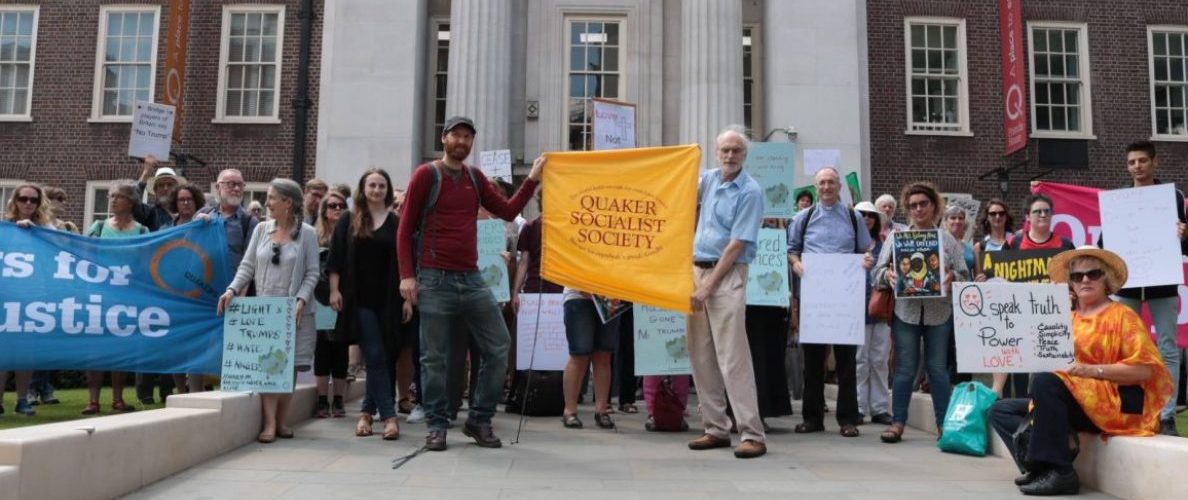
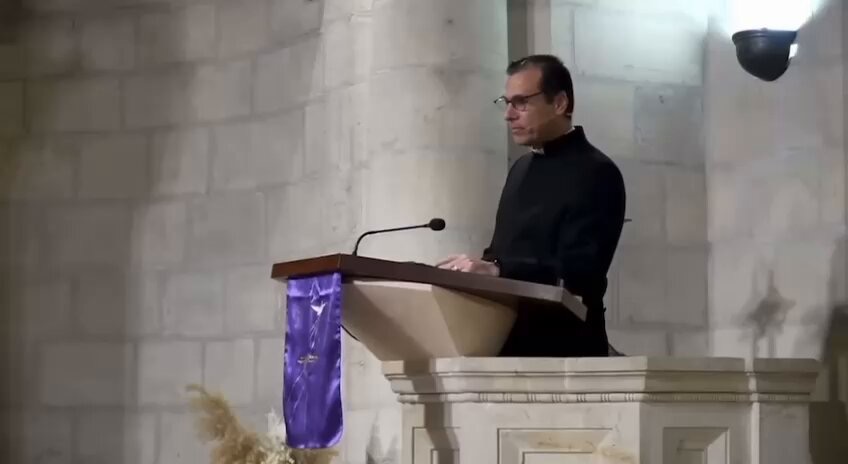
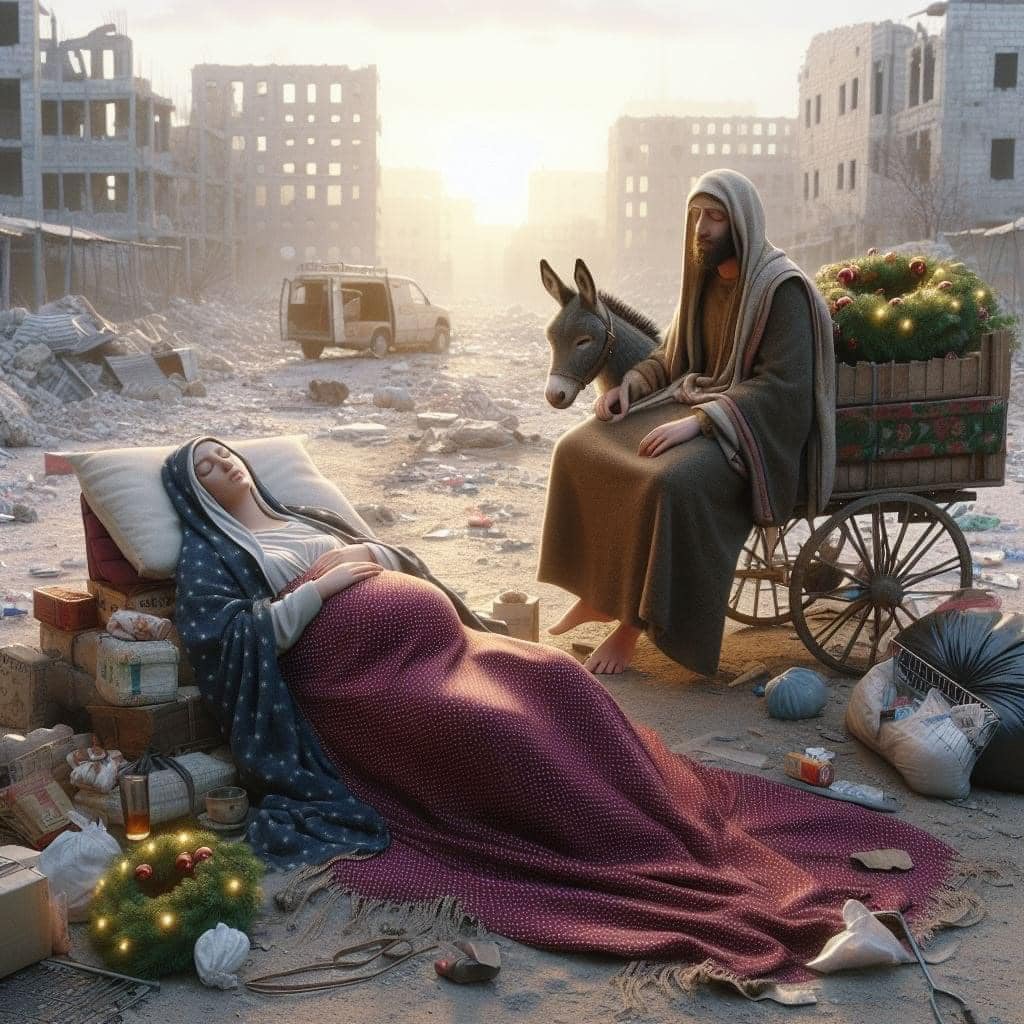
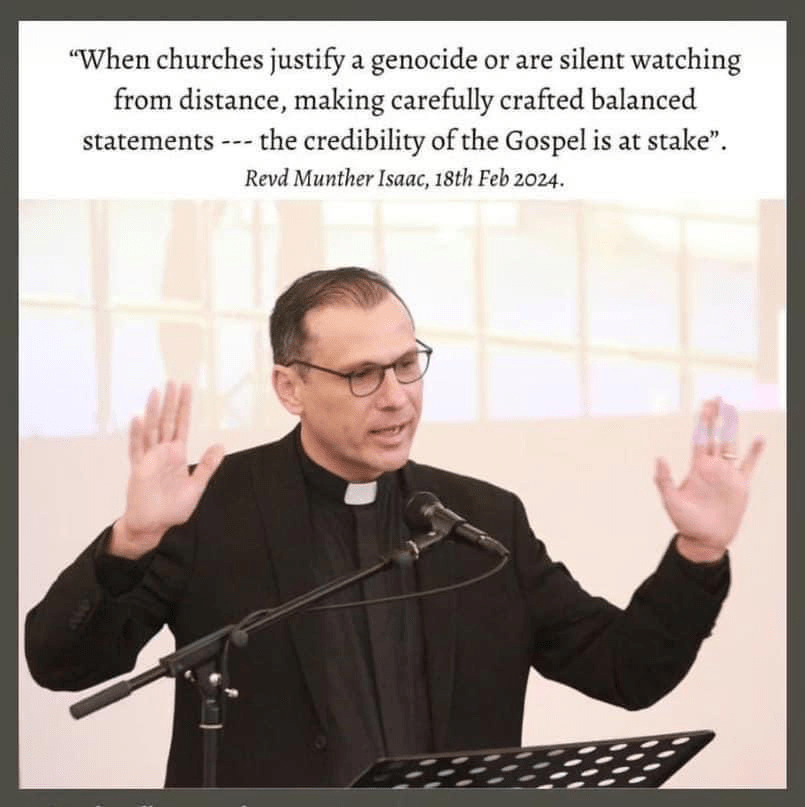
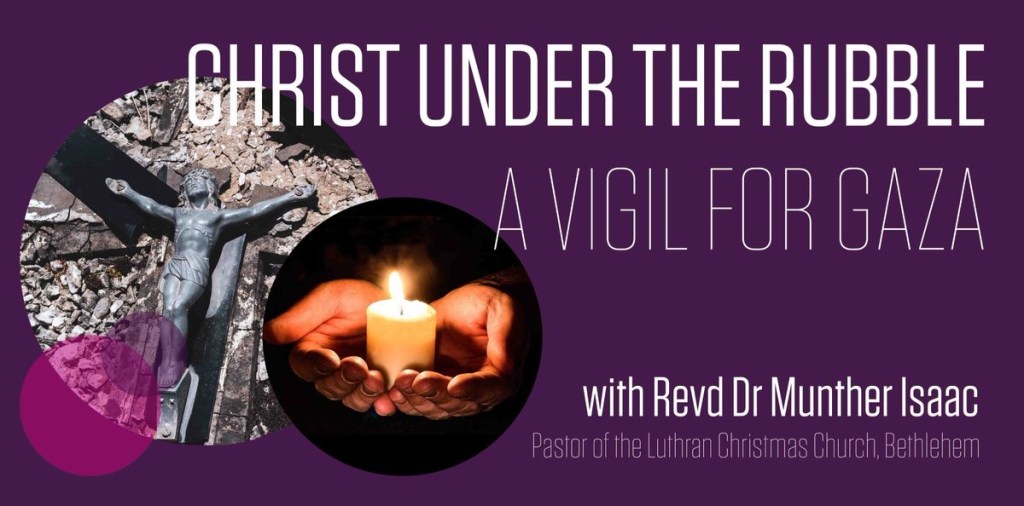

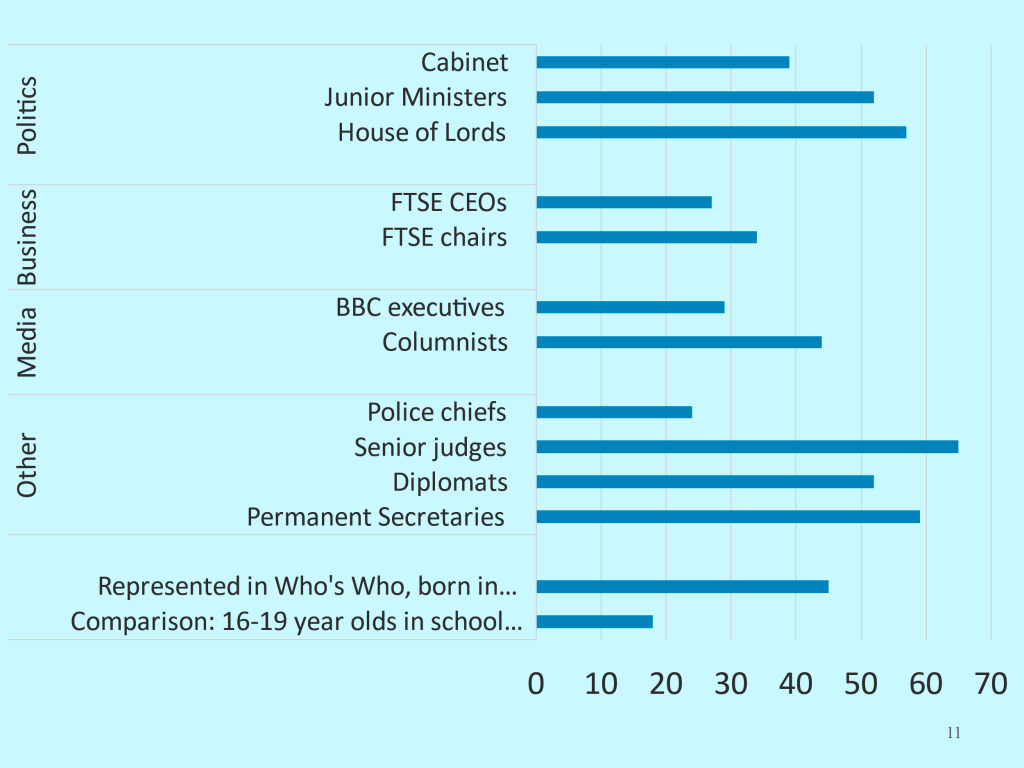
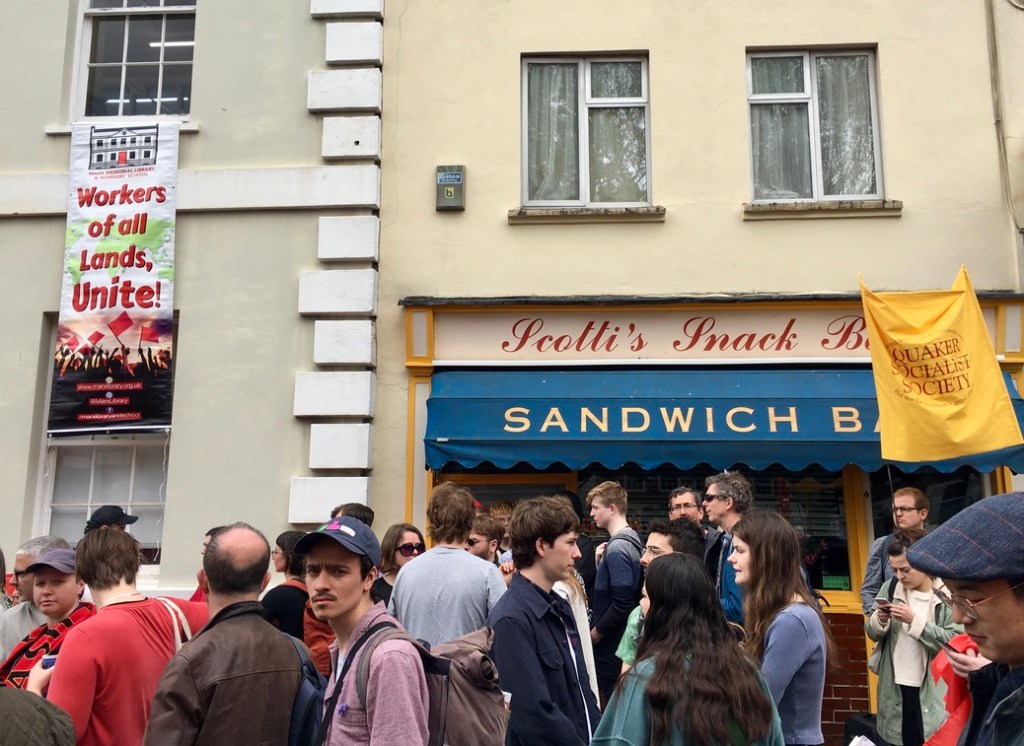
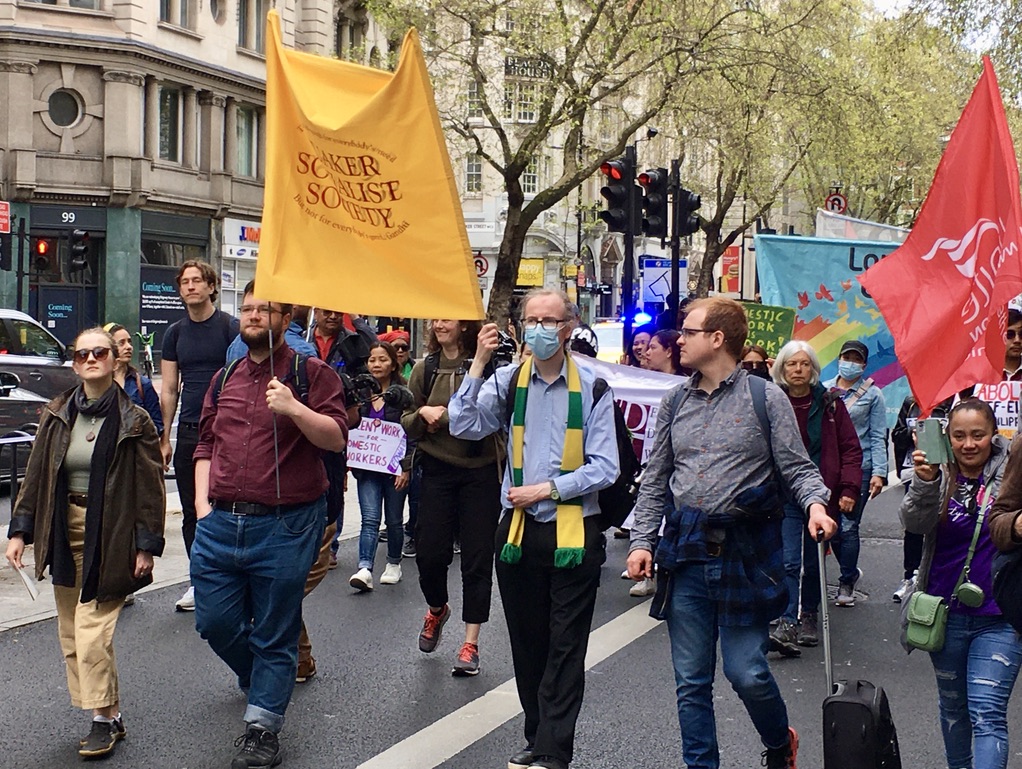
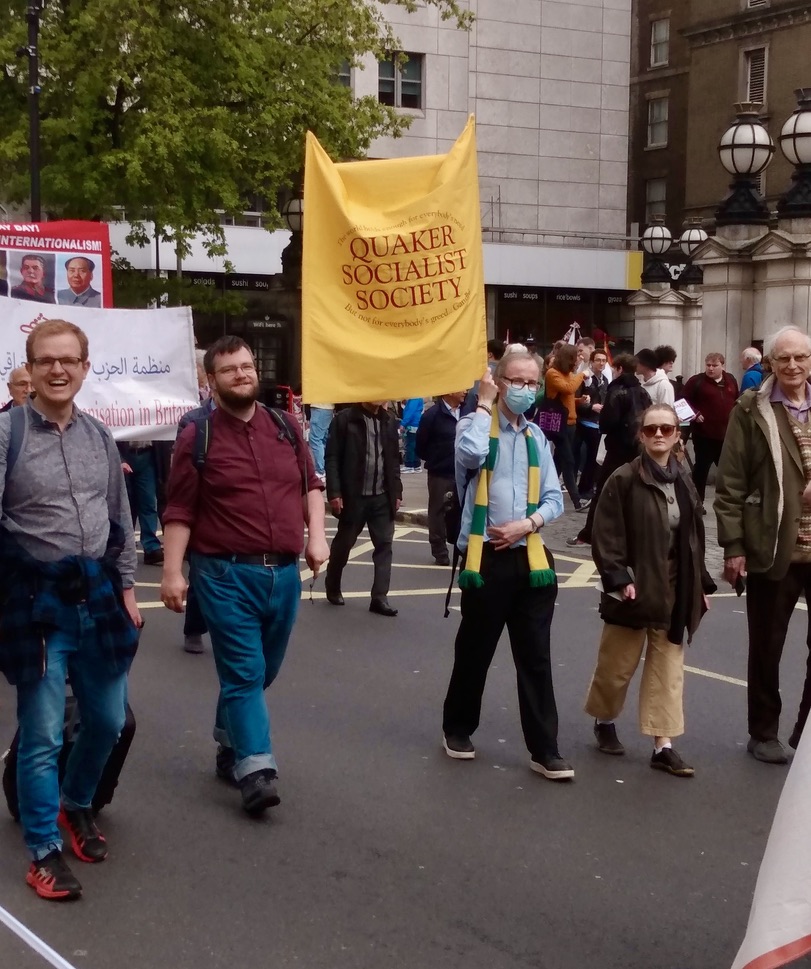

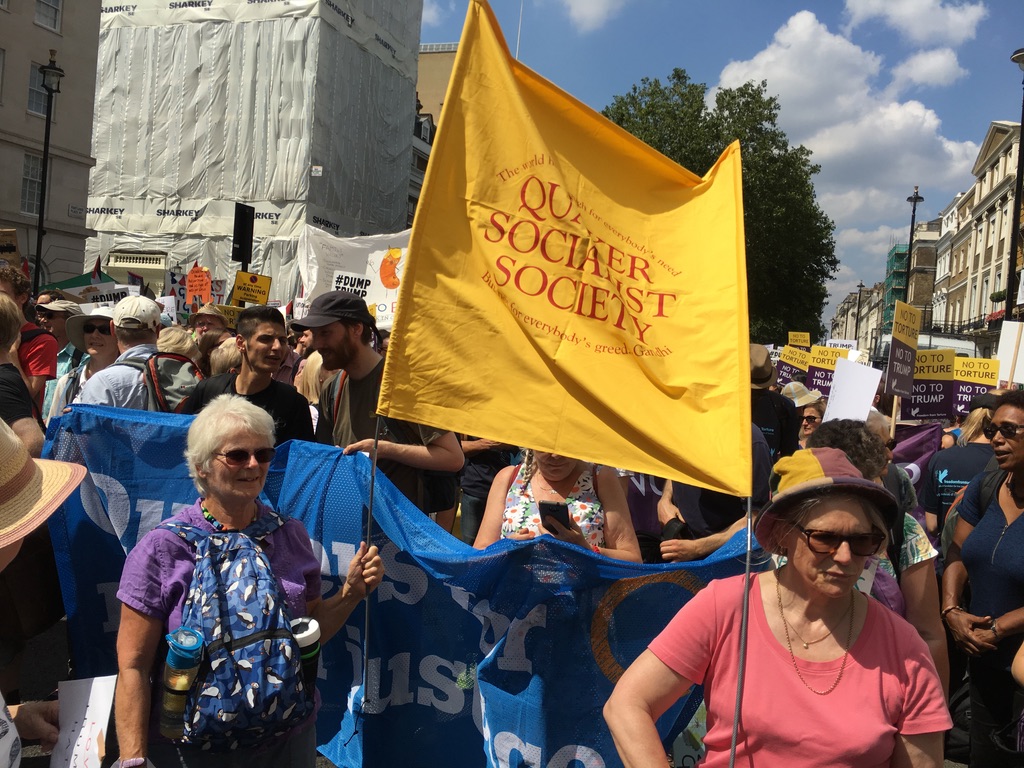
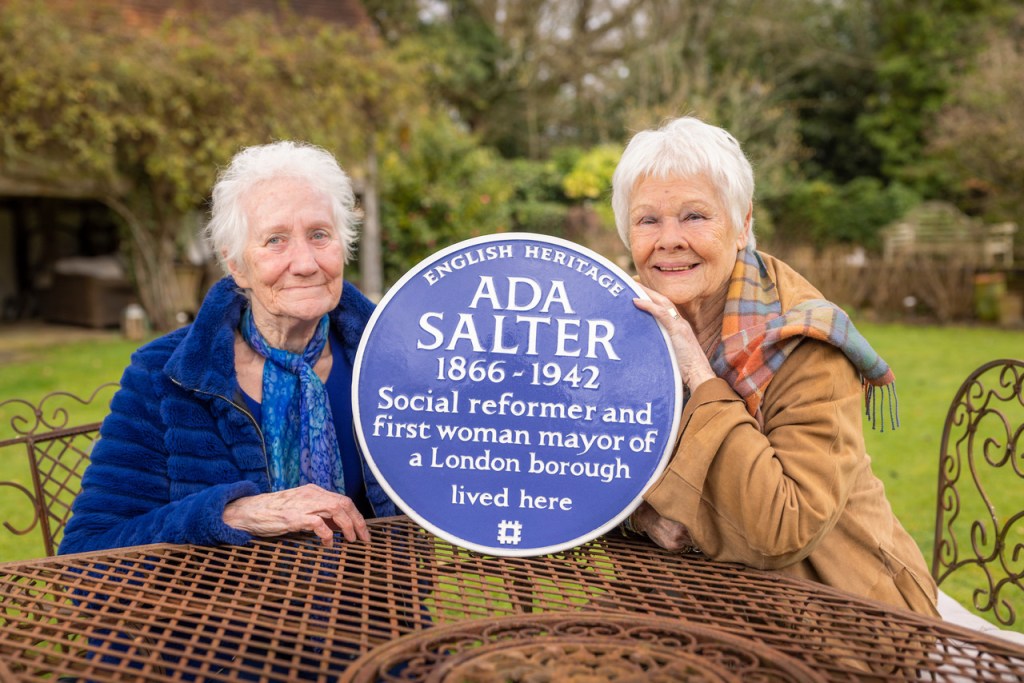


Leave a Reply