By Sheila Taylor.
Quaker Socialists are delighted that Nozizwe Madlala-Routlege has been awarded an Honorary Doctorate by the University of Strathclyde. In 2021 Nozizwe delivered the Salter Lecture on ‘Quaker Values in South Africa’s Struggle’, the first black woman on the list of prestigious lecturers. In 2024 she received her first Honorary Doctorate from the University of Bradford in recognition of an inspirational lifetime’s work for peace and social justice.
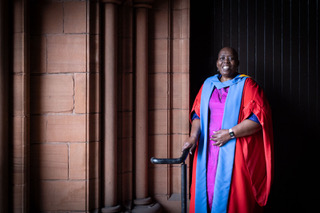
Professor Churnjeet Mahn introduced Nozizwe in Strathclyde with moving oratory about the fight against racism, and Nozizwe responded with an appeal to the new graduates based on her Quaker beliefs: “The value most needed in our time is empathy…. It is the first step towards human solidarity…” “Imagine boldly: a world where borders do not become walls around compassion; where the stranger is met not with fear, but recognition; where nations do not compete in cruelty but co-operate in care. Imagine a world built in the spirit of Ubuntu — solidarity, shared responsibility and generous human co-operation. Then help make that world possible.”
The ceremony is available to watch on: https://www.youtube.com/watch?v=k2P8CJkmJq8
There follows: 1) the text of Professor Mahn’s introductory speech, and 2) Nozizwe’s speech of acceptance:
Churnjeet Mahn, Professor of English Literature, University of Strathclyde. 30 June 2026
“Associate Principal, I have the honour to present to you Nozizwe Madlala-Routledge. Her life’s work stands as a powerful example of how principled leadership can transform not only political systems, but the everyday realities of people’s lives. From her early years as a youth activist under apartheid to her later roles in government and global advocacy, her work has consistently centred equality, dignity, and social justice. Born in KwaZulu-Natal in 1952, she came of age during one of the most repressive periods in South Africa’s history. Apartheid was a system of racial segregation that showed violence not just to people, but to the basic principles of humanity and freedom. Inspired by the ideas of Steve Biko and the leadership of Nelson Mandela, she became politically active while still young. She was also inspired by ordinary women who organised in the trade unions, in rural struggles for land, and through the global women’s movement, joining a generation determined to challenge injustice rather than accept it. Her activism brought serious consequences: she was imprisoned for her involvement in anti-apartheid activities, including a year in solitary confinement without rial.
Madlala-Routledge was part of the negotiations that dismantled apartheid and laid the foundation for a democratic state. Working alongside key figures, she contributed to the development of a constitutional framework rooted in dignity, equality, and human rights. Her later career in government brought this vision into practice. She served as Deputy Minister of Defence from 1999 to 2004 – an extraordinary role for a committed Quaker pacifist, and unique in global politics. Rather than seeing defence purely in military terms, she worked to reframe it around peace-building, cooperation, and the social conditions necessary for lasting stability. This perspective challenged traditional assumptions and helped shift thinking about security in a newly democratic context.
As Deputy Minister of Health from 2004 to 2007, her leadership during the HIV and AIDS crisis became one of the most compelling examples of her integrity. At a time when millions were affected, she challenged the government’s position which denied the real scale and impact of the virus.She challenged the social stigma around AIDS through compassionate action – she visited patients, including a widely noted unannounced visit where she witnessed the poor conditions affecting mothers and children. By speaking publicly about what she experienced, she drew attention to urgent systemic failures and insisted on accountability. She also publicly took an HIV test, challenging stigma and encouraging a culture of collective responsibility. After leaving ministerial ocice, her commitment to justice continued through civil society and international work. She co-founded Embrace Dignity, an organisation focused on women’s rights and the fight against exploitation and remained active in broader social movements calling for ethical leadership and democratic accountability.
She also served as Deputy Speaker of the National Assembly and later took her work to the global stage as Director of the Quaker United Nations Ocice in Geneva. Nozizwe Madlala-Routledge has delivered action informed by justice and compassion and has never flinched from speaking truth to power. In preparing for today, I asked young South Africans about the impact of Madlala-Routledge’s life and work on their generation. Their voice was united: her integrity and care in the face of the HIV AIDS crisis, a position that put her at odds with the government, helped to save potentially millions of lives. The scale of that impact – those people who were able to survive and not be the victims of ignorance, denial or complacency – cannot be underestimated. She is a hero.
Glasgow is a city that stood in solidarity with the anti-apartheid movement: Glasgow City Council renamed one of our city streets to Nelson Mandela Place in 1986. Graduands, this is part of your story too. Students at the University of Strathclyde successfully nominated Nelson Mandela for an honorary degree that was awarded in 1985 while he was still in prison and labelled as a terrorist. Our solidarity has not waned. Madlala-Routledge’s life work reminds us that change is built not only through positions of power, but through the courage and willingness to act, to speak, and to stand firm in the pursuit of justice—especially when it matters most. It is our honour to recognise your life’s work to build peace in our world. It is with great pleasure therefore, Associate Principal, that, with the authority of Senate, I ask you to confer upon Nozizwe Madlala Routledge the degree of Doctor of the University honoris causa.”
Churnjeet Mahn, 2026.
Nozizwe Madlala-Routledge, Strathclyde Honorary Doctorate Acceptance Speech
“Vice-Chancellor, distinguished faculty, fellow graduates, families, guests and friends. Professor Churnjeet Mahn, thank you for your deeply moving oratory, and for the generosity and grace with which you have introduced me to this gathering. I am deeply grateful to the University of Strathclyde for this honorary doctorate. I accept it with humility, and with gratitude to my family, friends and the many communities whose courage has shaped my life. I am especially moved to receive this honour from a university known as a place of useful learning — an institution whose degrees are not only symbols of academic achievement, but instruments of practical knowledge, public purpose and positive change.
Strathclyde’s distinction is reflected in its Queen’s Anniversary Prizes for Higher and Further Education in 2019 and 2021, its recognition as Times Higher Education University of the Year in 2012 and 2019, and its honour as Scottish University of the Year in 2020 by The Times and The Sunday Times. These awards affirm a university whose teaching, research and partnerships serve society and prepare graduates to make a meaningful difference in the world.
I want to congratulate the graduates. Today is your day. As Professor Churnjeet Mahn has said: “Our graduating students are our future.” Your degree carries your effort, and the love and sacrifice of families, friends, sponsors, university staff and professors. It also carries Strathclyde’s promise that learning must be useful – useful to society, to justice, to innovation, and to the making of a better world. May you never forget that achievement is never solitary; it is always held by many hands.
I also pay tribute to the people of Glasgow, whose solidarity with South Africa’s struggle for freedom will never be forgotten. Long before apartheid fell, this city chose moral courage: Glasgow was the first city in the world to confer the Freedom of the City on Nelson Mandela while he was still imprisoned and later renamed the street of the South African Consulate as Nelson Mandela Place. Those acts were more than symbolic: they told prisoners, exiles and oppressed people that we were not alone. They remind us that solidarity can travel across oceans, enter prisons, disturb injustice, and help bend history towards freedom.
My mother was an educator. She believed, as this university believes, that education is a tool of liberation. But liberation from what? From ignorance, from fear, from the smallness of believing that our lives belong only to ourselves. Education teaches us to see more clearly, act more bravely, and serve more generously.
As you begin your careers or continue your studies, I offer you words from Howard Thurman that have guided me: “Don’t ask yourself what the world needs. Ask yourself what makes you come alive, and go do that, because what the world needs is people who have come alive.”
But coming alive must never mean living only for ourselves. What is the use of being fully alive if we are untouched by the suffering around us? The value most needed in our time is empathy. Empathy is not a soft virtue; it is a courageous one: the power to feel the wound of another, and then to act. It is the first step towards human solidarity – the bridge beyond fear, indifference, and the narrow borders of self. This is the wisdom of Ubuntu: umuntu ngumuntu ngabantu – a person is a person through other people. Ubuntu teaches that my humanity is held in yours, that none of us rises alone, and that the measure of success is how many we are willing to carry with us.
In our time, this truth demands an urgent response to the movement of people across the world – families driven from home by poverty, conflict, climate change and inequality – and to the xenophobia that too often turns suffering into suspicion. So, I ask you, graduates: what kind of world will you help to build? Imagine boldly: a world where borders do not become walls around compassion; where the stranger is met not with fear, but recognition; where nations do not compete in cruelty but co-operate in care. Imagine a world built in the spirit of Ubuntu – solidarity, shared responsibility and generous human co-operation. Then help make that world possible.
My own journey began in high school, when teachers urged us to open our eyes to injustice. My teachers were a great part of raising my awareness to the injustices of the time. It was my teachers who encouraged me to apply to medical school and my first meeting with a great black consciousness student leader and mentor who influenced many of us deeply – Steve Biko and the South African Students Organisation taught me that liberation is not given to people; it is made by people who become active agents in their own freedom.
One of my teachers, Miss Llewelyn, came from Wales. We called her Hlu for short. She sent an appeal for donations which funded my entry and year at Medical School and later to Fort Hare University. This is what human solidarity represents for me, when people who did not even know me were able to dig deep for my tertiary education. Another lesson for me is: Expect the Best. I did not expect to become a deputy defence minister: I was a Quaker and a pacifist with no military background. But where does peace begin, if not in the courage to enter dialogue with those we may once have regarded as enemies?
Later, as deputy minister of health during the HIV pandemic, I learned that conscience sometimes asks a high price. When people were being denied life-prolonging ARV medicines, I stood with the vulnerable. It brought me into conflict with power, but speaking truth to power helped change policy and save lives. That is what education and leadership must be for: not status, but service; not comfort, but courage.
Graduates, you inherit a world of great beauty and great danger. Will you wait for perfect certainty before you act? Or will you begin where you are, with what you have, and with whom you can? Find what makes you come alive but join it to justice. Let your learning become courage. Let your success become service. Let your empathy become solidarity.
I end with Audre Lorde’s words: “When I dare to be powerful, to use my strength in the service of my vision, then it becomes less and less important whether I am afraid.” May you dare to be powerful. May you use your strength in the service of a generous vision. And may you leave this university not only with degrees, but with the courage to help heal the world. Thank you.
Nozizwe Madlala-Routledge, 2026.

